Tuesday, February 25, 2014

Yes, let's end the age of entitlement!


Federal Treasurer Joe Hockey has renewed his call for ending the “age of entitlement”.

It is a sentiment with which we thoroughly agree.
However, we suspect that there might be some slight disagreement between ourselves and Mr Hockey on just what is meant by an age of entitlement.

 
We would most probably agree that the term refers to people who believe that they are entitled, without any effort, to be on the receiving end of an endless flow of money, privilege and reward.
But before we pop the champagne corks and clink glasses with good ol’ Joe, toasting our shared commitment, we had best ask a few more questions.

Is rejecting the “age of entitlement” aimed at that class of parasitic financial investors who do nothing but make money out of money?
Is rejecting the “age of entitlement” an attack on the whole exploitative bourgeois class who take unto themselves the surplus value created through our labour power?

Is rejecting the “age of entitlement” a refusal by parliamentary cretins to line their own pockets through all sorts of lurks and perks such as attending friends’ weddings or travelling interstate to purchase property under the guise of doing electoral work?

 
No, and we won’t bore ourselves by going into the detail of Newstart Allowances, bushfire compensation, workers’ compensation, drought relief, CentreLink benefits, penalty rates, public libraries, Medicare, aged care, rental assistance, public education, pharmaceutical benefits schemes or free air.
Hockey has in his sights precisely those entitlements that we, the majority, have clawed out of the entitlements that the rich, the arrogant few, believe are theirs as our social betters and owners of property.

He is not about ending the “age of entitlement”; rather he seeks to extend the selfish entitlements claimed by the parasitic rich by pushing down on us.
Yes, we want the age of bourgeois entitlement ended, and we will fight to establish anti-imperialist independence and socialism so as to bring to an end the class structures that, since the times of slavery, have guaranteed underserving entitlements to the exploiters and robbers at the top of the pyramid.

Sunday, February 23, 2014

Here's a tip for Abbott


The Federal Government is pushing for the abolition of penalty rates so as to make Australian workers competitive with the impoverished of the world.

And before you think I’m talking about Bangla Desh or Cambodia, keep in mind that the Federal minimum wage in the US is only $7.25 per hour, that not a few US states have lower – or no – minimum wage rates.

That’s why you can be expected to pay a 15-20% tip or gratuity to hospitality workers, taxi drivers, hairdressers, grocery packers and others of the working poor in the world’s richest country. 

Abbott and Hockey have called for changes to, or removal of, penalty rates in a submission to the Fair Work Commission (FWC), hoping to hide behind the skirts of an “independent umpire”. 

 
Abbott and Hockey hope to con us into believing that any change to penalty rates was not their doing, but that of the Commission.

Of course, there is independence and there is independence,

A body such as the FWC may not be under the direct supervision or control of the government of the day, but, if ideologically, culturally and politically there is a commonality of agendas then it makes very little difference as to the formality of the ties.

The same demand for more “labour market flexibility” features in the upcoming South Australian state election where both the Liberal opposition and the Nick Xenophon group have also signalled the need to cut penalty rates.

But are the reactionaries merely lifting a heavy rock only to drop it on their own toes?

A few weeks ago, a prominent Adelaide pub restaurant, the Bombay Bicycle Club, erected a sign purporting to show how penalty rates of 2.75 times the value of the award wage would affect menu prices.

This was no spur of the moment act.  It was not an erasable chalk scrawl on a blackboard, but a professionally made, embossed sign.  It clearly displayed not the truth of the penalty rate usually applied but sheer bloody malice aforethought by an arrogant born-to-be-a-boss.

 
What came crashing down on the head and the toes of this creep was a torrent of negative and hostile comment on all avenues of social media.

The kiddies had struck back!

They had shown that this was an issue for their age group, and that once pushed to action, they were capable of effective and immediate mobilisation.

The restaurant owner backed down, pulled the sign and apologised on Facebook.

No wonder Abbott and Hockey want someone else to do their dirty work for them!

So here’s a tip for Abbott – bring it on you bastard, ‘cos once you’ve got the kids off-side, you’ll never get them back!

Monday, February 17, 2014

Mateship without comment

Another fine graphic from the imagination of Matt Walker:

Wednesday, February 05, 2014

71st anniversary of Stalingrad

Yes, Geoffrey (author of the article below), the silence is just as deafening in Australia, US neo-colony.


71st Anniversary of the Soviet Victory at Stalingrad

by Geoffrey Roberts

The Guardian (U.K) Feb 28, 2003 (the 60th anniversary)

http://www.theguardian.com/world/2003/feb/28/russia.comment

The anniversary of Stalingrad has inspired major celebrations in Russia [Volgograd officially changes its name back for the day], but a strange silence here. Sixty years ago the greatest battle of the second world war reached its climax. The site of that decisive battle was not the windswept sands of north Africa beloved of British war mythology, nor the broad expanses of the Pacific favoured in the American version, but
the debris of a devastated city on the Volga.

The German surrender at Stalingrad in February 1943 was the strategic turning point of the second world war. After Stalingrad, Hitler had no hope of winning on the eastern front and that meant inevitable defeat in the wider conflict.

In Russia, the 60th anniversary of the battle has been marked by great celebrations. President Putin led the commemoration in Volgograd (as the city was later renamed) and was joined by the British and American ambassadors. But in Britain and the US the silence about the battle has
been deafening.

At Stalingrad the Soviets lost a million people - more than the British and Americans during the whole war. Such sacrifices, as Churchill said, tore the guts out of the German war machine. More than 90% of German losses were suffered on the eastern front, including 10 million military casualties.

All other theatres were a sideshow compared with the gigantic battles in Russia. At the time it was clear that the second world war was primarily a Soviet-German war. During the cold war, however, the western narrative of the struggle against Hitler was rewritten to minimise the Soviet
contribution and to exaggerate an Anglo-American crusade to make Europe safe for democracy.

The Soviet war effort was not so much a crusade as a struggle for national survival. When the Germans attacked Russia in June 1941 they launched a war of annihilation – a campaign to destroy ’judeobolshevism’ by the mass murder of Soviet citizens. Among the victims of the Germans
in 1941-42 were 2 million Soviet Jews – a massacre that marked the beginning of the Holocaust.

The German campaign inspired a popular mobilisation to save the Motherland. ‘Kill the Germans,’ exhorted the Soviet writer Ilya Ehrenburg, ‘or they will desecrate the whole of Russia and torture to death millions more people.’

Among the many heroic episodes on the eastern front, none was more awesome than the Red Army’s defence of Stalingrad following the launch in June 1942 of a German offensive in southern Russia. This was Hitler’s war for oil, the aim being to reach Baku on the other side of the Caucasus and occupy the oilfields that supplied 80% of Soviet fuel.


The capture of Stalingrad was a secondary objective, but deemed vital to the German defensive line along the Don and Volga rivers and a convenient point to intercept oil supplies shipped to northern Russia. Neither was the symbolism of a German occupation of the ‘city of Stalin’ lost on Hitler. By October 1942 General Friedrich Paulus’s 6th Army occupied 90% of Stalingrad. Yet the Soviet defenders clung to positions on the western banks of the Volga, denying the Germans complete control of the city.

The traditional story of Stalingrad has emphasised the heroism of the Red Army’s defence. Antony Beevor questioned this heroic narrative, highlighting the coercive measures used by the Soviets to force their troops to fight. His reinterpretation has been seized upon by many
conservative commentators, keen to depict the struggle as a contest between totalitarian systems in which the more ruthless emerged as victor. But the contemporary evidence of Soviet heroism at Stalingrad is enormous and cannot be dismissed as wartime propaganda or retrospective
romanticism.

The turning point came in November 1942 when the Red Army launched a massive counter-offensive that broke through the Germans’ flanks and trapped Paulus’s 6th Army in the city. Within three months Paulus had surrendered and 150,000 Germans lay dead, with another 100,000 captured.

Maintaining a foothold in Stalingrad was crucial to Soviet plans for the great counter-offensive, which aimed not only to encircle Paulus but to entrap another half million Germans fighting in the Caucasus. A few days after springing the Stalingrad trap, the Red Army launched another
counter-offensive in front of Moscow, aiming to destroy German positions all along the eastern front. This was to be followed by a drive to Berlin that would deliver victory against Hitler in 1943.

In the event Stalin had to be content with stunning success at
Stalingrad. Hitler’s last chance came at the great tank battle at Kursk in July 1943. The Germans lost that, too, and thereafter the war on the eastern front was one Soviet victory after another.

Stalingrad was the most decisive encounter in military history, a clash of two European superpowers that determined the outcome of the second world war. It meant that the main victor of the war would be the Soviet Union: a result that determined the shape of Europe.

Dr Geoffrey Roberts is senior lecturer in modern history at University College, Cork and author of ‘Victory at Stalingrad: The Battle that Changed History.'

Thursday, January 23, 2014

Drive Chevron out of Australia!


(Watch this Mark Fiore cartoon on Chevron's use of the US Racketeer Influenced and Corrupt Organisations legislation to intimidate, bully and harass Ecuadorians complaining about poisonous wastes, and their allies.  This is the same company exploiting Australian and 457-visa workers in its relentless pursuit of global profits.)
 

The giant US energy corporation Chevron has operations in Australia at Gorgon in WA where it is extracting liquefied natural gas, and at Wheatstone and nearby Barrow Island.


Chevron owns 47 percent of Gorgon, while Exxon and Royal Dutch Shell Plc each hold 25 percent stakes and the rest is shared by Japanese LNG buyers. 

There is no Australian equity in what is an energy source of vital importance to the Australian people.

Initial capital outlay in what is still a pre-production phase is substantial - around $54 billion for Gorgon to date; however, the profit to be made over many years once production does begin (likely to be this year) will dwarf the investment.

These are profits that should accrue to the entire Australian people. 

These are our resources.

The situation spells out clearly the need for a strong anti-imperialist movement, led by the working class, to sweep away the treacherous institutions and personnel of our present parliamentary system and establish the right of the people to nationalise such industries as these without compensation.

None of the parliamentary parties or grouplets has any interest in pushing for genuinely anti-imperialist Australian independence, nor in unleashing the working people who, by virtue of their numbers and their place in the process of production, are the only truly decisive social sector capable of substantially changing the direction Australia is taking.


Tuesday, January 21, 2014

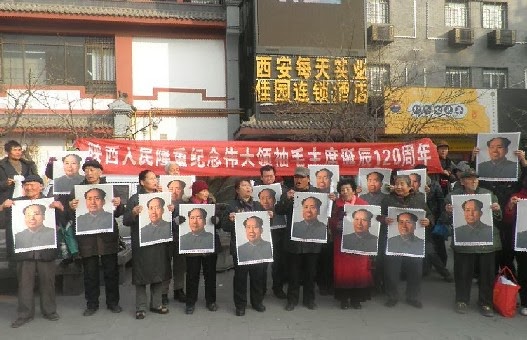
Chinese people demand the right to honour Mao Zedong

In many parts of China, the masses held their own spontaneous celebrations of Mao's 120th birth anniversary (December 26, 1893).  However, these were not welcomed by higher authorities in many cities: venues were denied and police called. 

Whilst the Communist Party of China asserts that Mao Zedong Thought remains its guiding ideology, it has systematically reversed the direction that China was taking under Chairman Mao, namely, the socialist road. The CCP has completely rejected what Comrade Jose Maria Sison of the Communist Party of the Phillipines has identified as the defining characteristic of Mao Zedong Thought: "...what brings Maoism to the level of the third stage in the development of the revolutionary theory and practice of the proletariat is Mao's theory and practice of continuing the revolution under the dictatorship of the proletariat through the Great Proletarian Cultural Revolution in order to combat revisionism, prevent the restoration of capitalism and consolidate socialism." 

It is very instructive to compare the bowdlerised version of Mao Zedong Thought in the Chinese Party's statement (via the link above), with Sison's excellent and highly creditable statement here.


Here are a selection of photos and comments put together from Chinese websites.  They indicate that ownership of the legacy of Mao Zedong remains a highly contested matter, with ordinary people determined to hold on to the revolutionary, working class orientation of Marxism-Leninism-Mao Zedong Thought against the so-called "market socialism" and privatisation carried out by the capitalist-roaders at the highest levels of Party leadership.

1.  Wuhan


Organisers first tried to book the Wuchang Peasant Movement Institute because of its obvious connection as an historical revolutionary site but were denied the venue by the police.

With one day to go, they then arranged to book the Conference Hall of the Wuhan Baofeng Hotel at a cost of 2000 yuan.  However, at 9 o'clock that night the hotel management rang and told them that the private room could not be booked for a public function.  Challenged, the hotel manager stated that he had "been informed of this by the higher authorities".

Participants had no option but to hold an impromptu footpath display of Mao Zedong posters which was kept under scrutiny by security officers.

2.  Shenzhen


Commemorative activities were held in Shenzhen, described by one Chinese netizen as a "window on the revisionists' restoration of capitalism in China".  Others revived memories of the prolonged labour disputes in the city and surrounds, including the tragic suicides of the Foxconn employees who jumped to their deaths from windows in the company's buildings.

On Sunday Dec 22, two groups of people who had come to show their respect for Chairman Mao were arrested in Donghu Park. Later more were arrested as they sang revolutionary songs eulogising Mao Zedong.  People were arrested while singing the national anthem!  When one elderly person was taken away by police he was rescued by the masses.

3.  Zhengzhou


On December 26, some three thousand people converged on Zilingshan in People's Square to pay their respects to Chairman Mao.  Two hundred police were on hand to "maintain order", but it was the plainclothes police who did everything to try and obstruct the singing of songs and recitation of poetry.  Despite this, people bowed towards a statue of Chairman Mao three times and sang songs such as "The East is Red" and "Sailing Seas Depends On The Helmsman".  Speeches were made on the spot. 

At 9:00, an old man came among young people. He said that the Mao era had been fair, there were no privileged cadres and the masses could have opinions without retaliation. Now, the corrupt officials run amok, and people are not allowed to speak out. Many of our people can not afford housing, while officials buy mansions in the United States.Compared with previous years' celebrations, young people accounted for a considerable proportion of those attending.

Earlier, on December 6, Ai Yuejin, founder of the pro-Mao Utopia website and bookshop had arrived at Zhengzhou's Xinzheng Airport to begin a series of lectures about Mao Zedong in the city.  On arrival he was met buy the police and taken to the airport police centre.  He thought at first that this was a very high level reception on the part of the organisers of his lecture tour, but was very quickly told that his talks could not proceed in Zhengzhou. He was asked to show his ID and grilled about his political views before being allowed to leave the airport.

At the Dukang Hotel on Tongbai Road where his first lecture was scheduled to be held, he found that the rented first floor lecture hall doors had been locked and was told by staff that there was a power circuit failure.  He was advised by security officers to find another venue, but 300 people had turned up and they decided to occupy the hotel lobby and use it for the lecture.

(Above: Ai Yuejin prepares to deliver his talk on Mao Zedong from the first floor balcony of the Dukang Hotel while the foyer, below, begins to fill with admirers of Chairman Mao.)


4.  Other places: a small selection of photos from other places where commemorations were held under similar conditions of difficulty:


Above:  Shaanxi Province


Above: Near Mao's birthplace, Changsha


Above: Luohe in Henan Province


Above: Shandong Provincial capital, Jinan


Above: Nanyang


Above: in Yunnan Province


Above: Zhanjiang

Thursday, November 28, 2013

Pyne occhio has got to go!


Thanks to my friend Kate for this inspired comment on the Abbott-Pyne dismantling of Gonski:
 
 
And it came to pass

That the terrible Daemon Christopher Pyne MP didst preside over the Australian Education System

And pronounce one day that "Gonski was a goner" and "Shorten was a shambles"

And there was much wailing and gnashing of teeth

And the teachers at the public schools didst remove their shoes

And smite Pyne's likeness all across the land,

Crying "Down with the Daemon and all his cohorts"

And the small children and adolescents in Public Schools cried out:

"Woe, woe

Verily it is true that, under this government, those who have will receive more, and those who have not will receive bugger all"

And rise up from their desks did they, and rend their school uniforms in twain,

And up and down the land, didst set fire to all the shiny European late-model vehicles outside the leafy private schools

Causing the mummies and daddies to grieve mightily

And cry "Woe to us for voting for the Daemon Pyne, for he has caused the social fabric of our people to dissolve

And our Australian Dream to be laid waste utterly"

.......................


We raised our hands for Gonski.


Now those hands must become fists!!!


Monday, November 04, 2013

Why I want Menzies in the curriculum

Tony Abbott and Christopher Pyne deplore the "scant attention" afforded Liberal Prime Ministers in the Australian Curriculum for History.

Specifically, they want more prominence given to long-standing PM Sir Robert Menzies.

I can't agree more.

Menzies has made invaluable contributions to our understanding of the mindset of the privileged born-to-rulers who have done so little for our country and our people.

Menzies was Prime Minister (prime monster, more likely) at the time of the dispute at Pt. Kembla over the loading of pig-iron for the Japanese.  Led by Communists, the wharfies engaged in a nine-week strike to prevent Australian pig-iron being turned into bombs and bullets to assist the Japanese invasion of China.
(Above: Pt Kembla wharfies support the Chinese people against Japan and its dirty collaborator Menzies)

To the great benefit of Australian school-children, this is to be the subject of a film the contents of which are explored in this article from the Illawarra Mercury:
http://www.illawarramercury.com.au/story/1881006/watch-port-kembla-wharfs-wonder-woman/

The "wonder woman" in the article's title refers to Ma Croft who yelled the term "Pig Iron Bob" at Menzies during a demonstration against him, a term that was to haunt him for the rest of his political life.  A trailer for the documentary is embedded in the article.

On a return trip from Nazi Germany in 1938, Menzies had told Parliament "I have a great admiration for the Nazi organisation of Germany. There is a case for Germany against Czechoslovakia. We must not destroy Hitlerism or talk about shooting Hitler".  Part of Menzies' admiration for Hitler was the "resolve" he showed in crushing the rights of German workers and their unions. 

The Japanese did not forget a true friend as they advanced towards Australia during World War 2.  A radio station in Japanese occupied Batavia, capital of the Dutch East Indies (later Indonesia) referred to Menzies as a "clear blue-eyed soul".

The end of Nazism did not mean the end of ruling class attempts in capitalist countries to crush the working class, its party and its unions. 

In 1950, Menzies proposed the Communist Party Dissolution Act.  A huge campaign in defence of democratic liberties was followed by the defeat of a referendum proposing implementation of the banning of the Communist Party.


Menzies loved the idea of Australians benefitting from the latest developments in science and technology and collaborated as a traitor to his people and his country with the British imperialists to arrange for the detonating of atomic weapons on Aboriginal lands around Maralinga during the period 1945-1963.  Aboriginal victims of these tests, and veterans amongst the civilian and armed forces deployed to set up and monitor the tests, are denied the right to compensation for the illnesses to this day.


Every school-child should be warned of leery old men ogling young women and uttering oleaginous inanities.  The sycophancy of Menzies towards the English monarchy took the revolting form of the 72-year old prime monster waxing poetic on the occasion of the English Queen's 1963 visit to the colonies.  "I did but see her passing by, yet I shall love her till I die", he said, quoting someone else. A borrowed turn of phrase for a borrowed monarchy.

Having committed Australian military "advisers" to assist the US imperialists replace France as colonial master of Indo-China, Menzies announced on April 29, 1965 that Australian troops would be sent to suppress the Vietnamese struggle for independence. 

His hands are stained with the blood of Australian service personnel - conscript and regular - who were killed and wounded by Vietnamese patriots on Vietnamese soil in the cause of freedom and independence.

His lick-spittle grovelling to the imperial masters of his youth was matched only by his lick-spittle obeisance to US imperialism.

However, only the former had the decency to reward him in the style to which he aspired.


An empty ceremonial title, Lord Warden of the Cinque Ports, was bestowed upon the Crown servant by HM Queen Elizabeth in 1966.  Luxuriating in mediaeval bling, Ming the Great never looked such a fool as he did performing his role as guardian of a couple of Kentish harbours.


So yes, let us have Ming the Disastrous front and centre in the Australian History Curriculum.  There is so much negative example from which to learn.


Wednesday, October 02, 2013

Book review: The Swan Book

This is a cross-posting from the Vanguard website of the CPA (M-L).  Readers might like to cross-reference it with my review of an earlier Alexis Wright book, Carpenteria.
.....................

Book Review: The Swan Book

Nick G.

Imagine the AAMI black swans TV ad took place in Bob Dylan’s Desolation Row.  Imagine that the swans were not on the attack, but were the spiritual brothers and sisters of a mute Aboriginal girl living half a century into the future under an even more punishing and widespread Intervention regime.

Indigenous author Alexis Wright, whose previous insight into Aboriginal Australia was set in a mythical Queensland community appropriately named Desperance, has delivered another powerful statement about the State’s denial of black self-determination in The Swan Book.

The protagonist is Oblivia Ethylene, who pursues, but is unable to articulate, a “quest to regain sovereignty over my own brain”.  She lives on a contaminated lake controlled by the Army and filled with the detritus of war machinery and naval craft.  Her homeland has become a secret locality for Defence Force scheduled training manoeuvres and bombing runs.

Into this incarcerated community, and others like it, are shipped all Aboriginal persons deemed unable or unwilling to adapt to life in capitalist Australia.  These “growth centres” of “truck people” are the outcome of the National Aboriginal Relocation Policy which is set up to deal with  the old people who, having done “nothing to change things by themselves for the future… had given up the right of sovereignty over their lives”.  

Not all Aboriginal people are trucked to such camps.  There are those who are exempt from the coercive policies imposed upon their compatriots by virtue of “presenting themselves as being well and truly yes people who were against arguing the toss about Aboriginal rights”.  They were “anti about whatever there was to be anti about if white people say so” and were thus granted an Aboriginal Nation Government.  From their ranks emerges young Warren Finch, and where have we heard before of a “Warren” in Aboriginal Australian political life?

Wright says of Finch: “He had become the only public Aboriginal voice of the era. The only one Australians would listen to, and reported in the newspapers, or had given their airways to whenever he spoke publicly.  It certainly seemed as though there was national deafness to hearing what other Aboriginal people had to say of themselves.”  And so she disposes of the black Judenrats promoted by the Murdoch media!

Finch claims Oblivia as his promise-wife and orders the Army to bomb her community out of existence so she has nothing to which to return.

Like Desolation Row, Wright’s novel has its cast of strange characters.

There is Oblivia’s protector, Bella Donna of the Champions, who arrives in the swamp community as a refugee from the climate change wars of the global north, an old white lady with a swan-bone flute.  She and others like her were the “new gypsies of the world…millions of white people…drifting among the other countless stateless millions of sea gypsies looking for somewhere to live.” 

Bella Donna spends much of her time arguing with the Harbourmaster, an “Aboriginal man with an Asian heritage…a healer for the country…he just flies where he wants to” although we are not talking aeroplanes here.

He and his monkey Rigoletto appear and disappear at will, as one would expect of a healer of great power; however, he is in reality a delusional character who “only had a big mouth and that was not going to move the sand mountain” that kept building up like a pile of unsolved social problems at the mouth of the lake’s entrance to the sea.

Wright’s acknowledgements include a nod in the direction of the late Tom Trevorrow, a Ngarrindjeri Elder from the Coorong which, like the Lake, had its entrance to the sea silted up as a result of climate change. 

These two powerful themes, failure to respect Indigenous self-determination and failure to respond to climate change, make The Swan Book a powerful weapon for dissecting the problems of contemporary Australian reality.

Thursday, September 26, 2013

Defend Australian science from corporations!

(A Canadian in the city of Kitchener-Waterloo makes her support for science very clear)

New Australian Prime Minister Tony Abbott has wasted no time in answering the prayers of the coal industry and other big polluting corporations.

He has shut down the Australian Climate Commission which provided the government and the community with expert advice on climate change science. He has also foreshadowed the closure of other climate-change government bodies, namely the Climate Change Authority and the Clean Energy Finance Corporation.

And in a further insult to Australian scientists, one which has even been criticised by government backbenchers, his is reputedly the first Australian Federal Government in 81 years not to have a Minister for Science.

It would be tempting to dismiss Abbott’s anti-science stand as deriving from his religious views - he was once a trainee for the priesthood and still takes personal advice from the arch-reactionary Cardinal Pell of Sydney.

But the attack on scientists is really part of a larger pattern of neoliberal revenge against advocates of evidence-based policy making.

David Suzuki, the well-known Canadian scientist, has linked Abbott’s moves to those of his ideological bedfellow, the Canadian Prime Minister Stephen Harper.

(September 16 rally in Toronto)

Suzuki states that “…the politicians and corporate executives… are driven by a totally different set of values, by the drive for profit, for growth, and for power”.
 
“Harper”, he says, “has cancelled virtually all research going on in Canada on climate change. He has muzzled government scientists: they are not allowed to speak out in the public, even in areas in which they are expert, unless they are first vetted by the prime minister’s office.”


(Toronto citizens rally in defence of science)

“That is what Abbott is doing,” he said. “It is criminal negligence through wilful blindness”.

Abbott is representative of big corporate interests that reject science if it does not serve capital accumulation. Last June, the head of Abbott’s proposed business advisory council, Maurice Newman, called for the renewable energy target to be scrapped “because he believes the scientific evidence for global warming and the economic case for renewable energy no longer stack up”.

Abbott’s pre-election policy for resources and energy took a climate change denialist position and further advanced the interests of the coal industry by proposing an investigation into the so-called “deleterious effects of wind farms.”

He has also imposed stringent new guidelines on the Australian Research Council which will divert funding from so-called “wasteful” research areas like arts and social sciences into areas that have immediate commercial application that can be utilised by corporations.

David Suzuki has called for Australian scientists to take to the ramparts, and the body representing 68,000 scientists and technologists, Science & Technology Australia, jas published a statement of “profound concern” about political interference in the awarding of research grants.

Meanwhile, back in Canada, scientists and their supporters held mass rallies in at least 17 cities as part of an Evidence for Democracy campaign. Reports on this campaign, and on the rallies, are to be found at item 7 in the Additional Reading links below.

…………………

Additional reading:

1. Climate Council faces ‘titanic struggle’, says Tim Flannery here (http://www.theguardian.com/environment/2013/sep/24/climate-council-faces-titanic-struggle  )


2. David Suzuki accuses Tony Abbott of ‘wilful blindness’ to climate change here (http://www.theguardian.com/science/2013/sep/24/david-suzuki-accuses-tony-abbott )


3.Tony Abbott’s climate change policy: the science is still crap here http://reneweconomy.com.au/2013/tony-abbotts-climate-policy-the-science-is-still-crap-26327


5. Anti-science, effective climate change denialist Abbott Coalition Australian Government azes expert climate commission http://www.countercurrents.org/polya240913.htm


7. Cross Canada rallies defend science against Harper Government’s anti-social offensive http://www.cpcml.ca/Tmld2013/D43105.htm#1  


Wednesday, August 07, 2013

Katyn: Was Stalin responsible?


In one of the great reversals of historical judgement, the massacre of thousands of Polish officers at Katyn during World War 2, originally blamed on the Nazis, has come to be accepted as one of Stalin’s major “crimes”.

The Wikipedia Katyn Massacre site (https://en.wikipedia.org/wiki/Katyn_Massacre ) provides a lengthy explanation of how this reversal occurred.  The judgement was sealed in 1990 when the Russians officially accepted the blame for the massacre, citing a 1940 proposal by Beria to execute 25,700 Polish officers. The proposal was counter-signed by Stalin, Molotov, Voroshilov and Mikoyan.

The Russian confession was a final repudiation of the era of Stalin.  The repudiation had begun in 1956 with Khrushchev’s so-called “Secret Speech” to the 20th Congress of the Communist Party of the Soviet Union.  Between 1956 and 1990, Soviet leaders undid much of the socialist collective economy of the Soviet Union and retreated from core elements of the theories of Marx, Engels, Lenin and Stalin. 

For nearly a quarter of a century the new orthodoxy of Katyn-as-Stalin’s-crime has become accepted fact in the mainstream media and history text books.  It has built on and further consolidated the anti-communist hostility that creates so many barriers to people working for the overthrow of capitalism and imperialism.

(Above: verdict not set in stone after all)

However, new developments may presage the reversal of the reversal.  History may be forced to rewrite its malicious judgements on Stalin.

Firstly, Russian Duma (parliament) member Viktor Iliukhin has produced materials that cast doubt on the authenticity of the “Beria letter” to Stalin.  If you have the time and the interest to pursue this matter, go to Grover Furr’s “The Katyn Forest Whodunnit” page here: http://msuweb.montclair.edu/~furrg/pol/truthaboutkatyn.html

Secondly, a joint Polish-Ukrainian group of archaeologists has unearthed evidence that persons listed on Soviet transportation documents could not have been killed by the Soviets, but were in all likelihood captured by the Nazis and shot at a later date.  The transportation lists name persons held in POW camps by the Soviets who were being moved to labour battalions.  Anti-communists such as Anna Cienciala et. al. (see Katyn: A Crime Without Punishment) have simply declared that these are lists of persons identified to be executed by the Soviets at Katyn.  The new evidence strongly suggests that the lists are what they claim to be.  The fact that a Polish prisoner’s name is on a Soviet transportation list can no longer be said to constitute proof that the prisoner was earmarked for execution.

Grover Furr, a multilingual professor of medieval English literature at Montclair State University at New Jersey in the US has translated documents relating to the new evidence and constructed a compelling account of the falsity surrounding the new Katyn orthodoxy.
This is available here: http://msuweb.montclair.edu/~furrg/research/furr_katyn_preprint_0813.pdf


It is the pre-publication version of the peer-reviewed final, published as Grover Furr. "The 'Official' Version of the Katyn Massacre Disproven? Discoveries at a German Mass Murder Site in Ukraine." Socialism and Democracy 27:2 (August 2013), 96-129.

I said in an earlier post that history will in all probability be kinder to Stalin than are the strident critics of our present era.

Grover’s article gives me further confidence that this will be the case.