This report from Lalgarh concerns the worrying, but not surprising, news of the involvement of US “intelligence” in the armed violence against the cadres of the Communist Party of India (Maoist) and their adivasi (tribal) supporters in West Bengal.
The imperialists practice bourgeois internationalism, helping to maintain the ruling classes of capitalist states in power. The task of the working class is to practice proletarian internationalism, helping oppressed people to win liberation.
Whilst it is not clear from the article below how the revolutionary forces are dealing with the new tactics being used against them, they will no doubt be guided by the writings of Mao Zedong, and will take heart from teachings such as:
“Lifting a rock only to drop it on one’s own feet” is a Chinese folk saying to describe the behaviour of certain fools. The reactionaries in all countries are fools of this kind. In the final analysis, their persecution of the revolutionary people only serves to accelerate the people’s revolutions on a broader and more intense scale…
Weapons are an important factor in war, but not the decisive factor; it is people, not things, that are decisive. The contest of strength is not only a contest of military and economic power, but also a contest of human power and morale. Military and economic power is necessarily wielded by people.
Latest Report from Lalgarh
Amit Bhattacharyya
Dated, 28 June, 2009
The Bengali daily Sanbad Pratidin of 27 June 2009 carried a front-pagenews item which clearly shows that US intelligence agencies and the Indianspace research centre, the ISRO are very much involved in this wardeclared by the central and WB state government against the people ofLalgarh.
The report is captioned ‘Chemical dyes and foreign technologyused to locate Mao’, and written by Rajarshee Dasgupta. This is a freetranslation.
“Goaltore: A literally ‘high tech’ war has started in Lalgarh. The namesof both the US intelligence satellite and the Indian space research centre, ISRO have been tagged with this war preparation for regaining the areas held by the Maoists. On the other hand, in order to trace the Maoist guerrillas who have kept themselves mixed with the villagers, the administration has taken the help of the most modern technology.
At thebeginning of the second round of the ‘Operation Lalgarh’, the air force has dropped special chemical dyes over Murarka village adjoining theBurishol forest where 1,500 Maoist guerrillas are supposed to be holed up. In case that dye falls on the bodies of the guerrillas, that colour will last for one year. It means that after they are driven out from that area by the forces, they would take shelter in another village; it would thus be easy to identify them. As a result, the Maoists, on the one hand, would not be able to get themselves mixed up with the villagers; on the other hand, the police forces would not be accused of arresting innocent peoplewhile going for the Maoists.
The first part in this ‘high tech’ war was successful on Friday (i.e, 26 June). There will be a fresh expedition on Saturday. On that day, the administration has taken the decision to apply this special method.
For the last eight months, the police were totally in the dark about what had been taking place in the interior. It was only after decision was taken to undertake joint expedition that the state home department woke up from its slumber. They requested the central government to help them know about the whereabouts, base area, the location of the forces etc of the Maoist guerrillas inside the ‘core area’.
After a lot of discussion, it was decided that foreign technological assistance would be taken. The central home department also thought about satellite pictures. Accordingly, the government turned towards the ISRO and US technology. It was through RI Sat-2 and US intelligence satellite that areas such as Baroperlia, Kantapahari, Ramgarh, Mahultal, Kadashol, Pingboni, Goaltore on one side and Dhrampur and Jhitka on the other came under the satellite scanner.
After continuous scanning, the two institutes started sending still pictures. Then army intelligence officers were called upon to analyze the data. The army intelligence officials sat down at the eastern army headquarter at Fort William, Kolkata and noticed the movement of a massive guerrilla army inside the Kadashol forest. They could also identify the movements of armed squads in Ramgarh-Narcha region. The news of a red Maruti van being parked in Ramgarh bazaar was communicated to police officials in charge of operations. On the basis of this information, the expedition started from Goaltore towards Ramgarh.
Morecompanies of the central forces were brought in. After that, order was given to those leading police supers, deputy supers and CRPF commandants for march. Ultimately, the expedition started on Friday (i.e, 26 June). As the forces had prior knowledge about the area, the joint forces could, with ease, capture the 6-km area from Goaltore to Kadashol by overcoming the difficulty posed by 12 landmines and the Maoist guns.
In course of the expedition, time and again did debate broke out over the question of how to separate Maoists from the villagers. It was to overcome this problem that the decision to drop one particular chemical from the helicopter was taken. On Friday, it was dropped on the Maoist guerrillas on an experimental basis. On different occasions in foreign countries and in many a war, this method was applied. It is in Lalgarh that for the first time in a state-led expedition, such things were applied against the secessionists(sic!).
On the whole, it can be stated that from the satellite pictures to the dropping of helicopters—everything in the‘Operation Lalgarh’ is ‘high tech’”.
Tuesday, June 30, 2009


Monday, June 29, 2009
Support the Iranian people!
The ruling regime in Iran has encountered massive opposition to the fraudulent presidential elections held in June.
The street marches and demonstrations go beyond support for the reformist candidates and strike a blow at the heart of the repressive forces of the regime.
Fishing in troubled waters, the US imperialists try to contain the people’s movement, hoping to see the ousting of the anti-imperialist incumbent, Ahmadinejad and his replacement by a government headed by the “opposition” candidate Mousavi. They promote Mousavi as a candidate sympathetic to negotiating an end to Iran’s nuclear program and promise a relaxation of their economic blockade of Iran if he can replace the “hard-liners”.
In fact, these two candidates are among the four chosen by the Guardian Council of the Islamic Republic to run for the elections. Each candidate is committed to the continuation of the Islamic Republic and opposed to secular and progressive change.
The reformists held office prior to the rise of Ahmadinejad. They had the opportunity twelve years ago to legalise the right to form trade unions, but refused. They support the neo-liberal economic policies of the WTO, the IMF and the World Bank and are fully in support of the privatization of major sectors of the economy in order to attract imperialist investment.
Ahmadinejad was brought into office by the Iranian ruling class as a response to imperialist economic sanctions, sabotage and threats. He takes a militant stand against imperialism and Zionism on one hand, but on the other, refuses to mobilize the most conscious and steadfast anti-imperialist section of the Iranian people, the workers. Indeed, labour activists are tortured and jailed. This year’s May Day rallies in Teheran, Sanandaj and other cities were brutally attacked by thugs of the regime, using electric batons and pepper spray. More than 150 activists were arrested.
We must support the right of the Iranian people to struggle against the bogus elections. The fight for the overthrow of the reactionary regime of the Islamic Republic, for the right to form trade unions and to strike, for full equality between men and women, for the prohibition of child labour and for the release of all imprisoned workers and progressive peoples, is entirely just and accords with the principle of international working class solidarity.
India seethes with discontent
 (Above, April 25, adivasis take their weapons to the streets of central Kolkata, the West Bengal capital. Around their necks they wear placards showing police atrocities in the Lalgarh district.)
India is a seething cauldron of people’s discontent.
Nowhere is this discontent stronger than in the adivasi areas, many of which are the strongholds of the Communist Party of India (Maoist) which has just been declared illegal by the "Left Front"
Nowhere is this discontent stronger than in the adivasi areas, many of which are the strongholds of the Communist Party of India (Maoist) which has just been declared illegal by the "Left Front"

There are some 70 million adivasis in India (about 8 percent of the population). They are the traditional custodians of vast swathes of Indian territory. Like Australian Aboriginal and Torres Strait Islander peoples, they regard themselves as belonging to and responsible for the land. Their lifestyles, belief systems and cultural practices are based on the land. They are incredibly knowledgeable and skillful in their appreciation and use of tribal territory, much of which is forested or jungle.
Despite protection as Scheduled Tribes in the Indian Constitution, they suffer discrimination and poverty. Once self-governing tribes, they suffered under British colonialism through the zamindari system, according to which the British allocated adivasi lands to certain feudal lords of the Hindu upper castes for the purposes of rent and tax collection.
Right-wing Hindus often regard the adivasis with the same contempt as is shown to the dalits, or untouchables.
For a number of years, adivasi lands have been expropriated for special economic zones by the big Indian and multinational industrialists and manufacturers. Struggles around the defence of adivasi lands have provided the CPI (Maoist) with opportunities to create liberated zones through armed struggle, drawing on the great Naxalite traditions of the 1960s. Currently, such liberated zones exist in the Indian states of Chhattisgarh, Orissa, Andhra Pradesh, Maharashtra, Jharkhand, Bihar, Uttar Pradesh, and West Bengal.
 On June 15, for example, armed units of the CPI (Maoist) near Lalgarh led thousands of adivasis to attack and burn to the ground a number of police camps, and a newly constructed two-storey house belonging to an official of the revisionist CPI (Marxist) which leads the government of West Bengal. More than 300 police fled the area.
Police have been beating and raping adivasis since last November’s road mine blast directed at the convoy of the state’s Chief Minister. He had been complicit in the expropriation of land for a 5000 acre SEZ on behalf of the Jindal company, and was hated by the adivasis.
With the support of the Maoists, the adivasis established a Peoples Committee Against Police Atrocities (PCAPA). The committee has faced up to the challenges of poverty and backwardness around Lalgarh, building 20kms of road and repairing quite a few tube wells that supply villagers with water. It has started land distribution and created a health centre at Kataphari.
A tribute to the close integration of the Maoists with the local people was a stern warning from the West Bengal government on June 17 for the Maoists not to use “innocent villagers, especially women and children, of trouble-torn Lalgarh as human shields”.
 The warning was issued by the Chief Secretary of West Bengal as the government sought to regroup police in the area so as to attack the liberated zone and crush the people’s movement.
But the PCAPA, according to the Hindustan Times, said the entire country will be in flames if the central forces entered Lalgarh.
"If the government deploys the central forces, then it will commit a blunder. The entire state, and even the country, will be in flames," said PCAPA leader Chhatradhar Mahato.
As the picture, abvove shows, specially trained anti-Maoist cobras (Combat Battalion for Resolute Action) have been deployed to the Lalgarh region and are imposing a reign of terror on the adivasi masses.
Sunday, June 28, 2009
Industrial manslaughter: killers should be jailed.
Adelaide woman Andrea Madeley has called for the national adoption of industrial manslaughter laws.
This follows a $72,000 fine imposed by an Adelaide magistrate on local business Diemould Pty Ltd which had employed her teenage son Daniel until his death in their workplace on Saturday June 5, 2004.
Her call follows the state Labor government’s disgraceful attack on worker’s compensation laws last year, and the Federal Labor governments “lowest common denominator” approach to a standardised national set of worker’s compensation laws.
The teenager suffered fatal injuries when his dust coat became caught in the unguarded spinning shaft of one of the company's boring machines. He died the next day in the Flinders Medical Centre.
The boy suffered injuries to every part of his body – his brain bled severely, his spine was lacerated, his arms and legs were broken and both feet were severed – in the incident.
"I need to ask Daniel's employer these questions now,” said Andrea Madeley. “We're talking about a machine capable of tearing a human being apart - please tell me what the hell you were thinking having Daniel operating that thing alone in the factory in the middle of the night?
"It will be my life's work to hound the conscience of shoddy operations - companies that believe the bottom line is more important than the lives of their workers and their loved ones. That is the promise I made to Danny. I aim to keep it."
To keep her promise to her son, and to help the families of other victims of workplace death, Andrea established the organisation VOID (Victims Of Industrial Death) in May 2006. She is its foundation President, and maintains this website for the organisation. As recently as April 28, she addressed construction workers and others at a Victoria Square rally to commemorate workers killed on the job (below).

At the time of Daniel’s death, the maximum penalty for an employer convicted of safety breaches was $100,000. The maximum penalty for such breaches tripled to $300,000 in January 2008, three and a half years after Daniel's death.
Industrial Court Magistrate Richard Hardy said Diemould had failed to put a protective guard around the machine, failed to prevent access to it, and did not provide instruction, training or supervision for its use.
He also rebuked the company for not banning the wearing of loose fitting clothing near the machines.
 (Above, Adelaide construction workers take on the ABCC which persecutes those who take a stand over safety issues - just see the Ark Tribe website for more info.)
 (Perth construction workers take on Worksafe, a government agency which fails to secure work place safety.)
This follows a $72,000 fine imposed by an Adelaide magistrate on local business Diemould Pty Ltd which had employed her teenage son Daniel until his death in their workplace on Saturday June 5, 2004.
Her call follows the state Labor government’s disgraceful attack on worker’s compensation laws last year, and the Federal Labor governments “lowest common denominator” approach to a standardised national set of worker’s compensation laws.
The teenager suffered fatal injuries when his dust coat became caught in the unguarded spinning shaft of one of the company's boring machines. He died the next day in the Flinders Medical Centre.
The boy suffered injuries to every part of his body – his brain bled severely, his spine was lacerated, his arms and legs were broken and both feet were severed – in the incident.
"I need to ask Daniel's employer these questions now,” said Andrea Madeley. “We're talking about a machine capable of tearing a human being apart - please tell me what the hell you were thinking having Daniel operating that thing alone in the factory in the middle of the night?
"It will be my life's work to hound the conscience of shoddy operations - companies that believe the bottom line is more important than the lives of their workers and their loved ones. That is the promise I made to Danny. I aim to keep it."
To keep her promise to her son, and to help the families of other victims of workplace death, Andrea established the organisation VOID (Victims Of Industrial Death) in May 2006. She is its foundation President, and maintains this website for the organisation. As recently as April 28, she addressed construction workers and others at a Victoria Square rally to commemorate workers killed on the job (below).
At the time of Daniel’s death, the maximum penalty for an employer convicted of safety breaches was $100,000. The maximum penalty for such breaches tripled to $300,000 in January 2008, three and a half years after Daniel's death.
Industrial Court Magistrate Richard Hardy said Diemould had failed to put a protective guard around the machine, failed to prevent access to it, and did not provide instruction, training or supervision for its use.
He also rebuked the company for not banning the wearing of loose fitting clothing near the machines.
(Above, Adelaide construction workers take on the ABCC which persecutes those who take a stand over safety issues - just see the Ark Tribe website for more info.) However, despite describing Diemould as "glaringly culpable'' and saying that he found it "difficult to envisage a more aggravated offence'' of workplace safety regulations, Hardy only imposed a fine of $80,000, and then reduced that to $72,000 in recognition of the company’s guilty plea.
"This is a joke,” said Andrea Madeley. “We put people in jail for embezzling money, we put such a high priority on other issues but when it comes to the life and safety of workers, and almost all of us are working in some degree, we would like to think somebody has our back.''
She said the Industrial Court had delivered her the "final blow'' by not enforcing its maximum penalty of $100,000 on Diemould.
"I was so sure the Industrial Court understood the severity of this and I am sorry but $80,000 doesn't come close.
"If he is saying there are worse (safety breaches) out there then there should be a jail cell.
"You cannot just exploit these young lives and walk away with such a pitiful fine.''
(Perth construction workers take on Worksafe, a government agency which fails to secure work place safety.)Madeley will now pursue the company for compensation in the civil court.
In a 2007 submission on the Workcover Corporation as President of VOID, Madeley had earlier described how “one of the most delicate issues that arises from this claims process is the overwhelming feeling of shame that comes with confronting the idea of compensation.”
“Financial matters are not an immediate priority, because the ability to focus on such matters is over shadowed by pain.
“By far the vast majority of the general public in this State would be unaware that in many cases, a death in the workplace can result in no compensation to family, even though the worker was clearly going about his work – and even though there is evidence of neglect where the death could have been avoided. It appears to not matter how little regard the employer had to OHS - the point is mute. The employer has no obligation to compensate irrespective of the seriousness of the neglect.”
Injured workers must have the common law right to sue employers for negligence.
The crime of industrial manslaughter must be introduced with a jail term and substantial fines as penalties.
Fresh Water Embassy opened at Clayton

Two hundred and fifty Lower Lakes and Coorong residents have opened a Fresh Water Embassy at Clayton in South Australia.
The purpose of the Embassy is to provide a profile for protest against the State Government’s plans to place an earthern water flow “regulator” from Kumarangk (Hindmarsh Island) to Clayton in order to cut off fresh water flow into Lake Alexandrina from the Finniss River and Currency Creek.
Other regulators and a weir are planned to completely seal off both Lakes Albert and Alexandrina.
 (Kumurangk in the background. A house boat sits high and dry. To the right, bulldozers wait for use in building a 400 metre wide "regulator" across the water to Clayton).
The Government claims that such measures are necessary following the drastic decline in water levels of both lakes and the need to manage the emerging problem of exposed acid sulphate soils and sediments. The Government intends to raise the water levels in the lakes by flooding them with salt water, although this will kill off their freshwater ecosystems.
The Government claims that engineering solutions are necessary to manage the ongoing effects of drought and climate change. These are both contributors to the plight of the lower sections of the River Murray.
However, the more significant factor in the water crisis affecting the Murray-Darling Basin is the privatization of what should be protected as a common good - water.
The establishment of a water market carries forward the criminal neo-liberal, free market fantasies of the Bush and Howard eras and is the real reason for the destruction wrought on the Lower Lakes and Coorong.
Maude Barlow, Senior Advisor on Water Issues to the UN General Assembly, claims that “Commercial water takings have decimated water systems in Australia and around the world.”
“Water markets are a terrible idea. They separate water from the very watersheds we need for survival and sell upward towards money, not need.
“They will also open up Australia’s water resources to foreign investors.”
The state Government has been forced to act like kiddies playing with Tonka toys in a sandpit because neither they nor the Federal government will take back water from the private market they have established.
They treat private profit as holy and betray the sacred trust of the environment and the people.
The opening of the Fresh Water Embassy was preceded by a Ngarrindjeri smoking ceremony carried out by Elder Major “Moogie” Sumner. The Ngarrindjeri people are the traditional custodians of the lands and waters of our Lower Lakes and Coorong.
 (From right: Diane Bell, Major Sumner, Tom Trevorrow)
Ngarrindjeri Elder Tom Trevorrow in a circulated statement said that “we support an holistic approach to the problems occurring in the River, Lower Lakes and Coorong due to over allocation of water…(the) regulators will cut up our country and waters.”
“As traditional owners, we have an inherited sacred responsibility to care for the country.
“Our teaching is that all things are connected.”
Then anthropologist Prof. Diane Bell spoke about the issues behind the protest and declared the Embassy open. She relayed a message of greetings and support from Maude Barlow.
The Australian, Ngarrindjeri and Murray River flags flew overhead.

Alexandrina Council Mayor Kym McHugh opened “relations” between the 1800 square kilometer Council and the Embassy, declaring that “We are resolute in our resolve to have a fresh water solution.”
Peter Laffan, spokesperson for the Friends of Gulf St. Vincent and the anti-desalination plant Save Our Gulf Coalition, conveyed greetings from the "salt water creatures of the Gulf to the freshwater creatures of the Lakes and rivers."
His presence symbolised the growing unity of purpose between various action groups that have developed in response to the water crisis in South Australia.
Local residents placed core flutes carrying their slogans around the flagpoles.
Local residents placed core flutes carrying their slogans around the flagpoles.

The Council has given permission for the Embassy to be housed in a shelter shed nearby for the duration of the “regulator” construction, and volunteers have posters and leaflets about the issue to hand to the public.
For further information see http://www.hurrysavethemurray.com/ and
http://www.stoptheweir.com/
For Matt Walker's much better photos, go to http://www.mattwalkerphotography.com/stoptheweir/stotheweir.html
Monday, June 08, 2009
Hundreds rally for Ark Tribe

Hundreds of South Australian unionists rallied outside the Elizabeth Magistrates Court this morning in support of construction worker Ark Tribe (above).
When Ark appeared in a closed court, the magistrate adjourned the case until August 11.
Ark has been charged with refusing to attend an interview with the Australian Building and Construction Commission, the so-called building industry watchdog set up by the conservative former government of John Howard.
Despite being put into office by the Australian working class on an electoral platform of workplace fairness, the Labor government of Kevin Rudd and Julia Gillard has continued with the ABCC and is now set to preside over the 6-month jailing of an ordinary worker.
Gillard has even gone so far as to boast that Labor is "keeping the cop on the beat"!
 Outside the Elizabeth Magistrates Court this morning, construction workers taking their RDOs (rostered days off) were joined by members of the Transport Workers Union, the LHMU, both education unions (public education's Australian Education Union and private education's Independent Education Union), the Nurses' Federation, and the Australian Metal Workers Union.
Construction union (CFMEU) State Secretary Martin O'Malley addressed the gathering, warning that the powers of the ABCC were a danger to all working people.
The ABCC has the right to interrogate anyone about the conduct of union meetings, or any other matter related to the construction industry. People who refuse to attend interviews with the ABCC (as Ark is alleged to have done), or who refuse to answer questions, or who tell any other person about their interrogation (spouse, children, workmates, union officials etc) face 6 months in jail and fines of up to $22,000.
"There's one set of laws for workers in the construction industry, and one set for everyone else," observed O'Malley.
"They say they've drawn a circle around our industry, but the circle can be widened at any time to include other groups of workers. This is what happened in Nazi Germany in the 1930s," he said.
He then introduced Tribe, describing him as "just a construction worker who wants to go to work each day and do his job."
State Secretary of SA Unions, Janet Giles congratulated Ark on the stand he was taking, adding "and I promise you we will be with you all the way."
 She related how Ark and other workers on a construction site at Flinders University had met to discuss workplace safety violations. "Workplace SA (the state government's workplace safety regulator) subsequently visited the site and served two notices on the employer," she said.
"Months later, Ark was told he had to attend an interview with the ABCC over the meeting."
As Ark stood waiting to go into court, O'Malley invited those present to sign a Eureka flag with messages of support for Ark, and then the whole assembly recited the Eureka Oath, first sworn at Ballarat in 1854 by miners who took up arms against the British colonial oppressors: "We swear by the Southern Cross to stand truly by each other to defend our rights and liberties!"

Those present them formed an arch of honour with Eureka flags and union flags fluttering above Ark as he walked to applause into the courtroom.


Wednesday, June 03, 2009
Howard's laws in Gillard's name - support Ark Tribe
South Australian construction worker and CFMEU member Ark Tribe is facing six months in jail for refusing to answer questions about a union meeting.
Is this Iran, the Philippines, Pakistan?
To even ask the question is to believe in the theory of exceptionalism - that the Australian ruling class is an exception to general ruling class hatred of workers, an exception to the general tendency of ruling classes everywhere to fall back on outright force and violence when other methods of intimidating and controlling the working class have failed.
Here's Ark's story, on video.
Liberal, Labor - both the same:
Howard's laws in Gillard's name!
Thursday, May 21, 2009
Jilin Connell: injury upon injury
Employees injured at work not only have their physical or psychological injuries to nurse; more often then not, they are subjected to the slander that they either caused the injury through their own negligence, or that the injury is psychosomatic, something they themselves have dreamed up. Victims of repetitive strain injury (RSI) were slandered in this way.
The most recent victims of such a slander are a group several thousand strong in an industrial zone in Jilin city, Jilin Province, China.
They were all either employees of the Jilin Chemical Fibre Company or nearby residents. All claimed that chemical discharges from a neighbouring firm, Jilin Connell Chemical Industry Co., Ltd. (JCCI) were to blame.
The Connell plant produces aniline, a highly-acrid poison used mainly in the manufacture of polyurethane. The capacity of the plant increased from 45,000 tonnes per annum to 66,000 t/a in the early 2000s, but was recently expanded to a massive 300,000 t/a. The aniline unit uses a nitrobenzene hydro-reduction process.
(Quite apart from the safety issues – or maybe they are linked after all - is a jockeying for position within the aniline industry in China which is facing a crisis of overproduction. Ironically, just as the poisoning scandal has erupted, a May 20-22 China Benzene-Aniline-MDI Industry Chain Conference is to take place in Beijing with discussion topics including Analysis of Benzene-Aniline-MDI industry chain development during economic crisis and How to rationally deal with "Aniline industry excess capacity". A “Background to the Summit” points out: “With JiLin ConNell Chemicals’ aniline device starting again soon, the situation of the domestic aniline excess capacity will be more serious.”)
Readily available website information identifies aniline as “toxic by inhalation of the vapour, absorption through the skin or swallowing. It causes headache, drowsiness, cyanosis, and mental confusion, and, in severe cases, can cause convulsions. Prolonged exposure to the vapour or slight skin exposure over a period of time affects the nervous system and the blood, causing tiredness, loss of appetite, headache, and dizziness”.
Around 450 of more than 900 workers who had sought medical attention from April 23, when the first symptoms were reported, remained in hospital by May 15, more than 3 weeks after complaints including headaches, numbness, and partial paralysis surfaced.
The Connell plant was closed on April 30. An investigative team was sent by the Health Ministry’s Centre for Disease Control and Prevention and concluded that releases of Connell plant gases such as carbon monoxide, hydrogen sulphide, aniline and benzene were within state limits. They also noted that none of the Connell workers had reported symptoms. In a report released on May 14, the health bureaucrats blamed “mass hysteria”.
Zhang Shoulin, who led the team, announced at a press conference organised by the city government that the “uncomfortable reactions” among workers were not caused by poisonous chemicals but rather by a socio-psychological phenomenon.
However, workers insisted that they were not imagining their symptoms.
“I cannot accept this conclusion,” said Wang Jinping, a worker of the Chemical Fibre factory. “Why are there so many sick people if there is no pollution?”
The issue was resolved following the intervention of the State Administration of Work Safety Supervision which released its own statement on May 18.
The work safety regulator confirmed that an accidental poison gas leak occurred in April at the Connell plant. Affected workers now have access to free medical treatment.
One wonders how, in a country in which the working class is meant to be exercising leadership, a bunch of Health Department bureaucrats can be so derelict in their duties, so totally dismissive of what workers themselves are saying, as to line up behind someone like the deputy manager of Connell, Wang Daxiang whose attitude was “We never discharged poisonous gases”.
In these circumstances, how can we not recall Chairman Mao’s scathing observation, in 1965, that “The Ministry of Public Health is not a Ministry of Public Health for the people, so why not change its name to the Ministry of Urban Health, the Ministry of Gentlemen’s Health, or even to Ministry of Urban Gentlemen’s Health?”
Extreme vigilance is required by the working class in China to defend the hard-won gains of the periods of revolution and construction, and to curb the arrogance and power of new elites who treat the workers with the same arrogance and contempt as do bourgeois elements everywhere.
(Sourced from Caijing Magazine, People’s Daily and various internet resources).
Tuesday, May 19, 2009
Condemn the coup in Nepal: the people will win!

(Maoist leader C.P. Gajurel told a 50,000 strong rally of supporters in Kathmandu on May 17, "Now we will capture the State!")
The Australian Government is a champion of parliamentary democracy, so you would expect that if a military commander defied an elected civilian government and forced the resignation of a Prime Minister then it might feel compelled to comment.
However, I don’t recall hearing anything from Rudd, Gillard or Stephen Smith, the Foreign Affairs Minister. The Department of Foreign Affairs has noted the “resignation of the Prime Minister on May 4” and issued an updated travel advisory notice calling on travellers to “exercise a high degree of caution in Nepal due to the uncertain political and security situation”.
The absence of any condemnation of this virtual coup is not surprising. The social-democratic Australian Labor Government is as much a supporter of US imperialism and international reaction as its predecessor, the conservative Howard Liberal Government.
The Communist Party of Nepal (Maoist) led a 20-year people’s war against the feudal monarchy and its social props, the Nepalese bourgeoisie and landlords. In 2006, a ceasefire was arranged and in 2008, the CPN (Maoist) surprised the international community by being the largest party in the elections to the Constituent Assembly.
Maoist leader Prachanda became Prime Minister at the head of a coalition government led by the Maoists.
His government determined that the head of the landlord-bourgeois Army of Nepal integrate into its ranks the fighters of the PLA. He refused. He was then stood down by Prime Minister Prachanda. He refused to step down, defying the elected government. He was encouraged in his defiance by the reactionary Nepal Congress Party and by the revisionist parties.
Prachanda has accepted the defiance as a declaration of disloyalty to, and sabotage of, the Constituent Assembly and walked out of the parliament, taking the struggle once more to the streets.
Like Venezuelan President Hugo Chavez, who faced a coup in April 2002, Prachanda has now experienced the capacity of the old state machine to maintain its loyalty to reaction, to the old elites, and to maintain its monopoly on the machinery of violence to frustrate democracy.
Chavez rallied the people and stared down the plotters. Prachanda is rallying the people and will do likewise.
The words of Henry Lawson, great Australian poet, ring out with starling relevance:
We’ll make the tyrants feel the sting of those that they would throttle,
They need not say the fault is ours if blood should stain the wattle.
Monday, May 11, 2009
Sison victory against "terrorist" slander
 FOR IMMEDIATE RELEASE
Press Release10 May 2009
Prof. Jose Maria Sison celebrates court victoryand launches two books in Amsterdam
Issued by International DEFEND Committee
Filipino and Dutch friends and well-wishers joined Prof. Jose Maria Sison in celebrating his legal victory in the Dutch courts and launching two new books containing his writings at the Mirror Centre in Amsterdam on 9 May 2009.
The books, entitled Democracy, Socialism and Peace and Democracy and Socialism against Imperialist Globalization, are the first two volumes of a four-volume series to be released this year.
On 30 March 2009 the Dutch Public Prosecution Service dropped the charges filed against Sison for allegedly ordering the killing of two Filipino military agents. Sison’s defense was handled by Michiel Pestman, Victor Koppe and Suus Hopman of the Bohler, Franken, Koppe & Wijngaarden law firm and his Philippine lawyers led by former UN judge Romeo T. Capulong of the Public Interest Law Center.
Sison was arrested on 28 August 2007 while Dutch police simultaneously broke into the office of the NDFP Peace Negotiating Panel and six colleagues' houses and carted away computers and voluminous paper files to search for so-called evidence. After 19 months of traveling back and forth to the Philippines interviewing dubious witnesses provided by the Philippine intelligence services, and a fruitless search for evidence from the computer and paper files the Dutch police had seized, the Dutch Public Prosecution Service has been forced to drop the evidently false charge against Sison.
The dismissal of the false charge of Prof. Sison is in accordance with the decisions of the District Court of The Hague, the Appellate Court and the examining judge ruling that there is no sufficient evidence and that the case has a political context involving the political motivation of the charge, the unreliability of witnesses provided by the Philippine government and the hindrances to Prof. Sison in cross-examining said witnesses and getting his own witnesses.
Rev. Hans Visser of the Committee DEFEND congratulated Sison for his victory in the court case. Committee DEFEND was set up by friends and sympathizers of Sison to defend him against political persecution after he was put on the terrorist list in August 2002 by the US and Dutch governments. Citing the current global economic crisis which has brought untold sufferings to millions of people around the world, Visser said that instead of a “terrorist list”, what is needed is a list of greedy capitalists who have dragged the world into the abyss of crisis.
Sivanandam Sivasegaram, a professor from Colombo, Sri Lanka, made a review of the first book Democracy, Socialism and Peace. He said that Sison’s writings are unambiguous in their aim to serve the Philippine people’s struggle for liberation, democracy and socialism. And for this he has paid a heavy price, he said. “The price includes incarceration in the Philippines under Marcos, forced exile and various forms of persecution and maltreatment by a combination of forces including the reactionary Government of the Philippines, its US imperialist master, and reactionary allies in the Government and the state apparatus of the Netherlands, including being branded as a 'terrorist', denial of political asylum, deprivation of employment and social benefits, unlawful detention; and threats of and attempts at assassination.” But he added that despite all these, Sison has been defiant in the face of adversity and has held firmly to his commitment to advance the Filipino people’s struggle and international solidarity against imperialism and reaction.
Bert de Belder, a Belgian doctor who stayed in the Philippines for 8 years, sharing his medical knowledge and helping to train “barefoot doctors” who served the needs of peasants in the countryside, made a review of the second book Democracy and Socialism against Imperialist Globalization. He said that well before the explosion of the full-blown global crisis in 2008, Sison had made well-grounded scientific analyses of the causes and implications of the ever-worsening crisis of the world capitalist system pointing out that such crisis was also laying the ground for socialism.
Rey Casambre of the Philippine Peace Center spoke on behalf of Aklat ng Bayan, the publisher of Sison’s two books. He said that Sison had predicted the current global crisis as early as eleven years ago. He said that the publication of the two volumes was heartily welcomed by progressive people in the Philippines who always wanted a compilation of Sison’s writings readily accessible.
At the end of the program, Sison thanked the Filipino people and friends and sympathizers from all over the world who had supported him in his long-running struggle against political persecution. He said that his court victory in the Dutch courts would help him in his battle at the European Court of First Instance in Luxembourg to remove him from the European terrorist list.
After the short program, he signed copies of his books and had pictures taken with the book buyers and well wishers. The entire event was covered by live video stream on the Internet at www.mogulus.com/book launch
Friday, May 01, 2009
Marathon cleans up Mt Gee, gets dumped on at HQ
Marathon Resource’s clean-up of the despoiled Mt Gee site within the Arkaroola Wilderness Sanctuary has now been formally approved by PIRSA, the government department overseeing minerals development in South Australia.
In anticipation of government approval for a resumption of exploratory drilling, major players, believed to include the shady Lebanese Black Pearl outfit, coal boss Ken Talbot, and Director John Lynley, have been buying up big. Lynely took up 375,000 shares at 40 cents each on April 24. Today, on May Day, they are worth 67.5 cents, or a neat $106,250 profit on an outlay of $150,000. Someone’s got to make these sacrifices to keep the capitalist system going!
Marathon has rather tamely declared that it will spend the next couple of months working out how best to proceed with its program, and has announced (yet another) resources upgrade with references to increased mineralization.
The reason for its subdued response to the PIRSA clean-up approval was the fact the Minerals Minister Holloway had told SA Parliament on Tuesday that there were still hurdles facing the company:
"Marathon's activities on this exploration lease brought to light some deficiencies in compliance and enforcement provisions of the Mining Act 1971 that need to be strengthened. In the coming months, I will be giving notice of proposed amendments to the Mining Act. As indicated to this council previously, the government will not contemplate any further ground disturbing activity by Marathon Resources on Exploration Licence 3258, at least until that legislation is in place."
Holloway is clearly trying to buy time: the State government faces an election next March and wants to minimise the impact of the Marathon issue in state politics.

Meanwhile, May Day started at the Marathon offices on Port Road with the discovery that “vandals” (surely as clear a case of the pot calling the kettle black as we are ever likely to find), had daubed the front door and the footpath with some sort of green slime. The capitalist press reports:
A chemical spill at Hindmarsh, suspected to be a protest against mining company Marathon Resources, brought traffic to a standstill today before playing havoc with a mass bikie run to Parliament House.
The pale-green substance, splashed across Marathon's front entrance, was found by employees as they arrived for work this morning.
The spill is believed to be a protest against Marathon's exploration of Mt Gee for uranium deposits.
Cleaning company Graffiti Kill SA was dispatched to clean up the spill, but when cleaner Richard Everson arrived at the scene, he quickly called the Environmental Protection Agency.
"It was giving off a foul smell, like ammonia," Mr Everson said.
Not wanting to risk a fine, he contacted the EPA - but, he says, they were busy.
"The woman I spoke to said it was going to be a while, and that I should call 000."
Emergency crews arrived moments later in over a dozen fire engines, police cars and ambulances, and shut down east-bound traffic on Port Road.
A hazardous materials team, sealed from head to toe in bright yellow chemical suits, entered the exclusion zone and collected samples of the substance.
They could not identify the substance, but determined it was not dangerous.
District officer Kevin Eckermann said that emergency services worked by the book.
"We've always got to assume the worst to protect our personnel and ensure the safety of the public," Mr Eckermann said.
Police later re-opened two of the three inbound lanes on Port Road while fire officers cleaned the spill.
Marathon Resources employees declined to comment, with CEO Peter Williams saying it would be "innappropriate" for him to speak.
Marathon Resources has been exploring Mt Gee, within the Arkoola Wilderness Sanctuary in the Flinders Ranges, for uranium. However, in January 2008, the Minister for Mineral Resources Development suspended the exploration licence after it was found that Marathon had dumped almost 23,000 bags of non-radioactive waste and 20 drums of samples within the sanctuary.
No group has claimed responsibility for the stunt.
And hold those congratulatory emails…it weren’t me!
In anticipation of government approval for a resumption of exploratory drilling, major players, believed to include the shady Lebanese Black Pearl outfit, coal boss Ken Talbot, and Director John Lynley, have been buying up big. Lynely took up 375,000 shares at 40 cents each on April 24. Today, on May Day, they are worth 67.5 cents, or a neat $106,250 profit on an outlay of $150,000. Someone’s got to make these sacrifices to keep the capitalist system going!
Marathon has rather tamely declared that it will spend the next couple of months working out how best to proceed with its program, and has announced (yet another) resources upgrade with references to increased mineralization.
The reason for its subdued response to the PIRSA clean-up approval was the fact the Minerals Minister Holloway had told SA Parliament on Tuesday that there were still hurdles facing the company:
"Marathon's activities on this exploration lease brought to light some deficiencies in compliance and enforcement provisions of the Mining Act 1971 that need to be strengthened. In the coming months, I will be giving notice of proposed amendments to the Mining Act. As indicated to this council previously, the government will not contemplate any further ground disturbing activity by Marathon Resources on Exploration Licence 3258, at least until that legislation is in place."
Holloway is clearly trying to buy time: the State government faces an election next March and wants to minimise the impact of the Marathon issue in state politics.
Meanwhile, May Day started at the Marathon offices on Port Road with the discovery that “vandals” (surely as clear a case of the pot calling the kettle black as we are ever likely to find), had daubed the front door and the footpath with some sort of green slime. The capitalist press reports:
A chemical spill at Hindmarsh, suspected to be a protest against mining company Marathon Resources, brought traffic to a standstill today before playing havoc with a mass bikie run to Parliament House.
The pale-green substance, splashed across Marathon's front entrance, was found by employees as they arrived for work this morning.
The spill is believed to be a protest against Marathon's exploration of Mt Gee for uranium deposits.
Cleaning company Graffiti Kill SA was dispatched to clean up the spill, but when cleaner Richard Everson arrived at the scene, he quickly called the Environmental Protection Agency.
"It was giving off a foul smell, like ammonia," Mr Everson said.
Not wanting to risk a fine, he contacted the EPA - but, he says, they were busy.
"The woman I spoke to said it was going to be a while, and that I should call 000."
Emergency crews arrived moments later in over a dozen fire engines, police cars and ambulances, and shut down east-bound traffic on Port Road.
A hazardous materials team, sealed from head to toe in bright yellow chemical suits, entered the exclusion zone and collected samples of the substance.
They could not identify the substance, but determined it was not dangerous.
District officer Kevin Eckermann said that emergency services worked by the book.
"We've always got to assume the worst to protect our personnel and ensure the safety of the public," Mr Eckermann said.
Police later re-opened two of the three inbound lanes on Port Road while fire officers cleaned the spill.
Marathon Resources employees declined to comment, with CEO Peter Williams saying it would be "innappropriate" for him to speak.
Marathon Resources has been exploring Mt Gee, within the Arkoola Wilderness Sanctuary in the Flinders Ranges, for uranium. However, in January 2008, the Minister for Mineral Resources Development suspended the exploration licence after it was found that Marathon had dumped almost 23,000 bags of non-radioactive waste and 20 drums of samples within the sanctuary.
No group has claimed responsibility for the stunt.
And hold those congratulatory emails…it weren’t me!
Monday, March 23, 2009
Derivatives and the Overproduction of Capital

So, what is a quadrillion? It’s a thousand trillion, or one million billion. A bit later in this article, I’ll direct you to an amazing series of graphics that tries to give some sense to these terms.
For the moment, let us just note that the Bank of International Settlements has recently reported that global outstanding derivatives have reached 1.14 quadrillion dollars. Most of which doesn’t exist. It’s fictitious. And most of it is in the process of getting wiped out – written off as bad debt. To hell with it too, except that somewhere back along the food chain there are certain assets that this fictitious capital claims some connection with, and that’s why one of my friends said he lost $300,000 from his superannuation fund last year. Others report similar losses.
Let’s look at some fundamental questions of the capitalist economy.
Lenin characterized imperialism as the highest stage of capitalism, as capitalism in its decadent, moribund final phase.
It was that stage of capitalism in which finance capital, which had arisen from the merger of industrial and bank capital, had created a financial oligarchy within the bourgeoisie. These finance capitalists had assumed the leading role, the strongest and loudest voice among the component parts of the capitalist class.
The export of capital from the centres of advanced industrial production to the colonial periphery had played the major part “in creating the international network of dependence on and connections of finance capital” (All quotes from Lenin are from Section 3, “Finance Capital and the Financial Oligarchy” in Imperialism, the Highest Stage of Capitalism.)
The publication of Lenin’s work was a creative development of Marxism, drawing together all the threads and all the newly developing phenomena in the capitalist economies since Marx’s theoretical studies of the “laws of motion of modern capitalism” in his 3-volume Capital. In the final volume of that work, Marx had noted that the endless pursuit of the accumulation of capital had accelerated the usurious and speculative practices by bankers and financiers on the stock market. The tendency for the rate of profit to fall in conventional industries created an attraction for the owners of finance capital to speculate in financial markets. There had already been precursors to today’s sub-prime crisis and credit crash, for example the South Sea Bubble of 1720, and Marx was well aware that such speculations caused fictitious capital to be created and destroyed in great cycles of financial melt-down.
By Lenin’s time, the concentration of production in great monopolies was accompanied by a growing separation of banking and industrial capital from finance capital. Today, the term “real economy” is still used to refer to that part of the productive process associated with the manufacture and sale of goods and services, as opposed to the speculative and parasitic world of the financiers.
Lenin wrote, “It is characteristic of capitalism in general that the ownership of capital is separated from the application of capital to production, that money capital is separated from industrial or productive capital, and that the rentier who lives entirely on income obtained from money capital, is separated from the entrepreneur and from all who are directly concerned in the management of capital. Imperialism, or the domination of finance capital, is that highest stage of capitalism in which this separation reaches vast proportions. The supremacy of finance capital over all other forms of capital means the predominance of the rentier and of the financial oligarchy; it means that a small number of financially “powerful” states stand out among all the rest. The extent to which this process is going on may be judged from the statistics on emissions, i.e., the issue of all kinds of securities.”
In fact Lenin was only touching the surface of what would emerge from the creativity of the “best and brightest” of this financial oligarchy. He might never have guessed how limited and infantile his phrase “all kinds of securities” might appear from the vantage point of the 1970s and onwards.
A finance vocabulary has come into existence since the 1970s that would have sounded like gobbledegook to an earlier generation of economists. Structured investment vehicles (SIVs) collateralised debt obligations (CDOs), CDOs of CDOs, credit default swaps (CDS), hedge funds, private equity firms, funds of funds, and so it goes on.
Just what are derivatives? According to Ellen Brown, author of the book Web of Debt, “Until recently, most people had never even heard of derivatives; but in terms of money traded, these investments represent the biggest financial market in the world. Derivatives are financial instruments that have no intrinsic value but derive their value from something else. Basically, they are just bets. You can "hedge your bet" that something you own will go up by placing a side bet that it will go down. "Hedge funds" hedge bets in the derivatives market. Bets can be placed on anything, from the price of tea in China to the movements of specific markets.”
In other words, unlike investments in the “real economy”, derivatives create nothing but the demand from banks for extensions of vast of amounts of credit that constitute fictitious amounts of capital.
The scale of this fictitious capital is almost beyond our ability to see how big it really is.
The Gross Domestic Product of all the countries in the world prior to the current collapse stood at about $US60 trillion. The amount gambled in the big derivatives casino stands at $US1.1 quadrillion. Given that a quadrillion is 1000 trillion we can start to appreciate the fantastic (as in “fantasy”, “not based in reality”) scale of this speculative and parasitic overproduction of finance capital.
To really “see” the scale of this fraud we’ll use the following graphics sourced from here (they are bigger and easier to see in the original).
We start with a $US100 bill.

One hundred of these is half an inch thick and can fit in your pocket. That’s $US10,000.

One hundred packets of these could comfortably fit into a backpack. That’s $US1 million.

One hundred of these would fit onto a standard-sized pallet ($US100 million)...
...and ten pallets would represent 1000 million dollars, or $US1 billion.

A trillion is one thousand billion, so we multiply our ten pallets one thousand times…and it's getting hard to see our human figure at the bottom left hand corner of the pallets, now double-stacked to keep within the frame.

You’ll have to do the next bit yourself. A quadrillion is one thousand times the last image.
And don’t forget, our unit of measurement was a $US100 note, so we’d need one hundred lots of our quadrillion to see what a quadrillion $US1 notes look like!
And all of this money has created nothing (but non-existent values of itself) and will collapse back to nothing unless the banks and financial institutions that have underwritten this gambling idiocy are bailed out by taxpayers.
"Too big to collapse?" You bet! (It's a safer bet than derivatives trading!)
Lenin was unaware of the potential for the overproduction of finance capital (ie the creation of fictitious capital) on this scale through derivatives trading, but he was aware that in the imperialist era, it would be this sector of capital that would require the whole of society to pay for its speculations. He wrote, “Finance capital, concentrated in a few hands and exercising a virtual monopoly, exacts enormous and ever-increasing profits from the floating of companies, issue of stock, state loans, etc., strengthens the domination of the financial oligarchy and levies tribute upon the whole of society for the benefit of monopolists” (emphasis added).
At the moment a social-democratic wind has emerged in the aftermath of the super typhoon of the credit collapse prompted by the sub-prime crisis. Australia’s Labor Prime Minister Kevin Rudd has written a lengthy piece attacking neo-liberalism and declaring that “Not for the first time in history, the international challenge for social democrats is to save capitalism from itself” (The Monthly, February 2009). US Democrats President Barak Obama states, “We need not choose between a chaotic and unforgiving capitalism and an oppressive government-run economy” (Global Viewpoint, March 2009).
Suddenly it is fashionable for servants of capitalism to talk like socialists, even if it’s for the purpose of further service to capitalism and the capitalists!
Our task is to rebuild the revolutionary movement of anti-imperialist and anti-capitalist elements under working class direction and leadership and to create a sustainable, collective, planned and regulated economy that meets the needs of the people.
Tuesday, March 17, 2009
Li Minqi and The Rise of China

Li Minqi’s book The Rise of China and the Demise of the Capitalist World Economy (Monthly Review Press 2008) is an important contributor to discussion about the relationship between that sector of the Chinese economy that is capitalist and the greater world capitalist economy.
In particular, Li reaffirms again and again in his book, often through extensive statistical evidence, that the capitalist system of production for profit in pursuit of an endless accumulation of capital for its own sake is simply unsustainable. In a masterful final chapter he shows how the insatiable demand by capital that it have its own value reproduced over and over again is in conflict with environmental sustainability and life-sustaining climatic parameters. There can be no disagreement with his conclusion that “humanity must work for the overthrow of the global capitalist system as soon as possible” (p. 187).
Equally convincing is his analysis of the emergence and victory of the restorationists within the Chinese Communist Party. As he did in his earlier online study, Capitalist Development and Class Struggle in China written between 1993-96, Li traces the emergence of the restorationists to an urban, intellectual elite that formed as a new bureaucratic class through their membership of the CCP not long after the foundation of the People’s Republic of China in 1949. In Li’s view, this class survived the mass mobilization of the Great Proletarian Cultural Revolution because Mao Zedong and other Marxist-Leninists failed to grasp the need to form a new Party of the proletariat to carry forward the revolution under the conditions of the dictatorship of the proletariat. Li even disputes the existence of a proletarian dictatorship arguing that such can only exist when workers have complete control over production unmediated by government and Party cadres.
Nevertherless, he is entirely supportive of the economic gains of the so-called “Maoist” period and the new book’s second chapter Accumulation, Basic Needs and Class Struggle: the Rise of Modern China is an essential companion piece to Mobo Gao’s The Battle for China’s Past and Han Dongping’s The Unknown Cultural Revolution: Educational Reforms and Their Impact on China's Rural Development, 1966-1976 (East Asia (New York, N.Y.).)
For a book that is looking at the world system of capitalism, written by a self-described “Marxist-Leninist-Maoist” (Intro p. xiv), it is unfortunate that the Leninist analysis of imperialism as “moribund capitalism” is totally ignored in favour of Wallerstein’s “world systems” approach. If a “Leninist” (as Li claims to be, or perhaps he grew out of that when he started reading Wallerstein in 2001)) prefers a systems theory approach to analyse trends in capitalism to the approach used by Lenin then I would at least expect some comparative analysis of the two and some justification for preferring Wallerstein to Lenin. But there is none. You will look in vain for Lenin’s name in the index, and the term “imperialism”, which is mentioned in passing three times, is also excluded from the index.
I find the world systems approach to be static and mechanistic and question some of the conclusions that Li draws by using this approach. It is central to Li’s argument that the hegemony of the United States, now in decline, can not be rivalled or replaced. A continent-sized rival hegemon is required (size does matter!) and neither Brazil, Russia, China, or India (the so-called BRIC states) can mount the challenge and still maintain a sustainable world capitalist economy.
Li argues, “To the extent that the existing world-system has exhausted its ability to renew and restructure itself through the construction of a new hegemonic power, it has reached its own historical limit” (p. 23). This might be hoped-for news, but I don’t think it exhausts all the possibilities that materialist dialectics reveals: the movement of things towards their opposites; one divides into two, and so on. If imperialism is on the verge of collapse, then it is not for lack of jostling for position and rivalry between contending capitalisms.
Li even hints at a Leninist perspective on inter-imperialist rivalry when he observes that “capitalism is a world economy without a world government that can effectively represent the collective interests of global capitalists as a whole. Instead, individual capitalist states are motivated primarily to maximise their national rates of accumulation in order to prevail in global competition” (p. 144). However, he takes this analysis no further.
Similarly, for Wallerstein, it is not the models of proletarian revolutionary seizures of power that count, but rather the example of the large, powerful and militant Landless Workers’ Movement (MST) in Brazil. All power to the comrades in the MST, but the force at the core leading our cause forward must be a Marxist-Leninist Party, imho.
Wallerstein’s remedy for the current ills of capitalism were articulated recently in an article in The Nation (and reproduced here on a comrade’s very useful Political Economy Research website).
He asks “What can we do?” and replies, “First of all we must be clear what the battle is all about. It is the battle between the spirit of Davos (for a new system that is not capitalism but is nonetheless hierarchical, exploitative and polarizing) and the spirit of Porto Alegre (a new system that is relatively democratic and relatively egalitarian). No lesser evil here. It’s one or the other.”
What are the battle tasks? “The primary thing to do is to encourage the decommodification of as much as we can decommodify. The second is to experiment with all kinds of new structures that make better sense in terms of social justice and ecological sanity. And the third thing we must do is to encourage sober optimism.”
This is an eclectic and confused scenario, and I divert from directly discussing Li Minqi’s book only because of the heavy reliance he places upon Wallerstein’s approach for his own conclusions.
Li’s book is a study in the unequal exchange of values between the core advanced capitalist economies and the periphery and semi-periphery. He establishes beyond doubt that there is a massive transfer of surplus value from the proletariat in the latter two zones to the owners of capital in the core. This is a tremendously useful study (although I’d like to see some of the graphs that generally finish around 2006 with the economic information of the last couple of years added. Going south anyone?)
It can be argued that the concentration on this exchange of unequal values, however, has led Li to ignore the moribund and parasitic over-production of finance capital in its fictitious bubble form. I don’t mean to say that he should have predicted the detail and timeline of the events that have unfolded since the sub-prime crisis first occurred, but he hints at something of this in a discussion of “mobile financial capital” (p. 114) and then leaves it alone. The fact that the global derivatives market has been estimated recently at $US1.1 quadrillion (that’s 10 to the power of 15, or $1000,000,000,000,000!) and that most of this just don’t exist is testimony to the parasitic and moribund state of imperialism (and it is just one of the forms, and one of the values, of fictitious capital currently disappearing before our eyes).
Li Minqi has written a very good book (in fact one of three “good books” on China that have appeared in the last year or two, together with The Battle for China’s Past and The Unknown Cultural Revolution.)
His work should be widely read by all seeking an understanding of contemporary China and the current crisis of capitalism.
Thursday, March 12, 2009
Whoever opposes Chairman Mao is an enemy of the people

The following is my translation of a poem posted on the Chinese language “China Red Travel” website on February 26, 2009. The broad masses of the Chinese people love Chairman Mao and revere his memory. With the restorationists having the upper hand, the masses who have lost the right to free education and health care, and who are suffering as a result of China’s integration into the crisis-ridden system of world capitalism, are increasingly voicing their anger at the new system.
The original poem has a strict seven character per line structure which is impossible to replicate in English, and difficult to translate from as it jettisons conventional grammar. If any Chinese speaker would like to correct my translation, I would very much appreciate it so that my learning of Chinese improves.
Whoever Opposes Chairman Mao is an Enemy of the People
1
The clowns who oppose Mao must be struck down
Their hatred of communism has not disappeared
Monsters and demons want to overturn the heavens[1]
The moneybags and landlords want to stage a comeback
2
Capitalist-roaders have emerged from within the Party
An evil wind rises to oppose Lord Mao[2]
Lord Mao conquered the world for the people
And restored the cool breeze to Heaven with his hands
3
Lord Mao held power for thirty years
The workers and peasants of the whole country beamed with joy
Everybody had a bowl of rice
And you didn’t need money to go to school or to a doctor
4
The workers and peasants managed things and were the masters of the house
From that time on, they had the right to speak
The broad masses of the people supported Chairman Mao
Capital and Self have given us the Word of Deng[3]
[1] Literally “Cow monsters and snake demons”, a traditional epithet used widely for counter-revolutionaries and capitalist-roaders during the Cultural Revolution.
[2] The Chinese original has a strict 7-character per line structure. Referring to Mao as “Lord Mao” (2 characters) rather than “Chairman Mao” or “Mao Zedong” (both three characters) allows greater flexibility within the line. The character for the feudal term “lord” or “duke” has passed into common parlance as an indication of respect or reverence for an elderly male. Mao is more often referred to as “laorenjia” (a bit like “the old man”) in everyday speech, which has the same meaning, but the more formal term of reverence is appropriate to the poetic form.
[3] Deng Xiaoping eventually succeeded Chairman Mao. Deng’s reforms, centering on a “socialist market economy” have opened the door for the reemergence of capitalist economic practices and capitalist relations of production in China.
China needs more leaders like Shi Zongyuan

(Comrade Shi Zongyuan, above, at the March 2009 National Peoples Congress)
China needs more Shi Zongyuans
Shi Zongyuan is the Party Secretary of south-west China’s Guizhou Province. Last year he personally intervened in the Weng’an Incident after the masses had attacked local government offices and set cars and buildings on fire. The Weng’an Incident was a very complicated affair. I covered it in a post here, and, as far as one can from a distance, judged Shi Zongyuan’s actions as having been very much in the mould of the true leader. I was impressed by his statement that “You cannot impose the dictatorship of the people onto the people themselves”.
I was therefore intrigued to see an interview with Shi on the Caijing website in which he explains how he uses the internet to monitor and respond to people’s complaints and difficulties.
China needs more honest Party leaders like Shi Zongyuan. The efforts of the working class and peasants to keep China on the socialist road require the Communist Party to be composed of communists.
The interview follows:
A Chat with Webaholic Shi Zongyuan
03-12 17:05 Caijing comments( 0 )
The party secretary of Guizhou has directly handled more than 600 cases based on opinions posted on the comment board on the internet.
By Editor Hu Shuli
(Caijing.com.cn) On the eighth day of the National People’s Congress, I had a chance to dine with Shi Zongyuan, secretary of the Guizhou Provincial Party Committee. How he surfs the Internet interests me most.
A former head of the General Administration of Press and Publication, Shi is a kind of “webaholic.” The first thing he does every day is surf the net. He usually turns on the computer at about half past seven. “I do odds and ends when the computer is powering up. After the program starts, I read the web.”
He spends about an hour on the Internet. His most visited sites are People.com.cn, Xinhuanet.com and Sina.com.cn. Generally, he first visits the People site. Apart from important news, he never misses reading a comment board for local authorities on the People site. He opens his ears to the Guizhou public. Some people leave messages with an IP address but no other contact information. Others, however, provide contact details that allow him to take note of messages and reply when there is any important news.
“I don’t give feedback on the comment board,” he said. “But I try to take real action in response.” This is the principle Shi follows. He said he has directly handled more than 600 cases based on opinions posted on the board. “I have done as much as I can do.”
I later visited Shi’s comment board on the People site and found 1,038 messages on his pages through March 11, 2009.
Shi told me he usually visits the news page of Sina for international news and then domestic news to try to grasp the breadth and depth of current issues.
In fact, Shi’s history of listening can be traced back to five years ago when he was head of the General Administration of Press and Publication. After that, less attention was paid after he was appointed secretary of the Guizhou Provincial Party Committee in December 2005. But in responding to a special event in Weng An County last August, Shi’s speedy management and frank manner won him a great deal of support from the general public. That event shifted my attention toward him and now, like many people, I feel he is a good boss.
The Weng An case was triggered by a girl’s death last June 21. The girl, Li Shufen, after having dinner with her boyfriend and other friends, jumped into a river and drowned. Local police conducted a postmortem examination, but the girl’s relatives refused to accept the results and claimed she had been killed. The incident aroused a great deal of attention from the local public.
Monday, March 09, 2009
More Western media lies about Tibet
An Agence France Presse photo and accompanying caption that have been widely copied (Yahoo, Wall Street Journal etc) have revealed again the way that facts are distorted to suit the prejudices of anti-Chinese forces in the West.


The second label, on the bottom of the wall at the rear of the display case actually reads "An M1A1 Thompson machine gun used by rebels in 1959."
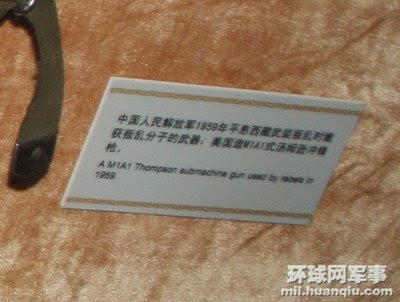
In the report below, a visitor to a Beijing exhibition marking the 50th anniversary of democratic reforms carried out in 1959 in Tibet is described as looking "at guns used by Chinese soldiers". (The 1959 reforms followed an uprising by senior monks and upper class Tibetans and freed the region from its feudal theocratic system. As the head of that system the Dalai Lama, who had pretended to cooperate with Mao Zedong and the Chinese Communist Party, chose to side with the reaction and fled to India.)
Before we look again at this picture and its caption, one might well ask, "What else was on display here? What other exhibits might there be about either the system that was replaced, or the new way of life that emerged in Tibet after 1959? Why was this the only image chosen to represent the exhibition? Are the Chinese so blood-thirsty that they would really display the guns that they had used to 'suppress' the Tibetans? Are they boasting about their 'invasion' and 'dictatorship'?"
But the truth will out! The labels on the exhibition reveal a different reality to that dreamed up by Agence France Presse reporter Peter Parks, and gleefully replicated by other anti-China media.
The label closest to the front actually reads (in Chinese and English) "A Bren machine gun used by rebels in 1959".
The second label, on the bottom of the wall at the rear of the display case actually reads "An M1A1 Thompson machine gun used by rebels in 1959."
The Chinese captions additionally reveal that both weapons were manufactured in England, hinting at connections between the Tibetan reactionary ruling class and the imperialists.
We have seen this sort of deliberate falsehood before: Nepalese police of the old regime attacking Tibetan exiles in Kathmandu being passed off as Chinese police "attacking innocent Tibetan civilians in Lhasa" during last March's shameful campaign against the international passage of the Olympic torch.
Caught out once again, the capitalist press must always be regarded with suspicion as a source of misinformation about workers' struggles, liberation movements...progressive politics of any kind.
Thursday, March 05, 2009
"Behind the scenes" with Marathon
Senior South Australian Liberal Party figurehead, Federal Senator Nick Minchin, has said that “revelations about the rather intriguing and complex background to Black Pearl Global Opportunity Fund, now a substantial shareholder of Marathon Resources…should be of considerable interest to all South Australians, given Marathon’s thoroughly undesirable proposal to open a uranium mine in the Arkaroola Wilderness Sanctuary.”
In a letter published in the current edition of Adelaide newspaper The Independent Weekly, Minchin continues, “If Marathon is to become the plaything of international hedge fund operators operating out of the Cayman Islands, then I for one am even more convinced that the Rann Government should not allow Marathon to renew its controversial test-drilling program at Arkaroola, and should announce that it will never allow a uranium mine to be established in a part of SA that is simply too precious to mine.”
Minchin’s long-standing personal opposition to the Marathon venture is very welcome, although probably not by his old Senatorial sparring partner, Labor’s (former) Senator Chris Schacht.
Schacht has just added to his shareholding in the company by taking up some of his entitlements as a Director under a rights issue. He’s increased his holdings from 45,000 to 63,000 shares whilst CEO Peter Williams has increased his from 684,000 to 817,600.
These acquisitions occurred on December 10, 2008. However, the Australian Securities Exchange (ASX) was only notified on March 3, 2009 despite a rule that requires notification within 5 business days.
When the ASX sent Marathon a “please explain”, the best Marathon could do was to plead “inadvertent administrative error and the fact that the holiday period followed the issue and allotment date”.
Pretty bloody sloppy, and the ASX must be getting sick and tired of sending this mob “please explains”.
The real “please explain”, however, should be why Williams and Schacht are buying further into a company that does not yet have its exploration program reinstated and whilst State Parliament is yet to vote on Greens Senator Mark Parnell’s private members Bill to ban mining at Arkaroola.
And why, for that matter, Ken Talbot, former CEO of Macarthur Mining, whom the kiddies in the chatroom are convinced is “a very smart man” has gone on a buying spree starting January 20, 2009 and increased family company Talbot Group Holding’s stake from 13.7 million shares or 18.1%, to 14.5 million shares or 19.1% of Marathon Resources with on-market purchases. The shares were acquired at between 34 cents to 40 cents per share.
One of my chatroom readers (g’day “lazyguns”) believes that Talbot is “patiently waiting for the smaller holders to sell down in to them due to the DOW panic etc. IMO they seem to be putting a lid on the price at 40c to soak up as many shares as they can in the mid 30s range….he seems to be a man who knows what is going on behind the scene.”
Talbot and Chinese investment giant CITIC formerly had a Memorandum of Understanding to act as associates in Marathon (as they have in several other ventures), but dissolved that partnership on January 15.
Did CITIC not want to waste more of its money on Marathon?
Did the MOU have to go to free Talbot’s hand?
Is someone getting assurances that the State Government will accept Marathon’s “change of heart”, block Parnell’s Bill and restore the exploration licence “under the close supervision and monitoring of PIRSA”? (PIRSA is the SA government’s primary industries department.)
Who else knows “what is going on behind the scenes”?
Monday, March 02, 2009
Songs champion the cause of China's rural poor

(Above: migrant workers appeal for help - their slogans, written on sheets of newspaper read Wo yao hui jia or I want to go home.)
The rise and rise of China has depended to a large extent on a vast reservoir of cheap human labour: the peasantry.
Men and women, girls and boys from Anhui, Hebei, Henan and other rural provinces have come to the big coastal cities in droves since the mid-eighties. Like a blind flood, rural workers who had only known their local village became restless nomads following rumours of work on building sites, in manufacturing and in domestic service.
The market in human labour power was the condition for capital accumulation on a vast scale.
All of the ugly prejudices against the poor that Mao had tried so hard to eradicate, particularly during the Great Proletarian Cultural Revolution, resurfaced as senior Party leaders fell in behind Deng Xiaoping and his exhortation, “It is glorious to get rich!”
Deng gave a green light to the restoration of capitalist practices with another slogan: “It doesn’t matter whether the cat is black or white, so long as it catches mice”.
The colour of the cat, if you’ll excuse a mixed metaphor, was always a red herring: the real question was “for whom?”. For the use of the workers and the peasants, or for the private expropriation by, and enrichment of, an emerging capitalist class…that is the question.
The treatment of the mangliu, the migrant workers, has been scandalous.
As of 2006, the total amount of unpaid wages owed to migrant workers in mainland China amounted to 10 billion yuan. Unpaid wages in the construction industry amounted to 72.2% of the total.
New land laws have removed the one safety net that existed for most of these migrant labourers – the farms that they had walked away from in search of cash payments in the city.
In order to satisfy the demand for land for manufacturing expansion, a Chinese-style of enclosures has been visited on some villages with compensation rarely meeting the needs of farmers for relocation and rebuilding of homes.
A new form of land leasing, or renting, is now leading many peasants to sign away their rights to land so that returning migrant workers, laid off from the big factories and job sites, have no farmland to fall back on for sustenance farming.
It is estimated that 20 million rural workers have been dismissed from factories that have been faced with a crisis of overproduction following the disappearance of finance capital from world markets and the evaporation of credit that has substituted for the immediate realisation of surplus value through the sale of commodities.
Two songs have recently commented on the plight of the migrant labourers. One can be seen in a video clip here, whilst the second can be seen by following the link further down the same page (you can ignore the instructions to install a language pack)
The lyrics of the first read:
Cuihua (his wife’s name), mom and dad, I won’t go back home for the Spring Festival,
Cuihua (his wife’s name), mom and dad, I won’t go back home for the Spring Festival,
Without wages in my pocket, I cannot face you all
Son and daughter, don’t ask me where the red envelopes are
I cry to the heaven and to the earth but where can I complain?
Why does the boss himself have a luxurious life but no money to pay the wages?
Why does the boss himself have a luxurious life but no money to pay the wages?
He has no reason to be so proud even when he drives a BMW or Mercedes because that’s what he owes us.
Repay my wages, Repay my wages
We are thousands of miles from home
We work so hard in the cities
We are from Shaanxi, Shandong, Sichuan, Hubei and Anhui
We build the high-rise buildings but we are ironically looked down on
We are not paid and there is nothing we can do about it.
I ask myself whether there is any justice and I calm myself down
I persuade myself that I am the creditor and that’s no doubt
You owe me, You owe me…
The lyrics of the second follow:
I had a hard life in the mountain area
I needed to wait for my hen to lay eggs in exchange for cigarettes
One day I left the mountain with my uncle
I worked very hard in the construction site and earned six thousand yuan within a year
I was waiting for the pay and planned to spend the Spring Festival with my family
However, the boss said he was out of money and let me wait
After the third snow, the boss still didn’t pay me
He said he had no money to pay but he spent several thousand yuan to play Mahjong
He said he had no money to pay but he spent ten thousand yuan to get his mistress a new cell phone
People in the labor department were very warmhearted and they kept calling the boss until he powered off the cell phone
The boss said he was very angry because we sued him and he even threatened us
The Labor Department let me report it to the court
The court said it would process the case for us after New Year
We waited till then and the court did process the case
But the boss had run away with our wages
He said he had no money to pay but he spent several thousand yuan to play Mahjong
He said he had no money to pay but he spent ten thousand yuan to get his second mistress a necklace
The visuals associated with both sets of lyrics depict the cruel life and times of the migrant labourers.
At the end of the second song, the singer wields a large sword and leaves no doubt about what he would do with the laoban, or boss, should he ever catch him.
Two recent Beijing Review articles on this topic are also worth reading:
Subscribe to:
Posts (Atom)

