Tuesday, February 28, 2012

National bourgeoisie must accept workers' leadership

The online Business Spectator has today published a piece that highlights the imperialist domination and control of Australia’s economy.

It does so from a national bourgeois perspective.

Nevertheless it highlights matters that are of critical importance to the anti-imperialist socialist movement. In particular it highlights how US imperialism has manoeuvred itself into an incredibly privileged position with respect to its imperialist competitors and the local capitalist victims of its takeovers (investment targets).

The author, Christopher Tipler, cannot even contemplate a role for us, as the citizens of this country and the creators of its wealth, to provide a solution to the problem that he raises.

Instead, he says that the “answer may be provided by one of the international think tanks working in this field”.

This is consistent with his stand in support of Australian manufacturing. He correctly raises the issue of foreign domination of the economy and its responsibility for the “potentially terminal illness” of Australian manufacturing, but sees the answer in growing capacity among small and medium enterprises and cites the Bavarian “Mittelstand approach of constant innovation, of doing things faster and smarter than competitors” (see http://corpusrios.com/cms-blog-entries/a-german-cure-for-our-dutch-disease.phps ) . This is a little bit like the laying on of hands, a miracle cure that would enable the terminally ill small and medium national bourgeoisie to turn the clock back and regain its youthful vigour.

Tipler must make a study of the reality of state power and let us who work for a living give the lead through mass political struggle and revolutionary activity so that in a socialist, anti-imperialist state manufacturing can be given the protection and support that we need it to have.

.................................................................

Sailing adrift towards productivity
Christopher J Tipler, Management Insights
Published 6:10 AM, 29 Feb 2012 Last update 6:10 AM, 29 Feb 2012

As a strategic adviser I have always believed in the importance of knowing where you are going, or at least where you want to go. This, of course, reflects the fact that businesses exist for a purpose; an over-arching goal is inherent in their makeup. So planning to reach this goal becomes critically important.

Perhaps it is an inappropriate bias, but I tend to assume the same principles should apply at the macro-economic level; that collectively we should have some idea of where we want to go and broadly how we will get there. I suspect I am not alone – that most Australians, if asked, would say that we should know, and hopefully do know, what sort of country we want to be and what sort of economy we need. In this we are deceived as current, long-standing policy settings are completely silent on goals and antithetical to them. This situation is untenable.

At the highest level of population and land use, our governments have refused to be prescriptive; we have no consensus on how many of us should be here, where we should be living or what we should be doing. The implication is that there is no ‘should’. Our approach to economic and industry policy confirms that we are not interested in defining scope and scale dimensions.

The touchstone of economic policy since the mid-1980s has been efficiency, or productivity, to the exclusion of just about anything else. The Productivity Commission which, along with Treasury, is the peak economic policy group, declares ‘productivity isn’t everything, but in the long run it is almost everything’. There is a near-pathological commitment to deregulation, structural adjustment and trade liberalisation so that local and global market forces can determine outcomes. The Productivity Commission believes, for example, that ‘a country gains most of all from reducing its own trade barriers, regardless of what other countries do’.

In all of this there is no hint of a goal, for one obvious reason – the pursuit of goals may well be inconsistent with the pursuit of efficiency. Yet anyone with a strategic orientation understands that efficiency without a goal is of very limited effect. To create a condition of effective intent you must define, and reconcile, both capability and ambition. We must do things right but we must also do the right things. In this more strategic view, efficiency may be necessary but it is not sufficient.

It is important to appreciate the implications of an almost exclusive emphasis on open market principles. An economy is made up of many markets – places where things are bought and sold – and large numbers of buyers and sellers for these things (including international participants). To set these forces loose in a small economy is like tossing a dinghy into a swirling ocean. Who knows where it will go or what will happen to it? The little craft may be inherently seaworthy but it can be swept to somewhere that we never envisaged, or swamped by large waves. Is that what we want?

We might have more influence over our boat’s journey if we decided who could own and sail the craft, but we have eschewed even that. There are almost no effective controls over foreign ownership of enterprises and real estate in Australia. Under current FIRB guidelines a foreign person or entity can buy a business with a value of up to $244 million without the need to gain approval from anyone. If you are American, the threshold is $1.06 billion. Yes, you read these figures correctly - $244 million and $1.06 billion. In the past, even where approval has been required, it has almost invariably been given (rare exceptions relate to the exercise of ‘national interest’ provisions).

We do not know what the level of foreign investment in Australia is, or how rapidly it is growing, as the ABS no longer publishes statistics on this topic. We know that in critical sectors such as manufacturing it has increased substantially. In general, there is very strong interest in buying Australian assets, particularly from Asian investors. The problem here is that overseas-owned companies will always work to an international agenda that may be inconsistent with Australia’s interests.

To top it off, we provide a powerful incentive for our entrepreneurs to sell out, often to international buyers, as only 50 per cent of a capital gain is taxed as income. The ‘smart’ money cashes in to take advantage of this while it can. This is a bizarre anomaly in our tax system.
In combination, the ‘let it rip’ policy trio of efficiency for its own sake, encouragement of overseas ownership and low capital gains taxes is leading Australia into very dangerous waters. In these waters, with no sense of direction, we are a small and vulnerable ship.

Our economic policy settings represent a failure of both imagination and common sense. We must now create a strategic context for policy by balancing capability with ambition; moving from the ‘necessity’ of efficiency to the ‘sufficiency’ of vision and control. This process starts by defining potential scenarios for Australia and testing them through widespread consultation. Answering the question ‘who should do this?’ is not easy. The answer may be provided by one of the international think tanks working in this field.

Christopher J Tipler is a Melbourne-based management advisor and author of Corpus RIOS – The how and what of business strategy. His web site corpusrios.com contains more material on this and related topics.

Thursday, February 09, 2012

Catholic education office lobbies against fairness


(Two views, above, of the Caritas College junior covered area, which won the top award in the 2011 SA Architecture Awards.)


The OECD, hardly a left-wing think-tank, has today issued a report on Equity and Quality in Education. It notes that across OECD countries, the highest performing education systems combine quality with equity. In relation to “choice” it observes that “Providing full parental choice can result in segregating students by ability, socio economic background and generate greater inequities across education systems”.

The release of this report is quite timely given that proponents of school choice in Australia are cranking up their engines in anticipation of the release of the review into the funding of schools led by David Gonski.

One such proponent is the Catholic Education Office.

A few days ago, Caritas College, a Catholic R-12 school in Port Augusta, sent home a letter to parents urging them to “become aware of the funding situation for Catholic schools”. It stated that, on average across Australia, CEO schools received a net income of $10,008 per student compared to a net income per student of $11,132 in government schools. It was silent on the fact that, on average across Australia, other private schools had a net income per student of $13,700.

The Caritas letter (I suspect it is a form letter being sent out by many Catholic schools) states that “Catholic schools have a commitment to supporting all families – no matter what their economic or social circumstances”.

“Suffer the little children of the poor and the marginalised to come unto our Catholic schools”?
I think not.

Before we get onto Caritas, the recent study by Richard Teese mentioned in a previous post, claims that “Private non-Catholic schools are found in low social status areas, but their intakes vary in different ways from the complexion of the area. This is also true of Catholic schools.” He provides summary figures for primary school enrolments across the whole of the nation that show that for the ten years 1996-2006, the percentages of students from the two lowest SES quartiles remained static at 14% and 16% respectively, but that the two highest quartiles rose from 16% to 18% and 21% to 22% respectively (Teese, p.32). Some good Catholic marketing there!

In the secondary sector, there were small increases in the Catholic share of each of the SES quartiles, but the proportions are revealing: from the lowest to highest, in 2006, the Catholic share was 13%, 16%. 19% and 24% respectively. In other words, the Catholic enrol nearly twice as many wealthy students as they do poor students.

Moving from the general to the particular, Teese provides a detailed study of schools in a number of low SES communities in Western Australia and Victoria and concludes that “As socio-economic status rises, an increasing share of enrolments is found in the Catholic school, and conversely as SES declines, an increasing share is found in the public schools (Teese, p. 45)”.

With that background, let’s look at Port Augusta.

Port Augusta is a large regional town with many unemployed and low wage families. It has significant Aboriginal and LBOTE communities and these attract additional funding, so the figures below are not representative of the Australian average. Nevertheless, they raise questions about the social integrity and political agenda of the Catholic school lobby.

Based on student data for 2009, Caritas had a student profile against the SES quartiles (lowest to highest 25% segments of the population) of 61%, 27%, 12 %, and 1%. (For 2010 the figures were 13%, 36%, 29% and 22%!)

This compares with public secondary school and primary schools as follows:

Pt Augusta Secondary School: 83%, 16%, 1%, 0%.


Augusta Pk PS: 97%, 1%, 1%, 0%.


Willsden PS: 92%, 8%, 0%, 0%.

Caritas College, in a community with a large Aboriginal population, had only 5% Indigenous students. It had only 1% of students from a Language Background Other Than English (LBOTE).

Pt Augusta Secondary School had a 36% Indigenous intake, and 24% LBOTE students.

Augusta Pk Primary had a 50% Indigenous intake, and 46% LBOTE students.

Willsden Primary had a 62% Indigenous intake and 83% LBOTE.


(Above, students at Port Augusta Secondary School).

Remember Caritas’s self-serving and sanctimonious claim about Catholic schools serving “all families – no matter what their economic or social circumstances”?

Excluding parent fees and other private sources of income, and on the basis of financial data for 2009, Caritas received government recurrent funding of $8580 per student.

Aggregating the funding for the three government schools to produce a comparable R-12 profile, these schools received government recurrent funding of $13,112 per student.

Whereas the government schools were able to raise some hundreds of dollars per student in fees and other income, Caritas raised an additional $2698 per student for a total net per student income of $11,279.

That is still below the funding received by government schools for the students they cater for in Port Augusta. Perhaps Caritas might have advised its parents that if they wanted more government funds for their children then they should enrol them in the government sector. But in a town like Pt Augusta, white flight is a one-way street.

Instead of bashing government schools for the funding they receive for the "heavier lifting" required to meet minimum standards for disadvantaged students, the Catholic lobby would be better advised to call on its parents to query why other private schools, most of which serve the higher end of the SES profile, should receive even more recurrent funding per student than those in both the Catholic and government systems.


Monday, February 06, 2012

Responding to Kevin Donnelly


Yesterday, Dr Kevin Donnelly placed a piece defending the inequitable schools funding model on OnLine Opinion. His purpose was to undermine the credibility of a research paper by Prof. Richard Teese commissioned by all State (except NSW) and Territory Departments of Education for the Gonski Review of Schools Funding. The Teese paper calls a spade a spade. It is very good. The commissioning governments tried to keep it under wraps but it was leaked to the media. The link to Donnelly’s article is here: http://www.onlineopinion.com.au/view.asp?article=13203 .
The link to Teese’s paper is here: http://www.aeufederal.org.au/Publications/2012/RTeesereport2012.pdf

Donnelly is a prominent conservative academic much beloved of the Murdoch media and often sought for comment by radio and TV personalities.

I responded to Donnelly’s piece as follows:

I wish to thank Kevin for reminding us that facts should not get in the way of a good story.

I’m not referring to his quotation of that old saying, but to the rest of his article.

Donnelly cites OECD research that “proves” that “Australia is one of the most egalitarian countries in the world”. Note that “in the world” includes the A-Z of the world’s poorest countries, from Albania to Zimbabwe. But let’s look at child poverty across the OECD. In Australia 14% of children live below the poverty line (2008 OECD figures), compared to rates like 3.7% (Denmark) 5.4% (Finland) and 7% (France). In fact (if you don’t mind my saying that Kevin), 24 out of the 34 OECD countries had a lower rate of child poverty than Australia.

Donnelly argues that it is “also the case” that the “current socioeconomic status (SES) model of funding” (through which private schools receive Federal recurrent funds) “is based on need”. Yes, and mothers’ milk comes from mothers. So what? Is Donnelly seriously going to challenge the fact that public schools do the heavy lifting, that as a system, public education has a much larger proportion of socially and educationally disadvantaged students than either of the Catholic and “independent” systems? So why should the cost of educating these students benefit non-government schools?

Even if it could be argued that the Average Government School Recurrent Cost is a fair basis for funding non-government schools, how can he defend the “funding maintained” provision that ensures that no private school will lose funding even if the fact is that they should?


Opposition education spokesperson Christopher Pyne’s seat of Sturt is an example. Nine out of the 14 private and Catholic schools in the Sturt electorate have “funding maintained” status in respect of their recurrent funding from the Commonwealth. For example, St Ignatius College was entitled to receive 56.2% of the Average Government Student Recurrent Cost (AGSRC) in 2008, and is maintained at that level despite the 2009-12 entitlement being only 36.2% of AGSRC. On average, there is a difference of 10.7 percentage points between what these schools’ current real share of AGSRC should be, and the percentage at which they are being maintained by the Commonwealth Government’s unfair funding formula.


Donnelly says that “Australian research also proves that socioeconomic background is not the most influential determinant of educational success or failure…” What research? The speciousness of Donnelly’s fact here is immediately obvious when one looks at this qualifying comment: “…equally as important are factors like student ability and motivation, teacher effectiveness, school climate and the quality of the curriculum”. Only a person with a Doctorate would have the insight to disassociate socioeconomic background from student ability and motivation, and those in-school factors that are determined by where and in what community a school is sited.


Another “fact” cited by Donnelly “is that most of the growth in (private school) enrolments over the last 20 years or so has been in low fee-paying non-denominational schools serving less affluent communities.” Yet the Teese study of changes in enrolment shares over the two decades 1986-2006 demonstrates “that the greatest increase in the proportion of students attending private (including Catholic) schools has occurred in high SES localities, while no increase at all has been registered in low SES localities”.


Donnelly writes that “state and federal governments spend millions every year on programs designed to strengthen educational outcomes, especially in literacy and numeracy, for under-performing and at-risk groups of students.” Here he unwittingly endorses one of Teese’s observations, namely that the government funding of choice, by moving more highly achieving students out of the public and into the private system, creates the need for extra funding to address the resultant increase in low achievement in the public system. Research by the NSW and SA education department, and by Teese in Victoria, shows that low SES students do better in schools where there are higher SES students than in schools where there are concentrations of low SES students.


So, to paraphrase Donnelly, who would have believed that the good Doctor would be at it again, trying to justify educational inequality and privilege?

Posted by mike-servethepeople, Monday, 6 February 2012 1:38:44 PM

(Great cartoons by Simon Kneebone, Adelaide).

Thursday, February 02, 2012

Expose the fact of death at work and act to prevent it!

When media personality Molly Meldrum fell from a height at home and was hospitalised with head injuries radio, press and TV covered the story like ants on a chop bone.

Some publicity was to be expected, but this was saturation coverage. The impact of his fall on Meldrum was one thing, but we had to “share” its impact on fans, friends and family, as well as reviewing his status, interests and lifestyle.

Molly’s injuries were severe and unfortunate, but he has lived to tell the tale, unlike another pre-Christmas accident victim, a member of the CFMEU employed by Alinta Energy at the Leigh Creek coalfields.

This death at work was virtually ignored by the media.

It’s not that there wasn’t a story: this comrade had a family, including children, and friends, and their grief was all the more poignant for his death having occurred the day before Christmas.

But the capitalist press gets no mileage for the class it serves by publicising death and injury at work. Rather than appearing as stories in the press, these incidents are “disappeared”. At most there is a passing reference to an “industrial accident that claimed a man’s life”, but no exploring the circumstances, no use of the power of the press to tell the human story involved so as to pressure the capitalist class and its managers to clean up their act and stop killing workers.

The Leigh Creek man was operating a 30-year old hydraulic excavator. The machine operates 24 hours a day, so compared to a machine operating on an eight-hour shift, its effective working age was around 100 years.

Safework SA has yet to deliver a report on the state of the machine, but it would be a safe bet to say that they had not inspected it, or had not done so recently.

That was the case with the metal borer that caught and killed young Daniel Madeley in 2004. It had never been inspected. Even as late as 2010, and despite having discovered that there were 78 workplaces which operated borers in SA, the SafeWork SA inspectors had only managed to visit seven.

At Leigh Creek, a turbine on the excavator overheated and burst, spilling hot oil onto the operator who was then immolated. Suffering severe burns, he was airlifted to Adelaide, but died in hospital.

Five days before, a 58 year old man was killed at a stockfeed manufacturing business at Kapunda when he was hit by a large shuttle used to transport hay bales across the site.

The press treated this tragedy in the same way – with indifference.

The working class is not expendable. The life of each working person is precious.

The requirement for safety at work is a set of understood safe operating procedures that take priority over production for profit.

And the foundation of safe operating procedures around machinery is regular and thorough maintenance and repair despite what this may mean in terms of capital costs and interruptions to production.

No more deaths at work!

Sunday, January 29, 2012

Hands Off Kim Sattler!

(John McTernan and The Thick Of It's Malcolm Tucker. See below for the link...)


Kim Sattler is Secretary of Unions ACT and is the person who is being hung out to dry by Julia Gillard in the wake of the stupid decision by her security staff to rush her in a wedge of copper heavies to her car.

Sattler had been tipped off by Gillard’s press secretary Tony Hodges to the effect that Opposition leader Tony Abbott had made remarks indicating that there was no future for the Aboriginal Tent Embassy which was celebrating its 40th anniversary. She was also told that Abbott was at a function with Gillard at a nearby restaurant.

Kim is well-known to have close links with the Aboriginal Tent Embassy. The information she was given by the Gillard staffer was obviously meant to be passed on to the hundreds of people at the Tent Embassy with the aim of making Abbott a target of their complaints and that expressed in the form of some sort of anti-Abbott protest.

Kim took the advice she was given in good faith and passed it on as any supporter of the Tent Embassy would have.

As intended, a group of people from the Tent Embassy rushed across to the restaurant and demanded that Abbott come out and speak to them about his comments.

When Abbott declined to do so, they began hammering with the hands on the windows of the restaurant and chanting.

The capitalist press whipped this up into reports of a “riot” and deplored the “violence” directed, as a result of the security over-reaction, at Gillard who was photographed minus a shoe and stumbling – not from the actions of any protester – but because of the way her security was bustling her to her car.

I wasn’t there, so I can’t give an eye-witness account.

But these people were, and here is what they say. From a contributor to Inymedia:

Not for the blink of an eye were Julia Gillard and Tony Abbott so much as threatened, even less endangered, on the 26th of January by demonstrators from the 40th anniversary Aboriginal Embassy camp in Canberra.


The only violence came from a young copper who punched and choke-gripped a young painted up Aboriginal man, a young Aboriginal woman, an SBS cameraman and I believe one other person standing harmlessly near the restaurant side exit through which clumsy security men rushed out Gingeralla, causing her to lose that now famous blue suede shoe. The only “violence” from the demonstrators I’m aware of was a punch by an activist to the copper who had roughed up the woman without cause. “I won’t stand for any man doing that to a woman,” he told me, showing me bleeding chapped knuckles that must have connected with something metallic on the copper. Nothing would have been easier than to just form a corridor of two lines of coppers for the PM to calmly walk though to her car.


It went the rounds of the protest encampment that that choke-gripping copper is the son of Canberra’s police chief. True or false – I don’t know. But one can imagine that someone from such a stable might think they’re above the law and can do anything with impunity.

Violence from us? Rubbish. I stood close to a handful banging for a while with their hands on the about 2cm-thick glass walls of The Lobby restaurant, part of a group of about 50 making a lot of noise. A bit of noise is enough to spook our two top political leaders and agents guarding the prime minister? No wonder the Americans commented gleefully, can’t they even protect their prime minister?


Violence? How about this for potentially disastrous violence: One copper in the line pushing us back was seen unbuttoning his pistol holster. Another copper had his hand on his taser weapon. A third had his truncheon extended. We heard no order given for any of this. We did, though, see a lot of frightened young faces in that blue-black line advancing on us. The Australian Federal Police said its officers lost control and had no choice but to bustle Gillard and Abbott away in the prime minister’s car. Lost control over 50 noisy but otherwise peaceful demonstrators with almost the same number of police there?


And the story above is corroborated by this account from a website covering current affairs in the ACT:

Rod and I were at the Embassy and I must explain what happened to counteract the fantasy many in the media have created regarding the so-called riot. Media in Australia are often pathetic in their requirement for the sensational - if it isn't, they will make it up.

We were all listening to the speeches by the elders when they were interrupted by the news that Tony Abbott was at a function close by and had called for the Aboriginal Tent Embassy to be torn down. This, of course, did not win him many friends in the gathering. From what I gather, a group of five or six walked across the rose garden to the restaurant that was called The Pork Barrel Café on the sandwich board outside but was really called The Lobby. The group asked to speak to Tony Abbott but he wouldn't come out so the group told him through the surrounding windows how they felt about what he'd said.


It was at that point that Julia Gillard's security people began to panic. Instead of formulating a plan to get her and Abbott out of the restaurant with as little fuss as possible which would have been quite easily done, they instead called the police - local and federal - and then pushed and dragged the PM in a flying wedge toward her car. The crowd of people they pushed and dragged her through consisted of media and security. That's when the PM lost her shoe. Michael Anderson was knocked to the ground on the same steps and several others in the group were manhandled by the police.


The PM was never in any danger, there was no riot. By the time the rest of the people came across to see what was going on, the PM was long gone and Abbott too. Rod and I arrived to see a police cordon across the street - blocking it as well as police cars at the other end blocking that. If a riot had occurred they would have had us like fish in a barrel. There was a bit of shouting by individuals but the police never moved - just looked grim and menacing - no one was arrested. I saw a cop unclip his gun holster and put his hand on his freed gun and it occurred to me that the police might not need much to lose their cool. Rod was just walking forward and I warned him about the gun and the mood of the police.

The leaders from the Tent Embassy called for everyone to go back to the site and people began straggling back.

So much for a “riot”!

Then it was revealed that Gillard’s press secretary had resigned.

That was a bad look for Gillard and her office - that the so-called “riot” had been initiated by her team to get at Abbott.

So someone must have suggested that the blame be placed elsewhere. Anything to take the heat off Gillard.

That was when Kim Sattler received a phone call from John McTernan, the former Blair adviser appointed to manage Gillard’s communications strategy.

I give some background on McTernan in an earlier blog post here: http://mike-servethepeople.blogspot.com/2011/09/gillards-spin-doctor-wont-cure.html .

Elsewhere (see: http://www.thepowerindex.com.au/power-move/gillard-to-get-media-makeover-from-a-whip-cracking-spinner/20110925455 ) he has been linked with the character Malcolm Tucker, from the excellent BBC series The Thick Of It.

According to Sattler, McTernan phoned her to say that she would be named as the person who had given the information about Abbott to the Tent Embassy people.

Sattler told McTernan she had a right to privacy.

“He said, ‘Well, we are going to release your name’. He said, ‘We’re going to have a press conference and we are going to name you’”, reported Sattler.

The she accurately described herself as the meat in the sandwich, as the messenger that was being shot.

Now, I’ve got to admit that I knew Kim a long time ago when she was living in Adelaide.

I haven’t seen or spoken to her for years, but I hear of her from time to time and I know that she is an absolutely genuine supporter of the working class and of progressive causes, which is more that can be said of either Gillard or Abbott.

So I say “Hands off Kim Sattler”.

She doesn’t deserve to be sacrificed to the capitalist media by Gillard’s team of spin doctors just to get a totally unprincipled traitor to whatever the Labor cause might mean these days, off the hook.

Long live the Aboriginal Tent Embassy!

For a Treaty and a new Constitution!

Monday, January 09, 2012

Great news: capitalism to lurch to new crises in 2012


The world crisis of capitalism will continue and deepen in 2012.

This is not the view of Marxists alone, but of many bourgeois economists and finance capitalists as well.

For example, Bill Gross, co-founder and co-Chief Investment Officer of the US multinational PIMCO (Pacific Investment Management Company) stated on January 6, 2012 that the “financial markets and global economies are at great risk” (Gross, Paranormal Economic Activity).

Gross should know: PIMCO oversees investments totaling more than $1 trillion on behalf of a wide range of clients, including millions of retirement savers, public and private pension plans, educational institutions, central banks, foundations and endowments, among others.

While world attention continues to focus on the eurozone countries, the fact that the United States is a geographically separate entity can no longer mask the intricate web of financial ties between it and Europe. Ultimately, the buck still stops in the USA.

Contradictions within the eurozone will continue to unravel. As economic commentator Stephen Bartolomeusz commented on January 9, “If the eurozone were to splinter, deep holes would be gouged in bank balance sheets across the region, requiring more massive taxpayer bailouts from economies that can’t afford them.”

The logical inference of his observation that capitalist “economies” can no longer “afford” to bail out the rich is that further attacks on the people are on the agenda.

Karen Maley, writing in the same day’s Business Spectator, pointed out that “eurozone countries will not be able to fall back on government stimulus packages to get their economies moving. Instead, economic activity will contract sharply as governments embark on a draconian tightening of budgetary policy aimed at eliminating budget deficits that range between 2 per cent and 12 per cent of GDP.”

“Draconian” indeed! As if the belt tightening imposed by the speculators and their governments have not already been draconian enough.

But with repression comes resistance. Rich lessons have already been learned throughout 2011 in all areas where capitalism and imperialism are in control. Or, based on the above, out of control.

Bring on the further unravelling of the crisis.

Away with the private ownership of the means of production, distribution and exchange…..


Wednesday, December 14, 2011

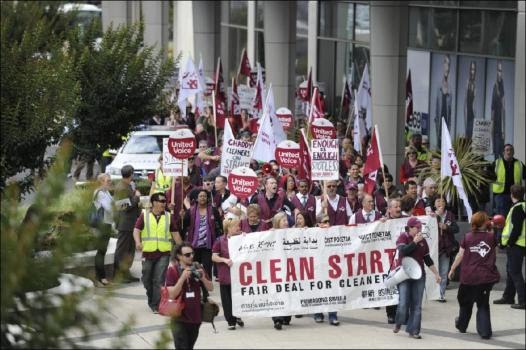
Cleaners Rising Up


Cleaners around the country are some of the most lowly paid and precariously employed members of the working class.

For several years, United Voice (formerly the Liquor, Hospitality and Miscellaneous Workers Union or LHMWU) has been organizing these workers in its Clean Start campaign, winning impressive victories around some of the capital cities’ CBDs.

Now the campaign is getting out to major shopping centres in the suburbs.

A case in point is the Chadstone Shopping Centre in suburban Melbourne.

Like workers throughout the cleaning industry, Chadstone workers have been subjected to an intensification of their labour by their profit-hungry bosses, putting the public at risk as short-cuts are taken particularly around toilets and food courts.


Gamal Babiker(above) has been a cleaner at Chadstone since 2000 and said conditions had got worse over the last five years.

He said the budgets for training and health and safety had been cut as shopping centres pushed for tighter and tighter contracts.

What happened yesterday is that cleaners went on strike at lunch time only for an hour or two and as they went out a large group of community supporters went in. Those in the photos include United Voice delegates who held their annual convention yesterday. As part of their training and skills development they were bussed down to Chadstone shopping centre to get some practice in community support action!


Apparently Westfield locked the doors to the Centre after about 80 community supporters had walked inside, leaving about another 80 demonstrating on the outside. In other capital cities including Adelaide, cleaners are taking short strike action supported by community including sit-ins, cavalcades around the centres, balloons, leafleting shoppers etc.


Spotless, backed by the Shopping Centre Council are showing no public signs of giving in, so it could be a long fight. The Shopping Centre Council is actually arguing for a reduction in retail workers’ wages through ‘freeing up’ penalty rates on weekends.

So it is not surprising to see them pushing a hard line on cleaners’ demands which include increasing the base rate from the award $16.57 per hour to $21.17 per hour which is the rate cleaners in the Clean Start CBD have won.

The irony is that Spotless are a party to the CBD Agreement and major players in the Shopping Centre Council like Colonial First State, Stockland and Dexus are ‘funding’ Clean Start rates in their commercial cleaning contracts in the CBD.

The difference between the CBD and retail shopping centres is that most of the workers in CBD offices are salaried or on EBAs and well paid compared with cleaners who clean those buildings.

But retail, thanks largely to the tame cat union Shop Distributive and Allied Employees Union (SDA) is a low wage industry with many workers on $17 per hour or less as junior rates apply in retail. There are no junior rates in the cleaning award.

The SDA, led for years by a right-wing Catholic clique, spends most of its time and a large chunk of membership fees in factional influence inside the ALP.

The biggest ‘threat’ to the big retailers is they don’t want an organized workforce and that is what campaigns like Clean Start give, an opportunity to organize.

A far sighted big retailer would have settled already, but maybe their reduced sales and retail slump over-ride their thinking.


Thursday, November 24, 2011

Business Council set to continue reactionary agenda


The Business Council of Australia is the representative of the biggest local and overseas companies.

In early November, it elected a new President, Transfield Services Chairman Tony Shepherd.

Transfield is an Australian company but Shepherd will speak as BCA President for the interests of imperialist capital – just over half of BCA’s members are foreign companies or their subsidiaries, and more are local companies in which foreign private and institutional investors have a controlling influence.

In any case, Transfield’s business and investment practices place it at the centre of the infrastructure development required by the multinationals to enable them to squeeze more and more profit out of the Australian people.

It has contracts with coal seam gas operators in the Surat Basin south-west of Gladstone, has major defence industry contracts for "garrison support services" at military facilities throughout the country, runs some of the biggest Public Private Partnerships projects in Australia, and was a major player in 1999 in the privatization of Australian Defence Industries which opened the war supplies sector to the US, French and British companies which now operate in Australia.

Shepherd is no shrinking violet.

He has spoken out strongly against the carbon tax ("We are a carbon-intense economy…we should do everything in our power to protect that"), and strongly supported Rudd’s "Big Australia" proposal for a population of 36 million. "Our domestic consumption base is too narrow to support the industries we need," he told the Australian Financial Review on 25 November. It was a fairly blunt statement that the basis for determining the size of our population is the need for capital to continuously accumulate. More people, more infrastructure, more Transfield profit.
What else does Shepherd have in his sights?

The big ticket item is industrial relations. He hankers for the days of WorkChoices and says that Fair Work Australia is flawed. Actually, FWA works pretty well for the ruling class as the Qantas and Victorian Nurses’ disputes have shown. But having the power to fine and jail unionists who dare go beyond "protected" industrial action is not enough for Shepherd - he wants individual work contracts back!

"I certainly have no problems if companies want individual contracts and employees want to do that," he told the AFR.

He also wants the Federal budget back in surplus "as quickly as possible", even if it means "cutting the cloth" to decrease government expenditure.

Education comes in for a big serve from Shepherd who complains of its "abysmal failure" to provide industry with a skilled workforce.

But what about a social vision for the country, for something that goes beyond the greedy demands of big business?

With more and more people outraged at sky-rocketing CEO salaries, Shepherd is simply dismissive. "Who cares? It’s irrelevant," he told the AFR.

That’s small consolation for the "overwhelming majority of the Australian community (that) is sensible, frugal and hardworking". Noses down, bums in the air and keep slaving folks while those who wallow in wealth praise you for your "frugality"!

But at least the social democrats can be pleased with the praise Shepherd heaps on Hawke, Keating and Kelty. They knew how to use class collaborationist policy to achieve an "integrated" populace without division "into a political class, a business class, and a working class".

Shepherd is not going to go away, but neither are the Australian people.

There are very good signs of an increasing awareness of the injustices of mega-wealth on one side for a tiny handful, and of "frugality" and "cloth-cutting" for the "overwhelming majority of the Australian community".

And that is leading to a rising tide of struggle, and to a willingness to defy rulings and injunctions against the very actions that are needed to address the yawning gaps between rich and poor in the country.

Let the Business Council be warned - the people are on the move!
 

Thursday, November 17, 2011

Murdoch’s Australian spruiks the US line

The Australian is a disgusting rag. It’s made up of about 20% distorted news and 80% open or disguised opinion pieces and editorial columns justifying the spin.

As if it’s not bad enough that it has its own stable of hacks like Greg Sheridan, Janet Albrechtsen et al, it has a coterie of former Labor politicians and tame-cat academics who can be relied upon to keep the discourse within the parameters of safe discussion.

The framing of discourse around the stationing of US troops on Australian soil is a case in point.

It is obviously aimed at China, so China has to be demonized to make the betrayal of our independence and sovereignty into a "response" to a China "threat".

For example, comprador academic Paul Dibb was given column space on November 15 to explain how the US troop invasion of Australia protects our sovereignty. His explanation was based on a deficit view of Beijing: "it is open to Beijing to contribute much more to maritime security concerns in the region by supporting the universally recognized Law of the Sea convention…"

The United Nations Convention on the Law of the Sea is widely recognized: 161 member states have ratified it.
 
But it cannot be said to be "universally" recognized while ratification is refused by a major player.
 
And no, that is not China, which has signed and ratified the Treaty.
 
It is the United States.
 
Perhaps the good professor had a senior’s moment and put in "Beijing" where he really meant to say "the United States"….but I think that’s being a little to kind to him.

He knows what he’s doing.

Likewise, on the front page the following day was an EXCLUSIVE (their highlighting and capitalisation) exposure by reporter Cameron Stewart of the "fact" that a "satellite ground station in the West Australian desert is being used by the Chinese military to help locate Australian and US navy warships in the region."

A close reading of the article shows nothing factual at all - just a series of speculations and half-truths emanating from Professor Des Ball, described as "the nation’s foremost expert on space-based espionage".

Despite an Australian government denial of the claims, buried towards the end of the article, this crap piece of pimp journalism was picked up by the likes of the Sydney Morning Herald and the Melbourne Age and given further prominence.

A spokesperson from the Chinese Embassy in Canberra, Miao Miao, had to submit a letter to the Australian to get the Chinese side of the story into print – not on the front page, but tucked away on p. 15 where it was the last letter printed.

Miao Miao found it "difficult to agree with" Cameron Stewart’s article.

"I note his claims," she wrote, "that a satellite ground station at Mingenew is being used to locate US ships.

"In fact, the Australian government recently confirmed that the station is entirely for commercial purposes. It identified no security concerns with operation of the facilities.

"People cannot but wonder the purpose of publishing such an article at this moment.

"China is Australia’s largest trading partner and has never posed any military threat to Australia. Any attempt to spread Cold War remnants is against the trend of the times."

But can we trust a Chinese denial?

It is not a newspaper on the national stage, but the Geraldton Guardian sent out a reporter to discover the truth.

Here is his article:

Chinese "spies" at Mingenew were the flavour of the US presidential visit week, judging by reports in a range of capital city newspapers.

They were excited by President Barack Obama’s declaration that the US would step up its military presence amid "growing fears about the rise of China".

And the satellite tracking station 20km west of Mingenew was claimed to be the target for nefarious Chinese military activities.

Australian National University Professor Des Ball was quoted as saying the federal government may have unwittingly acted against the national interest by allowing China to use the station to track its Shezhou satellite launched on November 1.

The satellite "was not just part of China’s space program but was used to collect electronic emissions from warships", it was claimed.

Geraldton Newspapers decided we had better get on to this, so a reporter and photographer were dispatched to investigate.

There the station’s manager, Vince Noyes, said the original story in a national newspaper was as far from the truth as its observation that Mingenew — in the middle of the Wheatbelt — was in "the WA desert".

"There’s no kerfuffle between the Chinese and the Americans about using the station," he said.
"They both signed international traffic in arms regulations and entered into a technical assistance agreement so China could use the station to track satellites associated with its proposed space station."

As well, Mr Noyes said, everything done through the station — now owned and operated by the Swedish Space Corporation — was overseen by the corporation’s onsite staff.
Mr Noyes works for Electro Optic Systems, which is subcontractor for the corporation’s Mingenew satellite tracking operations.

He said there was nothing secret or sinister about the station, which had been operating in various forms since 1979 before the Swedish Space Corporation became involved.

"Under the arms regulation agreement, required by the US because the corporation is using a satellite station owned by them but built by the Americans, there’s no way the Chinese can use the equipment for anything but scientific purposes," he said.

Mr Noyes said the "kerfuffle" arose because China had taken a lease on satellite station time and had recently placed tracking equipment in the station.

This was being used for tests to ensure correct docking of parts being assembled for the Chinese space station.

Mr Noyes said there were no guards or restrictions on visits to the satellite station, and its facilities were used by the United States, Geoscience Australia and the University of Tasmania as well as the Chinese.

"It’s even on the route for grey nomad wildflower tours," he said.

Mingenew Shire CEO Ian Fitzgerald also discounted claims that it was being used by the Chinese as some form of spy base.

"This has gone viral and I’ve been interviewed by the BBC and a Chinese newspaper about it," he said.

"Happily, the latest publicity simply places Mingenew at the centre of the universe, just where it should be," he said, adding that there might be an opening for a Chinese restaurant in the town.

There’s another reason China might have an interest in Mingenew.

The husband of local baker Michelle Boylands makes the fireworks used in big events in Geraldton.

"I guess we could sell some of them to the Chinese," she said.

So let me get this straight.
 
The US President stands in an Australian Parliament to lecture China on "playing by the rules" and "upholding international norms".
 
At the same time, he encourages us to sell uranium to India, one of only three states not to "uphold the international norm" of being a signatory to the UN Nuclear Non-Proliferation Treaty (the others are Pakistan and Israel).
 
This is after he and Gillard have agreed to disregard "international norms" of political independence, state sovereignty and territorial integrity by stationing US troops on our soil who are answerable only to their own military command.
 
The purpose, as outlined by Hillary Clinton most clearly in an article in the November edition of Foreign Policy magazine, is to enhance the meddling by the United States in China’s waters under the banner of "defending freedom of navigation in the South China Sea".
 
There is bipartisan support for this from Gillard and Dr No although China, our top foreign direct investment destination and largest trading partner, is a country that has "played by the rules", having ratified the UN Law of the Sea, whilst the US has not.
 
For the US to dictate the terms of our subservience in disregard of international norms is a disgrace.

And the comprador journalists, like the comprador academics, are simply willing servants of imperialism to be named and shamed.

Wednesday, November 16, 2011

No to US troops in Australia!

("Cartoon by Mark Rhodes - www.markart.com.au")


The Australian bourgeoisie is totally servile to the interests and needs of US imperialism.


The struggle for the redivision of the world into areas for the most profitable investment of export capital has direct implications for the Australian people.


We are cemented into a subservient political and military relationship with US imperialism on the basis of an economic situation that is fluid and changing. Part of that change involves the only significant potential challenger to US "full spectrum domination", and that is China. "Australia is China’s top foreign direct investment destination...China is Australia’s largest trading partner and will remain so for the foreseeable future" (see
http://www.lowyinstitute.org/Publication.asp?pid=1616 ).


However, China is no longer free of the contradictions and crises of capitalism, its Gini coefficient is one of the highest in the world, and there is an underlying social discontent amongst its working and peasant classes. It is exporting capital to areas from which the US imperialists would dearly like to exclude it.


These circumstances mean that the current struggle for economic redivision of sources of raw materials and markets between the US, Western Europe and China (with smaller but significant input from India, Russia, Brazil) is directly involving Australia and that the political and military loyalties of the Australian bourgeoisie will sharpen contradictions at a potentially huge expense to our people and our class.


Thus, we have the news of the permanent stationing of US troops on Australian soil under conditions in which they are only answerable to the US.


The following comment was released today on the website of the Communist Party of Australia (Marxist-Leninist):


No to US troops in Australia!


In a shameful abdication of responsibility for the protection of Australian national independence and sovereignty, the Australian government has agreed to the permanent stationing of US troops in Australia.


US imperialist President Barak Obama announced the permanent stationing of 2500 US marines at Darwin’s Robertson Barracks on his mid-November visit.

In a cynical manipulation of media spin, the announcement was leaked the day after the annual misuse by the ruling class of people’s genuine remembrance of war dead on November 11.
In order to deflect popular opposition, the base will not be identified as a "US base" and the US Pacific Command troops will be rotated on a "pre-positioning" basis which one assumes means before being sent to other areas in the Pacific region.


Robertson currently houses 4500 Australian soldiers, and will have to be expanded to accommodate the desired US deployment size.


Obama also indicated that a greater number of US war planes will use RAAF bases in the Top End including for live bombing training exercises, and there is talk of the Curtin naval base near Perth becoming virtually a permanent dock for ships and nuclear-powered submarines of the US Pacific Fleet.


US imperialism struggling to control the region


The Asia-Pacific Region is seen by the US imperialists as crucial to their continued economic, military and cultural domination of the globe. Establishing a much more prominent "forward presence" in the Pacific and Indian ocean regions is seen as central to out-manoeuvring China and keeping India under control respectively. (Gillard’s proposal to reverse the ban on sales of uranium to India has also been made on US instructions and is part of the same plan.)
This new development was the thrust of a revealing article in the November 2011 edition of Foreign Policy magazine, by Hillary Clinton.


Under the heading, "The future of politics will be decided in Asia, not Afghanistan or Iraq, and the United States will be right at the center of the action", Clinton articulates a vision about being "smart and systematic about where we invest time and energy, so that we put ourselves in the best position to sustain our leadership, secure our interests, and advance our values."
Central to that vision is positioning the US militarily to vie with China, or as she puts it, "defending freedom of navigation in the South China Sea".


The so-called "freedom of the seas" has been a bone of contention between colonialist and imperialist powers since at least the mid-1600s when Holland and Britain struggled over the issue.


It is ironic that the US purports to champion the principle, now embedded in article 87(1)a of the 1982 United Nations Convention on the Law of the Sea, since it is the only major power to refuse to ratify the Convention. China, on the other hand, has signed and ratified the Convention.
Clinton went on to define the new US regional strategy. "For starters, "she wrote, "it calls for a sustained commitment to what I have called ‘forward-deployed’ diplomacy. That means continuing to dispatch the full range of our diplomatic assets -- including our highest-ranking officials, our development experts, our interagency teams, and our permanent assets -- to every country and corner of the Asia-Pacific region."


We will, we will rule you!


It is not difficult to see that the dominant imperialist power will stop at nothing to deny sources of raw materials, access to labour, opportunities for investment and political and cultural influence to its competitors. In this respect, an imperialist power led by a Nobel Peace Prize winner is nothing but an imperialist power.


"We have to guarantee that the defense capabilities and communications infrastructure of our alliances are operationally and materially capable of deterring provocation from the full spectrum of state and nonstate actors," declared Clinton. It is almost like she has rewritten the old Queen lyric and is singing "We will, we will rule you!"


And Obama has made it clear that only the US can make global rules and that China must abide by them.


US imperialism redefines Australia’s subservience


Clinton again: "We are also expanding our alliance with Australia from a Pacific partnership to an Indo-Pacific one, and indeed a global partnership. From cybersecurity to Afghanistan to the Arab Awakening to strengthening regional architecture in the Asia-Pacific, Australia's counsel and commitment have been indispensable."


This is the US imperialist state machine dictating the terms of the service it expects from the client traitor class running Australia. It is not necessary to consult the Australian people on the role they wish to play internationally as they do not hold state power and are under the class dictatorship of a bourgeoisie that aligns with US imperialism.


Noting that "we have resumed joint training of Indonesian special forces units," Clinton observed that "The stretch of sea from the Indian Ocean through the Strait of Malacca to the Pacific contains the world's most vibrant trade and energy routes."


Hence, in addition to basing US forces at Robertson, there will be a significant permanent naval presence in Singapore. "The United States will be deploying littoral combat ships to Singapore, and we are examining other ways to increase opportunities for our two militaries to train and operate together", wrote Clinton.


All of this adds up to what Clinton called "a more broadly distributed military presence across the region (which) will provide vital advantages".


We Australians must reject the imposition on us of even greater subservience to US imperialism.
We must demand of our government that it develop and maintain a capacity for independence in foreign policy.


Ultimately that noble goal can only be achieved when we take state power into our own hands and formally establish national independence on the basis of a socialist economy.

Monday, October 31, 2011

Nationalise Qantas Now!

Just days after receiving a 71% pay rise of around $2m, Qantas CEO Alan Joyce, without warning, grounded the entire Qantas air fleet in an employee and customer lockout.

His tactic was to create a crisis which threatened the Australian economy thereby requiring the intervention of the Australian Government which convened a compulsory conference of Fair Work Australia, the national workplace relations tribunal.

In a marathon sitting, FWA rejected the option of a 21 day suspension of industrial action and took the harsher decision, supported by the Gillard Government, to terminate the disputes between Qantas and three unions.

The FWA decision underscores the lack of industrial and workplace rights enjoyed by Australians. It grants limited rights to “protected” industrial action, but only during and related directly to a bargaining period. And as Qantas workers now know, even those limited “protected” rights can be taken away at the whim of FWA.


Joyce is the front man for Qantas and the Qantas Board’s decision to up his pay to $5.1m per year was quite rightly taken as an affront by working class Aussies. Imagine earning $50,000 per year – quite a good wage, and many are below it – and then doing your sums and working out that it would take a full 40 years of slaving your guts out to amass what Joyce has been handed as an annual pay increase! That’s close enough to an entire lifetime of work. To earn the equivalent of Joyce’s total annual salary, that same worker on $50,000 would have to start working the day he/she was born, and not stop for 100 years!

We’ll come back to this disparity a little later.

Qantas: A private company loyal only to profit

Qantas badges itself as the ultimate Aussie icon. It boasts the flying kangaroo symbol, the Spirit of Australia slogan, and the I Still Call Australia Home theme song.

In 1993 the then government-owned flagship carrier was privatised by the neo-liberal wolf-in-sheep’s-clothing, Labor Prime Minister Paul Keating.

Foreign investors were allowed to own up to 49% of the ASX-listed company and today control about 38% of its shares.

The top four shareholders are giant multinational investment corporations (JP Morgan Nominees Australia, HSBC Custody Nominees Australasia Limited, National Nominees Pty Limited, Citicorp Nominees Pty Ltd) through whom most foreign equity in Qantas is channelled. These four big institutional investors control 71.06% of Qantas shares. The top twenty shareholders (0.014% of total shareholders) control 80.36% of the shares.


At the other end of the scale are the “mom and dad” shareholders who protested at last week’s AGM about Joyce’s management tactics and the failure of the company to provide dividends over the past two years.

The smallest shareholders – owning up to 1,000 shares each – number 51,449, or 38% of all shareholders. This 38% owns a mere 1.03% of Qantas shares. In the next category, there are 63,734 people owning between 1001 and 5000 shares. They constitute 48% of shareholders but only own 7.03% of shares. These two categories of small shareholders constitute 86% of all shareholders but only control 8.06% of the stock.

This is the reality of so-called “people’s capitalism”. The vast majority of shareholders can be totally opposed to Joyce’s tactics and the financial rewards which come his way but their will is frustrated and blocked by the tiny handful of big institutional investors who align themselves with foreign capital and its plans to bust Australian unions and relocate the company offshore.

The Qantas Board: hand-picked for the class struggle

It would be wrong to concentrate on Alan Joyce alone. He can be sacrificed if he remains on the nose. It is the composition of the Qantas Board that shows how its personnel have been selected with an eye to waging a vicious class struggle against its employees and against what might be loosely described as the Australian national interest.

The full list of the eleven Board members and their other directorships and interlocking corporate and social interests can be found here: (http://www.qantas.com.au/travel/airlines/board-of-directors/global/en )

First there is Qantas Chairman Leigh Clifford who was first appointed to the Board in 2007. He had been with mining giant Rio Tinto for 37 years. The multinational giant waged industrial and political war against the mining unions in Western Australia's Pilbara region and then attacked the coal unions in the Hunter Valley. One of its tactics, under Clifford who personally broke union picket lines, was to impose a lockout and threat to sack 430 striking miners.

No wonder an October 31 report in the Murdoch rag, the misnamed “Australian” states: “Qantas's lockout looks to have come straight from the playbook of accomplished union-buster Rio Tinto, where Qantas chairman Leigh Clifford spent his executive career.”


Another former Rio Tinto Director is Richard Goodmanson, born in Australia but with dual Australian and US citizenship. Goodmanson was President and CEO of America West Airlines, a budget carrier, from 1996 until April 1999. During his tenure at America West, the airline achieved the highest rate of growth of any hub-and-spoke major carrier in North America, but at a cost to employees and to maintenance standards.


Operational problems reared their ugly head throughout the summer of 1998. Mechanical problems increased, unfavourable press ensued, and employee stress reached a breaking point. Union issues were becoming more and more common, for the flight attendant contract was still open. Mechanics elected the Teamsters as their representative, and were negotiating their first contract. Dispatchers had just concluded their first contract on April 13.


A well-publicized FAA fine was imposed on the airline in June. The record $5 million fine was imposed over maintenance issues, primarily oversight and changes in recommended procedures. America West admitted no wrongdoing, and half the fine was forgiven after a restructuring of the maintenance oversight procedures. Eventually, this would lead to yet another change in heavy maintenance contractors.


In March 1999, struggle broke out between America West Airlines management and its 2,400 flight attendants. The latter were arguing for the suspension of a pay freeze instituted along with a 10% pay cut in 1995 when the carrier was battling to emerge from Chapter 11 bankruptcy. According to the Knight Ridder newsagency the ultimate threat “is that the company will simply shut down”.

“Such a move -- described in a Feb. 12 memo to all employees from President and CEO Richard R. Goodmanson -- would idle 12,000 workers, ground 300 daily flights and could occur as early as Friday. It also could cost the airline $5.5 million a day in lost revenue.”


“If an employment contract isn't reached between the airline and the flight attendants by 10 p.m. Friday, the workers have threatened a series of random, last-minute strikes designed to create chaos for the airline …”


A last minute agreement between the carrier and its cabin crew did indeed “avert chaos”.


Goodmanson has had to wait until October 2011 to enjoy a good old-fashioned lockout.


Then there is Garry Hounsell, appointed to the Board in 2005. Hounsell provides a direct link to legal firm Freehills of which he is also a Board Member. Freehills are leading activists in the class struggle and were the advisors to Patrick Stevedores during its 1998 campaign to bust the Maritime Union of Australia. In April of that year, Patricks sacked its workforce and imposed a lockout enforced by balaclava-wearing thugs, dogs and coppers. Freehills has a long history of developing campaigns for some of the worst employers in Australia. It is an enemy of the working class of Australia.


Dr John Schubert is a former President of the Business Council of Australia and provides a link between that organisation and the Qantas Board. It is through such links that the ruling class constantly discusses its tactics in the war on working Australians. The BCA represents the core of the mainly multinational corporations that generate the most extreme reaction against the rights and liberties of Australian people. Schubert is also a Director of foreign multinational BHP Billiton.


Other Board members include a former Senior Ministerial Adviser to the architect of Qantas privatisation, Paul Keating, as well as persons with interlocking directorships with banking, construction, transport, finance, mining, retail….

The Qantas Board is a war cabinet of the most reactionary, best organised and openly aggressive sections of the ruling class.


Executive salaries: the great divide

The outrage over Alan Joyce’s 71% pay rise is an indication of the mood of the people. From Tahrir Square to Wisconsin, from London is Burning to Occupy Wall Street, there is a growing anger about the obscene levels of private wealth and the insecurity and uncertainty of life for those at the bottom.

The following graphs are based on US data but are indicative of international trends:


The first shows that corporate profits are at an all-time high. This is despite the economic crisis of 2007-08 and represents a half-century high point not seen since the economic boost of the Korean War. Precarious employment is on the rise, entire nations are being rescued from bankruptcy at the expense of their people’s living standards, but corporate profits are safe!


The second shows that whilst the CEOs, the board members and the giant institutional shareholders are wallowing in wealth, the working class that creates that wealth is getting a smaller and smaller share of the growth. The rapidly-falling blue line is wages’ share of the economy. Every picture tells a story!


The third shows that CEO salaries, once a mere 50 times that of the average worker’s salary, are now 350 times as much. Economically and socially, these parasites live on a very different planet to the rest of us!


The last one shows the terrible reality of the last 15 years as CEO salaries and corporate profits have sky-rocketed, whilst production workers’ wages have remained more or less static, and the US Federal minimum wage has actually gone backwards.


Occupy Wall Street indeed!

Nationalise Qantas!

The disgraceful performance of the social democrats in privatising Qantas (Keating) and using Fair Work Australia to take away workers’ rights to industrial action (Gillard) can only be righted by renationalising the company.

For most practical purposes, the only way into and out of Australia is by air. The interests of our people require a national carrier, owned and operated by the Government. If it needs to be subsidised to provide a safe and reliable service, then so be it, although there is no evidence that such a government carrier would necessarily run at a loss. Management must include the unions representing all categories of employees.

If anything is to be sent offshore, let it be Alan Joyce and his reactionary Board.

Nationalise Qantas and empower the workers!


Thursday, October 13, 2011

Zhengzhou residents support "Occupy Wall Street"

All around the world people are being inspired by the US people's courageous campaign to Occupy Wall Street. In the belly of the beast, US citizens are saying that they have had enough of finance capital's exploitation and of its free ride on the backs of people everywhere.

The people of China have experienced a world free of imperialist finance capital but are now faced with the growth of privatisation and of capitalism. Occupy Wall Street has provided a unique opportunity for them to both express solidarity with the US mass movement, and to restate their support for socialism over capitalism.

I have translated the following report from a Chinese website. It is an action taken in the heroic proletarian city of Zhengzhou, home to the monument to the February 7, 1923 railway strike.


(Above: Main banner at the Zhengzhou rally reads "Firmly support the US people's great "Wall Street Revolution".)


The Chinese people support the Wall Street Revolution

On the afternoon of October 6, several hundred Zhengzhou residents gathered at the Zhengzhou City Provincial Workers’ Cultural Palace to support the recent mass movement to “Occupy Wall Street”.

Everyone had made a rational analysis, observing this fiery eruption in the back yard of the United States. A cadre from a state-owned enterprise said that the United States does evil everywhere in the world: whoever it wants to hit, it does; it interferes in the internal affairs of other countries; it subverts the political power of other countries; it brandishes the big stick of freedom and democracy with which to beat other people – and now it is its own turn and its true colours have been exposed.


(Above: working people donning armbands supporting Occupy Wall Street.)

A young man then took over from him and said that capitalism had already set off on a dead end road, and the people of the capitalist countries have started to awaken; a middle-aged man from Shandong working in Zhengzhou said that socialism must not only save China, it must also save the world.


The crowd then loudly shouted: “Long live the socialist system of public ownership! The private ownership system of capitalism will not last!”

Although Chairman Mao is no longer with us, the internationalism he taught us lives on!

Monday, October 10, 2011

Notes on May 7 Cadre Schools

(Above: "Going to live and work in a productionteam and settle in the countryside to wage revolution".)

In 1974 I went to a May 7 Cadre School outside Beijing, saw high school students waiting at train stations to go "up into the hills and down to the countryside" to learn from the peasants about the conditions that had produced the momentous Chinese revolution. In Nanjing I spoke to a student, in his school, about going out to the country - he had been and had put in a request to go again. On the Shanghai wharves, I saw two young female doctors driving cranes - doing their required rotation of manual labour so that they would understand the conditons of the workers they might have to treat.

All of these socialist initiatives were wound down after Mao's death. Under Deng Xiaoping, intellectuals ("cadres") were allowed to complain about such "demeaning" practices and a whole market for whinging about the Cultural Revolution opened up in the West.

The author of this piece, which I have translated from Chinese, looks back fondly on his time in a May 7 Cadre School. Mao Zedong's instructions to Lin Biao about the creation of cadre schools is attached at the end for reference.
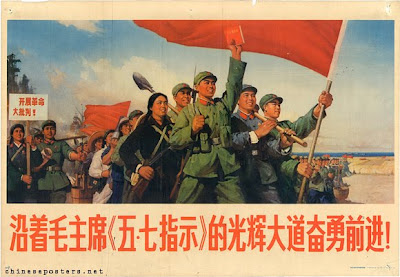

(Above: Advance courageously along the great and glorious road of Chairman Mao's '7 May Directive' )


Li Minyi: Notes on "May 7 cadre schools".

43 years ago today, Chairman Mao issued the “May 7th Directive"; 34 years ago --- that is, from April till September of 1975, I spent a few months as a “May 7 soldier” at the May 7 Cadre School of the General Staff Communication Department at Xuchang in Henan.

As far as entering the "May 7 cadre school" is concerned, because times then were different, and people’s situations were different, then each person's experiences were naturally not the same. For example, some people thought it was the “cowshed” where “cow demons and snake spirits” were locked up, and that they were no different to labor camps and prison sentences; some others thought that it was a labor-training school, conducive to the improvement of individual ideological consciousness and have always cherished the memory of that part of their life experience. There may people who had other experiences as well, but you can say for sure that I would like to belong to the latter group.

On the occasion of the 43rd anniversary of the issuing by Chairman Mao of the May 7th directive, with individuals remembering their experiences of May 7 cadre schools, and in so far as mine is a commemoration, and in so far as there are people who do not have experience or an understanding of that history, then we should not lose sight of such a beneficial resource.

Early cadre

In 1975 at the age of 29, I was a publicity officer in the first communications station of the General Staff of the Ministry of Communications in Beijing. In April, my work unit decided that I should go with four other people to a "May 7 cadre school." They were: deputy political commissar of the troops Wang Furang, in his fifties; Ding Wensheng, chief of security in his early 40s; the public health logistics section chief and a 30 year old assistant from the logistics department (I can’t remember the last two people’s names).

Although I don’t clearly remember the date, we took a train and got off at Xuchang in Henan province. A car sent by the cadres came to meet us and took us to our residence about 20 km outside the town. After arriving, we were quickly put into teams that had been arranged in advance by the school personnel. The head of the team was a 50 year-old cadre school cadre named Lu. He was the assistant to the head of the residential district. We and five comrades from the engineering headquarters (hereafter called EH) were put in one class and the section chief became class leader with young Assistant Wang from the EH as deputy class leader. Little Wang and I shared a room with two others from the EH. One of the latter was an acquaintance of mine, Liu Dingcai. During our time at Fudan University he was in the journalism department, and because one of my small group of classmates, Liu Guangsheng, was in his unit I knew him and remembered his name. Dingcai was younger than me by four or five years and was promoted to a cadre after graduation, and became the secretary charged with propaganda work in EH after he went to the cadre school. There was also someone called Liu Daozhu who was two or three years older than me who was a staff officer at EH. Our dormitory was on the second row of the Southern building and nearby, if you went east across Getiao Street, there was a big fish breeding pond.

The "May 7 cadre schools" was a division-level unit of the General Staff under the Ministry of Communications. Principal Liu Mingsheng, who lived a plain life and was approachable, was an old Red Army man. The cadre school was located about 20 kilometers south of Xuchang, surrounded by flat terrain. Less than a kilometer south of our dormitory was a river more than 10 meters wide flowing from east to west, although when the depth was around one meter or so, it did not flow. According to legend, it was the Yunliang River excavated by Cao Cao during the Three Kingdoms period. The deputy team leader would take us to catch fish by hand along this river. Once or twice each year, using this method, he would catch fish.

The actual procedure is to block up the two sides of the opening under the bridge, drain away the water inside, and you would be able to catch several dozen jin (one jin is equal to 0.5 kilos) of fish, mostly carp, and sticky fish. Bathing in the river I caught a small soft-shelled turtle, weighing about two to three liang (there are ten liang per jin so each liang is 50 grams). It was brought back to Beijing by Deputy Political Commissar Wang, and placed in his fish tank at home where I have seen it.


The whole "May 7 cadre school" had over 2,800 mu of land (one mu is equal to 0.165 acres). The main crops are wheat and rapeseed. After arriving at the school, we divided our time roughly equally between studying military administration and doing productive labour. Whilst at the cadre school, we also arranged to spend a week visiting the Red Flag Canal in Linxian (Lin County), and had two weeks in nearby rural areas, implementing the "three togethers", ie living, eating and working with the people. However, I just do not remember the name of that village.


(Above: "The university moves to our village")


Learn to farm

During our time at the "May 7 cadre school," the main types of farm work our class engaged in were: digging fish ponds, harvesting rapeseed harvesting and sun-drying the wheat, opening up wasteland to grow vegetables, construction of walls for a table-tennis room, making sun-dried bricks etc.


Because there was a relatively high degree of mechanization at the cadre school, harvesting of wheat was by machine, and there was a tractor ploughing team of around ten people. That combine harvester was an energetic fellow, reaping on one side and threshing on the other, and not long after the wheat could be transported to the site for airing and drying. We only had to cut the left-over wheat, and there was not much labor intensity involved. Building mud walls and making mud bricks were duties that only our class had to undertake. Because did it so well the first time, afterwards whenever there was this type of work, it was always done by my class. It is worth mentioning that the squad leader Lao Ding, was an expert, a genius. With a hand-held sickle, he looked like an old farmer; when he picked up the trowel, he looked like a qualified mason. He led the class in having a beautiful life, and the team cadres and the students all praised him with one voice.


All of our spare time was used up planting vegetables. Around the edges of the place where we were stationed and along the sides of several fish ponds, there was a weedy area which we dug deeply and turned into a vegetable plot. The teams and groups all competed, and after doing their best to dig out the vegetable plot, planted eggplant, hot peppers, kidney beans, pumpkin squash, and then harvested the vegetables and delivered them to the canteen, had said that registration of a certain time in the team announced the results will always be outstanding praise and encouragement.


Having said that, there is a small episode I’d like to raise. Section Chief Zhang from our class, later on divided up our group to help work in the kitchen. When he was opening up wasteland to grow vegetables, he and several companions from the canteen planted watermelon at the side of a fish pond, and they grew fairly well, and in particular, after they formed into small melons, growing quickly, a new one each day, he and his companions went there each day to enjoy some. Sooner or later some were harvested, but we had not heard of them being turned over to the canteen, and they had all been privately taken care of. However, a few of the mischievous boys in our dormitory had helped eliminate the first relatively big watermelon.


That was one night around ten or eleven o'clock, when a few in our dormitory had not fallen asleep; I do not remember exactly whose ingenious idea it was to pick a ripe watermelon and take it away, but others respond immediately. So we used the dormitory near the edges of the ponds and dressed in shorts and singlets, and quietly reached the watermelon ground, took the melon off, then holding it tightly in our arms, carried it to the table tennis room, and quickly completed our mission. To confuse the masters of melon, they then selected a large melon skin and put it back where the melon had been, camouflaging it with some melon leaves.


This method was really effective, and it wasn’t until 3 or 4 days later that we heard Old Zhao and others arguing about who ate his watermelon, causing a few of us in our dormitory to smile for quite a while! After I’d been back in Beijing, I once ran into Section Chief Zhang, and recalling the matter I asked him: "Section Chief, did you ever find out who ate that watermelon?" He said: "It wasn’t those guys from the mess squad! " It was only then that I told this upright elder brother the truth.


(Above: "Take the road of the May 7 Cadre Schools and persevere in continuing the revolution")


The officers and men are equal


If you were to ask me what was the most prominent feature of life in a "May 7 cadre school", it would be the equality between officers and men, that all were of equal standing. It should be said that this "May 7th road" had a powerful impact on the traditional hierarchy and on the consciousness of “being an officer".


On the first day of the cadre school, it was announced in the team that in order to get rid of bourgeois right, all those who had come here were “May 7th soldiers” taking the "May 7th Road", and that all were students, regardless of the level of their original positions in the army, and all were to be addressed as Old Wang or Old Li and that we were no longer to call them by their previous post and rank.


The whole team had three levels of leadership cadres, they are the Minister of the Ministry of Communications Shi Fuyin, the first deputy political commissar of the Ministry of Communications, Wang Furang and the second assistant director Wang, (I remember that he had been appointed as the head of the cadre school during this period). There were also many people who belonged to the Section Chief under the Head of Department.


The quality of these leading comrades was very high, and they could all place strict demands on themselves, could transform themselves into ordinary soldiers. They were older than us and had higher positions than us, but did not put on the airs of an officer while at the cadre school. They ate and boarded with us and shared our entertainment, and did the same farm work as us, so that they could indeed draw closer to us young people and share our intimate feelings. This kind of life makes us feel warm, free and casual, but also enabled us to learn many good ideas and many good traditions alongside the older comrades.


Take our deputy political commissar Wang Furang, in the army that’s a division-level head, and as we were usually on familiar terms, how could we not just call him Old Wang! In the cadre school it could happen that his former subordinate Section Chief Ding became his class leader and often assigned Lao Wang his tasks; young people from outside work units shouted at him, telling him to do this or that. This person, Lao Wang, was really easy-going, and he got along very well in his relationship with young people, and had lots of special stories in his head. Many times, when resting from work, they were all listening to him telling stories. Many people know that Wu Dalang (“Big” Wang) went to Japan to be king, and that to avoid the taboo on the use of the personal name of the king, the Japanese have stories about “Little” Lang, “One”Lang, “Supreme” Lang, but the first time that some of us had heard of this was from Lao Wang. My classmate Liu Dingcai later went on a work trip to Beijing from outside and made a special point of calling on Lao Wang from all those years ago.


Checking the harvest


It needs to be said that there were lots of things to point out in the cadre school’s harvest. For example, by undergoing the cadre school life, the mutual understanding of the various subordinate units was enhanced and the relations between them were neighbourly and friendly; at the cadre school we were all able to eat, sleep, build up our physique, learn to do farm work, in order to reap tens of millions of pounds of food out of the effort , sprinkled with sweat; In addition to the classroom arrangements for military and political education, we also went out of the barracks to visit and study, to broaden our field of vision, to experience and understand the hard life of the masses of peasants in Henan. This is not specifically described here, and there are only two things that left a deep impression to tell you about.


First, being involved in an emergency when on a study trip to Lin County.


According to the team's arrangements, the entire unit of one hundred people went out from the cadre school, visiting 27 commemorative monuments in Zhengzhou, Henan, and visited the Red Flag Canal in Lin County. When visiting Lin County, we ran into a rainstorm, and it is said that the area of Xuchang, Luohe, and Zhumadian in the space of 24 hours had 300 millimeters of rainfall. The rainstorm led to a flood disaster, and many farmland paths were washed away. On that day in the boarding house, we heard that several members of a certain village in the county had gone out to do farm work, but because the flood had washed out their bridge, they were caught stranded on a sandbar, and that they had already been without food and water for one day and night, and needed to be rescued. As an army made up of the sons of the people, how could we sit by and do nothing when the people faced difficulties! The leader of the cadre school political department (political work section?) Director Liu, (who afterwards moved to the Communications Command Academy in Wuhan as a teacher in the Marxist-Leninist Teaching and Research Institute where his office was alongside mine) after discussions with the team’s cadres, asked the county leaders for a combat assignment, and after authorization, formed an emergency squad of more than 20 young people who could swim, and they immediately rushed to the rescue site.


Dingcai and I were both honoured to be approved to participate in the operation. I remember that it was in the afternoon, and that we first went in a big car, but that as the distance was not far and because the asphalt had been washed away up ahead we had to get out and go off on foot. On the way to our destination, we stopped at a riverside where we could see the bridge that was destroyed, and we could also see across where the river was divided to where there were two members of the trapped. We needed to cross the first river, but although it was only 10 meters wide, the depth was unpredictable, and there was a large willow tree that had been swept into the river. The first person to jump into the water, surnamed Wang, (unfortunately I cannot remember his given name) had a rope tied at the waist and took the lead. He gave the rope a pull and a few others jumped into the water, and advanced to the bank of the second river to where the people were trapped. From the waves on the water it could be seen that the river was not deep, but the current were very turbulent and the water was also very wide, about forty to fifty meters across. In coordination with the people trapped on the other side a small stone was tied to the rope which was then thrown and the rope pulled tight. Our side of the river we tried to raise the rope high, to try and help Xiao Wang get back across the river but this was without success, and Xiao Wang swallowed a lot of water. It was very dangerous. As we were anxiously thinking of other ways, the local People's Liberation Army arrived with a rubber dinghy, which they successfully used to reach the stranded people.


The stranded people were not rescued by us, but the county highly appraised us and subsequently gave a banquet to express their gratitude to all of us. The banquet was in the main hall of the country guest house, and there was a huge variety of dishes on the table and wine glasses, as well as a variety of fruits, such a rich feast as I have never again experienced. After returning to the cadre school, Xiao Wang was awarded a merit citation Third Class for his bravery in leading the attempt to save the people.


Second, the recreational activities in which we participated during our time at the cadre school.


I would have to say that as regards cultural and sports activities, there was mainly sports. There was only one thing that could be regarded as “literary” and that was one night after there had been a forecast of rain, and the class worked more than an hour overtime to carry tens of thousands of pounds of wheat in storage bag into a warehouse before the rain came. The next day I wrote a report on it which was broadcast by the school radio station.


In quite a few sports there were those who were considered to be activists. In addition to the chess and poker competitions organized by the team, there were those who had played a lot of basketball.


The poker competition was played in ascending grades, and with my partner Liu Taozhu we progressed through several competitions in the class, district and whole unit and finally became the champions. Although the prize was only the pack of cards used in the competition, it caused us both to become targets of public criticism. After the competition, not only did many people in neighbouring dormitories want to play cards with us, but so did both Minister Shi and Director Wang of the Ministry of Communications, who lived in the row in front of us, and although I didn’t know whether they were not convinced that we were champions, or whether they were considering finding an ace to compete with us, but in any case we were invited there many times for a trial of strength.


Basketball was the most frequent activity for a few months. Besides spontaneously organized competitions within the team and between teams, there was a round robin competition organized for the whole school. Liu Dingcai and I both became enthusiasts and took part in the blue team. Our team didn’t mess around, but had standards. The team leader and captain were both 46 or 47 year-old old comrades. Every time before a game, we would have meetings to study strategy and tactics; after the match we would also sit down for serious analysis and lessons learned. So we improved with each game. During the games, individuals could stay on the court the whole time, and although I was playing guard, because the captain also played guard, he asked me to be a flexible guard and encouraged me to take the opportunity to shoot, so each game I also had a score. Hearing the commentary of the comrades in the propaganda team over loudspeakers giving recognition of our attack and defence was a a proud feeling to have. On one occasion, in a match against the tractor ploughing team, their forward and I hit our heads against each other. Above his eye was a two centimeter long gash which required 78 stitches; I had a centimeter long and half a centimeter deep gash as well. That lad was a couple of years younger than I, modest and shy, and we both laughed as we collided and later maintained a good relationship.


After the round robin had been played and a whole school team created, only me and a big man surnamed Liang from our team were selected. Unfortunately, they just announced the team, but were unable afterwards to organize training and competition with other units. Nevertheless, this incident also inspired me as when all is said and done, it affirmed my participation as an individual. The experience of playing basketball in the cadre school it can be said was the most uplifting feeling I ever had in a lifetime of playing basketball.


Attachment: Chairman Mao’s May 7 instructions of 1966


Notes On The Report Of Further Improving The Army’s Agricultural
Work By The Rear Service Department Of The Military Commission
May 7, 1966
[SOURCE: Long Live Mao Zedong Thought, a Red Guard Publication.]

Dear Comrade Lin Biao,
I have received the report from the Rear Service Department which you sent me on 6 May. I think it is an excellent plan. Is it possible to send this report to all the military districts and ask them to hold discussions of it among the cadres at the army and division levels? Their views should be reported to the Military Commission and through it to the Centre for approval. After that, suitable directives should be issued to them. Please consider this suggestion.


In the absence of a world war, our army should be a big school. Even under conditions of the third world war, it can still serve as a big school. In addition to fighting the war, it must do other work. In the eight years of the second world war, did we not do just that in the anti-Japanese base areas? In this big school, the army should learn politics, military affairs, and culture, and engage in agricultural production. It can build up its own middle- and small-size workshops to produce goods for its own use and the exchange of other goods of equal value. It can take part in mass work, factory work, and rural socialist education. After socialist education, there are always other kinds of mass work for it to do, to unite the army and people as one. The army should also participate in the revolutionary struggle against capitalist culture. In this way, it carries out military-educational, military-agricultural, military-industrial, and military-civilian work. Naturally, these kinds of work should be properly co-ordinated and a distinction should be made between major and subsidiary work. A unit can select one or two from the agricultural, industrial, and civilian combination, but not all three. In this way, the tremendous power of several million soldiers will be felt.


Likewise, workers should, in addition to their main industrial work, learn military affairs, politics, and culture, and take part in the socialist educational movement and in criticizing the capitalist class. Under adequate conditions, they should also engage in agricultural production, following the example of the Daqing Oilfield.


The communes do their main agricultural work (including forestry, fishing, animal husbandry, and subsidiary trades), but they must also learn military affairs, politics, and culture. When circumstances allow, they should collectively set up small-scale factories and take part in criticizing the capitalist class.


The students are in a similar position. Their studies are their chief work; they must also learn other things. In other words, they ought to learn industrial, agricultural, and military work in addition to class work. The school years should be shortened, education should be revolutionized, and the domination of our schools by bourgeois intellectuals should by no means be allowed to continue.


Under favourable conditions, people in commerce, service trades, and party and government offices should do likewise.


What has been said above is neither new nor original. Many people have been doing this for some time, but it has not yet become a widespread phenomenon. Our army has been working in this way for decades. Now it is on the threshold of new developments.