Monday, October 31, 2011

Nationalise Qantas Now!

Just days after receiving a 71% pay rise of around $2m, Qantas CEO Alan Joyce, without warning, grounded the entire Qantas air fleet in an employee and customer lockout.

His tactic was to create a crisis which threatened the Australian economy thereby requiring the intervention of the Australian Government which convened a compulsory conference of Fair Work Australia, the national workplace relations tribunal.

In a marathon sitting, FWA rejected the option of a 21 day suspension of industrial action and took the harsher decision, supported by the Gillard Government, to terminate the disputes between Qantas and three unions.

The FWA decision underscores the lack of industrial and workplace rights enjoyed by Australians. It grants limited rights to “protected” industrial action, but only during and related directly to a bargaining period. And as Qantas workers now know, even those limited “protected” rights can be taken away at the whim of FWA.


Joyce is the front man for Qantas and the Qantas Board’s decision to up his pay to $5.1m per year was quite rightly taken as an affront by working class Aussies. Imagine earning $50,000 per year – quite a good wage, and many are below it – and then doing your sums and working out that it would take a full 40 years of slaving your guts out to amass what Joyce has been handed as an annual pay increase! That’s close enough to an entire lifetime of work. To earn the equivalent of Joyce’s total annual salary, that same worker on $50,000 would have to start working the day he/she was born, and not stop for 100 years!

We’ll come back to this disparity a little later.

Qantas: A private company loyal only to profit

Qantas badges itself as the ultimate Aussie icon. It boasts the flying kangaroo symbol, the Spirit of Australia slogan, and the I Still Call Australia Home theme song.

In 1993 the then government-owned flagship carrier was privatised by the neo-liberal wolf-in-sheep’s-clothing, Labor Prime Minister Paul Keating.

Foreign investors were allowed to own up to 49% of the ASX-listed company and today control about 38% of its shares.

The top four shareholders are giant multinational investment corporations (JP Morgan Nominees Australia, HSBC Custody Nominees Australasia Limited, National Nominees Pty Limited, Citicorp Nominees Pty Ltd) through whom most foreign equity in Qantas is channelled. These four big institutional investors control 71.06% of Qantas shares. The top twenty shareholders (0.014% of total shareholders) control 80.36% of the shares.


At the other end of the scale are the “mom and dad” shareholders who protested at last week’s AGM about Joyce’s management tactics and the failure of the company to provide dividends over the past two years.

The smallest shareholders – owning up to 1,000 shares each – number 51,449, or 38% of all shareholders. This 38% owns a mere 1.03% of Qantas shares. In the next category, there are 63,734 people owning between 1001 and 5000 shares. They constitute 48% of shareholders but only own 7.03% of shares. These two categories of small shareholders constitute 86% of all shareholders but only control 8.06% of the stock.

This is the reality of so-called “people’s capitalism”. The vast majority of shareholders can be totally opposed to Joyce’s tactics and the financial rewards which come his way but their will is frustrated and blocked by the tiny handful of big institutional investors who align themselves with foreign capital and its plans to bust Australian unions and relocate the company offshore.

The Qantas Board: hand-picked for the class struggle

It would be wrong to concentrate on Alan Joyce alone. He can be sacrificed if he remains on the nose. It is the composition of the Qantas Board that shows how its personnel have been selected with an eye to waging a vicious class struggle against its employees and against what might be loosely described as the Australian national interest.

The full list of the eleven Board members and their other directorships and interlocking corporate and social interests can be found here: (http://www.qantas.com.au/travel/airlines/board-of-directors/global/en )

First there is Qantas Chairman Leigh Clifford who was first appointed to the Board in 2007. He had been with mining giant Rio Tinto for 37 years. The multinational giant waged industrial and political war against the mining unions in Western Australia's Pilbara region and then attacked the coal unions in the Hunter Valley. One of its tactics, under Clifford who personally broke union picket lines, was to impose a lockout and threat to sack 430 striking miners.

No wonder an October 31 report in the Murdoch rag, the misnamed “Australian” states: “Qantas's lockout looks to have come straight from the playbook of accomplished union-buster Rio Tinto, where Qantas chairman Leigh Clifford spent his executive career.”


Another former Rio Tinto Director is Richard Goodmanson, born in Australia but with dual Australian and US citizenship. Goodmanson was President and CEO of America West Airlines, a budget carrier, from 1996 until April 1999. During his tenure at America West, the airline achieved the highest rate of growth of any hub-and-spoke major carrier in North America, but at a cost to employees and to maintenance standards.


Operational problems reared their ugly head throughout the summer of 1998. Mechanical problems increased, unfavourable press ensued, and employee stress reached a breaking point. Union issues were becoming more and more common, for the flight attendant contract was still open. Mechanics elected the Teamsters as their representative, and were negotiating their first contract. Dispatchers had just concluded their first contract on April 13.


A well-publicized FAA fine was imposed on the airline in June. The record $5 million fine was imposed over maintenance issues, primarily oversight and changes in recommended procedures. America West admitted no wrongdoing, and half the fine was forgiven after a restructuring of the maintenance oversight procedures. Eventually, this would lead to yet another change in heavy maintenance contractors.


In March 1999, struggle broke out between America West Airlines management and its 2,400 flight attendants. The latter were arguing for the suspension of a pay freeze instituted along with a 10% pay cut in 1995 when the carrier was battling to emerge from Chapter 11 bankruptcy. According to the Knight Ridder newsagency the ultimate threat “is that the company will simply shut down”.

“Such a move -- described in a Feb. 12 memo to all employees from President and CEO Richard R. Goodmanson -- would idle 12,000 workers, ground 300 daily flights and could occur as early as Friday. It also could cost the airline $5.5 million a day in lost revenue.”


“If an employment contract isn't reached between the airline and the flight attendants by 10 p.m. Friday, the workers have threatened a series of random, last-minute strikes designed to create chaos for the airline …”


A last minute agreement between the carrier and its cabin crew did indeed “avert chaos”.


Goodmanson has had to wait until October 2011 to enjoy a good old-fashioned lockout.


Then there is Garry Hounsell, appointed to the Board in 2005. Hounsell provides a direct link to legal firm Freehills of which he is also a Board Member. Freehills are leading activists in the class struggle and were the advisors to Patrick Stevedores during its 1998 campaign to bust the Maritime Union of Australia. In April of that year, Patricks sacked its workforce and imposed a lockout enforced by balaclava-wearing thugs, dogs and coppers. Freehills has a long history of developing campaigns for some of the worst employers in Australia. It is an enemy of the working class of Australia.


Dr John Schubert is a former President of the Business Council of Australia and provides a link between that organisation and the Qantas Board. It is through such links that the ruling class constantly discusses its tactics in the war on working Australians. The BCA represents the core of the mainly multinational corporations that generate the most extreme reaction against the rights and liberties of Australian people. Schubert is also a Director of foreign multinational BHP Billiton.


Other Board members include a former Senior Ministerial Adviser to the architect of Qantas privatisation, Paul Keating, as well as persons with interlocking directorships with banking, construction, transport, finance, mining, retail….

The Qantas Board is a war cabinet of the most reactionary, best organised and openly aggressive sections of the ruling class.


Executive salaries: the great divide

The outrage over Alan Joyce’s 71% pay rise is an indication of the mood of the people. From Tahrir Square to Wisconsin, from London is Burning to Occupy Wall Street, there is a growing anger about the obscene levels of private wealth and the insecurity and uncertainty of life for those at the bottom.

The following graphs are based on US data but are indicative of international trends:


The first shows that corporate profits are at an all-time high. This is despite the economic crisis of 2007-08 and represents a half-century high point not seen since the economic boost of the Korean War. Precarious employment is on the rise, entire nations are being rescued from bankruptcy at the expense of their people’s living standards, but corporate profits are safe!


The second shows that whilst the CEOs, the board members and the giant institutional shareholders are wallowing in wealth, the working class that creates that wealth is getting a smaller and smaller share of the growth. The rapidly-falling blue line is wages’ share of the economy. Every picture tells a story!


The third shows that CEO salaries, once a mere 50 times that of the average worker’s salary, are now 350 times as much. Economically and socially, these parasites live on a very different planet to the rest of us!


The last one shows the terrible reality of the last 15 years as CEO salaries and corporate profits have sky-rocketed, whilst production workers’ wages have remained more or less static, and the US Federal minimum wage has actually gone backwards.


Occupy Wall Street indeed!

Nationalise Qantas!

The disgraceful performance of the social democrats in privatising Qantas (Keating) and using Fair Work Australia to take away workers’ rights to industrial action (Gillard) can only be righted by renationalising the company.

For most practical purposes, the only way into and out of Australia is by air. The interests of our people require a national carrier, owned and operated by the Government. If it needs to be subsidised to provide a safe and reliable service, then so be it, although there is no evidence that such a government carrier would necessarily run at a loss. Management must include the unions representing all categories of employees.

If anything is to be sent offshore, let it be Alan Joyce and his reactionary Board.

Nationalise Qantas and empower the workers!


Thursday, October 13, 2011

Zhengzhou residents support "Occupy Wall Street"

All around the world people are being inspired by the US people's courageous campaign to Occupy Wall Street. In the belly of the beast, US citizens are saying that they have had enough of finance capital's exploitation and of its free ride on the backs of people everywhere.

The people of China have experienced a world free of imperialist finance capital but are now faced with the growth of privatisation and of capitalism. Occupy Wall Street has provided a unique opportunity for them to both express solidarity with the US mass movement, and to restate their support for socialism over capitalism.

I have translated the following report from a Chinese website. It is an action taken in the heroic proletarian city of Zhengzhou, home to the monument to the February 7, 1923 railway strike.


(Above: Main banner at the Zhengzhou rally reads "Firmly support the US people's great "Wall Street Revolution".)


The Chinese people support the Wall Street Revolution

On the afternoon of October 6, several hundred Zhengzhou residents gathered at the Zhengzhou City Provincial Workers’ Cultural Palace to support the recent mass movement to “Occupy Wall Street”.

Everyone had made a rational analysis, observing this fiery eruption in the back yard of the United States. A cadre from a state-owned enterprise said that the United States does evil everywhere in the world: whoever it wants to hit, it does; it interferes in the internal affairs of other countries; it subverts the political power of other countries; it brandishes the big stick of freedom and democracy with which to beat other people – and now it is its own turn and its true colours have been exposed.


(Above: working people donning armbands supporting Occupy Wall Street.)

A young man then took over from him and said that capitalism had already set off on a dead end road, and the people of the capitalist countries have started to awaken; a middle-aged man from Shandong working in Zhengzhou said that socialism must not only save China, it must also save the world.


The crowd then loudly shouted: “Long live the socialist system of public ownership! The private ownership system of capitalism will not last!”

Although Chairman Mao is no longer with us, the internationalism he taught us lives on!

Monday, October 10, 2011

Notes on May 7 Cadre Schools

(Above: "Going to live and work in a productionteam and settle in the countryside to wage revolution".)

In 1974 I went to a May 7 Cadre School outside Beijing, saw high school students waiting at train stations to go "up into the hills and down to the countryside" to learn from the peasants about the conditions that had produced the momentous Chinese revolution. In Nanjing I spoke to a student, in his school, about going out to the country - he had been and had put in a request to go again. On the Shanghai wharves, I saw two young female doctors driving cranes - doing their required rotation of manual labour so that they would understand the conditons of the workers they might have to treat.

All of these socialist initiatives were wound down after Mao's death. Under Deng Xiaoping, intellectuals ("cadres") were allowed to complain about such "demeaning" practices and a whole market for whinging about the Cultural Revolution opened up in the West.

The author of this piece, which I have translated from Chinese, looks back fondly on his time in a May 7 Cadre School. Mao Zedong's instructions to Lin Biao about the creation of cadre schools is attached at the end for reference.
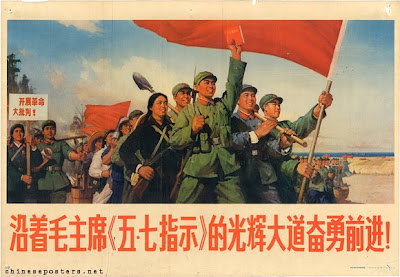

(Above: Advance courageously along the great and glorious road of Chairman Mao's '7 May Directive' )


Li Minyi: Notes on "May 7 cadre schools".

43 years ago today, Chairman Mao issued the “May 7th Directive"; 34 years ago --- that is, from April till September of 1975, I spent a few months as a “May 7 soldier” at the May 7 Cadre School of the General Staff Communication Department at Xuchang in Henan.

As far as entering the "May 7 cadre school" is concerned, because times then were different, and people’s situations were different, then each person's experiences were naturally not the same. For example, some people thought it was the “cowshed” where “cow demons and snake spirits” were locked up, and that they were no different to labor camps and prison sentences; some others thought that it was a labor-training school, conducive to the improvement of individual ideological consciousness and have always cherished the memory of that part of their life experience. There may people who had other experiences as well, but you can say for sure that I would like to belong to the latter group.

On the occasion of the 43rd anniversary of the issuing by Chairman Mao of the May 7th directive, with individuals remembering their experiences of May 7 cadre schools, and in so far as mine is a commemoration, and in so far as there are people who do not have experience or an understanding of that history, then we should not lose sight of such a beneficial resource.

Early cadre

In 1975 at the age of 29, I was a publicity officer in the first communications station of the General Staff of the Ministry of Communications in Beijing. In April, my work unit decided that I should go with four other people to a "May 7 cadre school." They were: deputy political commissar of the troops Wang Furang, in his fifties; Ding Wensheng, chief of security in his early 40s; the public health logistics section chief and a 30 year old assistant from the logistics department (I can’t remember the last two people’s names).

Although I don’t clearly remember the date, we took a train and got off at Xuchang in Henan province. A car sent by the cadres came to meet us and took us to our residence about 20 km outside the town. After arriving, we were quickly put into teams that had been arranged in advance by the school personnel. The head of the team was a 50 year-old cadre school cadre named Lu. He was the assistant to the head of the residential district. We and five comrades from the engineering headquarters (hereafter called EH) were put in one class and the section chief became class leader with young Assistant Wang from the EH as deputy class leader. Little Wang and I shared a room with two others from the EH. One of the latter was an acquaintance of mine, Liu Dingcai. During our time at Fudan University he was in the journalism department, and because one of my small group of classmates, Liu Guangsheng, was in his unit I knew him and remembered his name. Dingcai was younger than me by four or five years and was promoted to a cadre after graduation, and became the secretary charged with propaganda work in EH after he went to the cadre school. There was also someone called Liu Daozhu who was two or three years older than me who was a staff officer at EH. Our dormitory was on the second row of the Southern building and nearby, if you went east across Getiao Street, there was a big fish breeding pond.

The "May 7 cadre schools" was a division-level unit of the General Staff under the Ministry of Communications. Principal Liu Mingsheng, who lived a plain life and was approachable, was an old Red Army man. The cadre school was located about 20 kilometers south of Xuchang, surrounded by flat terrain. Less than a kilometer south of our dormitory was a river more than 10 meters wide flowing from east to west, although when the depth was around one meter or so, it did not flow. According to legend, it was the Yunliang River excavated by Cao Cao during the Three Kingdoms period. The deputy team leader would take us to catch fish by hand along this river. Once or twice each year, using this method, he would catch fish.

The actual procedure is to block up the two sides of the opening under the bridge, drain away the water inside, and you would be able to catch several dozen jin (one jin is equal to 0.5 kilos) of fish, mostly carp, and sticky fish. Bathing in the river I caught a small soft-shelled turtle, weighing about two to three liang (there are ten liang per jin so each liang is 50 grams). It was brought back to Beijing by Deputy Political Commissar Wang, and placed in his fish tank at home where I have seen it.


The whole "May 7 cadre school" had over 2,800 mu of land (one mu is equal to 0.165 acres). The main crops are wheat and rapeseed. After arriving at the school, we divided our time roughly equally between studying military administration and doing productive labour. Whilst at the cadre school, we also arranged to spend a week visiting the Red Flag Canal in Linxian (Lin County), and had two weeks in nearby rural areas, implementing the "three togethers", ie living, eating and working with the people. However, I just do not remember the name of that village.


(Above: "The university moves to our village")


Learn to farm

During our time at the "May 7 cadre school," the main types of farm work our class engaged in were: digging fish ponds, harvesting rapeseed harvesting and sun-drying the wheat, opening up wasteland to grow vegetables, construction of walls for a table-tennis room, making sun-dried bricks etc.


Because there was a relatively high degree of mechanization at the cadre school, harvesting of wheat was by machine, and there was a tractor ploughing team of around ten people. That combine harvester was an energetic fellow, reaping on one side and threshing on the other, and not long after the wheat could be transported to the site for airing and drying. We only had to cut the left-over wheat, and there was not much labor intensity involved. Building mud walls and making mud bricks were duties that only our class had to undertake. Because did it so well the first time, afterwards whenever there was this type of work, it was always done by my class. It is worth mentioning that the squad leader Lao Ding, was an expert, a genius. With a hand-held sickle, he looked like an old farmer; when he picked up the trowel, he looked like a qualified mason. He led the class in having a beautiful life, and the team cadres and the students all praised him with one voice.


All of our spare time was used up planting vegetables. Around the edges of the place where we were stationed and along the sides of several fish ponds, there was a weedy area which we dug deeply and turned into a vegetable plot. The teams and groups all competed, and after doing their best to dig out the vegetable plot, planted eggplant, hot peppers, kidney beans, pumpkin squash, and then harvested the vegetables and delivered them to the canteen, had said that registration of a certain time in the team announced the results will always be outstanding praise and encouragement.


Having said that, there is a small episode I’d like to raise. Section Chief Zhang from our class, later on divided up our group to help work in the kitchen. When he was opening up wasteland to grow vegetables, he and several companions from the canteen planted watermelon at the side of a fish pond, and they grew fairly well, and in particular, after they formed into small melons, growing quickly, a new one each day, he and his companions went there each day to enjoy some. Sooner or later some were harvested, but we had not heard of them being turned over to the canteen, and they had all been privately taken care of. However, a few of the mischievous boys in our dormitory had helped eliminate the first relatively big watermelon.


That was one night around ten or eleven o'clock, when a few in our dormitory had not fallen asleep; I do not remember exactly whose ingenious idea it was to pick a ripe watermelon and take it away, but others respond immediately. So we used the dormitory near the edges of the ponds and dressed in shorts and singlets, and quietly reached the watermelon ground, took the melon off, then holding it tightly in our arms, carried it to the table tennis room, and quickly completed our mission. To confuse the masters of melon, they then selected a large melon skin and put it back where the melon had been, camouflaging it with some melon leaves.


This method was really effective, and it wasn’t until 3 or 4 days later that we heard Old Zhao and others arguing about who ate his watermelon, causing a few of us in our dormitory to smile for quite a while! After I’d been back in Beijing, I once ran into Section Chief Zhang, and recalling the matter I asked him: "Section Chief, did you ever find out who ate that watermelon?" He said: "It wasn’t those guys from the mess squad! " It was only then that I told this upright elder brother the truth.


(Above: "Take the road of the May 7 Cadre Schools and persevere in continuing the revolution")


The officers and men are equal


If you were to ask me what was the most prominent feature of life in a "May 7 cadre school", it would be the equality between officers and men, that all were of equal standing. It should be said that this "May 7th road" had a powerful impact on the traditional hierarchy and on the consciousness of “being an officer".


On the first day of the cadre school, it was announced in the team that in order to get rid of bourgeois right, all those who had come here were “May 7th soldiers” taking the "May 7th Road", and that all were students, regardless of the level of their original positions in the army, and all were to be addressed as Old Wang or Old Li and that we were no longer to call them by their previous post and rank.


The whole team had three levels of leadership cadres, they are the Minister of the Ministry of Communications Shi Fuyin, the first deputy political commissar of the Ministry of Communications, Wang Furang and the second assistant director Wang, (I remember that he had been appointed as the head of the cadre school during this period). There were also many people who belonged to the Section Chief under the Head of Department.


The quality of these leading comrades was very high, and they could all place strict demands on themselves, could transform themselves into ordinary soldiers. They were older than us and had higher positions than us, but did not put on the airs of an officer while at the cadre school. They ate and boarded with us and shared our entertainment, and did the same farm work as us, so that they could indeed draw closer to us young people and share our intimate feelings. This kind of life makes us feel warm, free and casual, but also enabled us to learn many good ideas and many good traditions alongside the older comrades.


Take our deputy political commissar Wang Furang, in the army that’s a division-level head, and as we were usually on familiar terms, how could we not just call him Old Wang! In the cadre school it could happen that his former subordinate Section Chief Ding became his class leader and often assigned Lao Wang his tasks; young people from outside work units shouted at him, telling him to do this or that. This person, Lao Wang, was really easy-going, and he got along very well in his relationship with young people, and had lots of special stories in his head. Many times, when resting from work, they were all listening to him telling stories. Many people know that Wu Dalang (“Big” Wang) went to Japan to be king, and that to avoid the taboo on the use of the personal name of the king, the Japanese have stories about “Little” Lang, “One”Lang, “Supreme” Lang, but the first time that some of us had heard of this was from Lao Wang. My classmate Liu Dingcai later went on a work trip to Beijing from outside and made a special point of calling on Lao Wang from all those years ago.


Checking the harvest


It needs to be said that there were lots of things to point out in the cadre school’s harvest. For example, by undergoing the cadre school life, the mutual understanding of the various subordinate units was enhanced and the relations between them were neighbourly and friendly; at the cadre school we were all able to eat, sleep, build up our physique, learn to do farm work, in order to reap tens of millions of pounds of food out of the effort , sprinkled with sweat; In addition to the classroom arrangements for military and political education, we also went out of the barracks to visit and study, to broaden our field of vision, to experience and understand the hard life of the masses of peasants in Henan. This is not specifically described here, and there are only two things that left a deep impression to tell you about.


First, being involved in an emergency when on a study trip to Lin County.


According to the team's arrangements, the entire unit of one hundred people went out from the cadre school, visiting 27 commemorative monuments in Zhengzhou, Henan, and visited the Red Flag Canal in Lin County. When visiting Lin County, we ran into a rainstorm, and it is said that the area of Xuchang, Luohe, and Zhumadian in the space of 24 hours had 300 millimeters of rainfall. The rainstorm led to a flood disaster, and many farmland paths were washed away. On that day in the boarding house, we heard that several members of a certain village in the county had gone out to do farm work, but because the flood had washed out their bridge, they were caught stranded on a sandbar, and that they had already been without food and water for one day and night, and needed to be rescued. As an army made up of the sons of the people, how could we sit by and do nothing when the people faced difficulties! The leader of the cadre school political department (political work section?) Director Liu, (who afterwards moved to the Communications Command Academy in Wuhan as a teacher in the Marxist-Leninist Teaching and Research Institute where his office was alongside mine) after discussions with the team’s cadres, asked the county leaders for a combat assignment, and after authorization, formed an emergency squad of more than 20 young people who could swim, and they immediately rushed to the rescue site.


Dingcai and I were both honoured to be approved to participate in the operation. I remember that it was in the afternoon, and that we first went in a big car, but that as the distance was not far and because the asphalt had been washed away up ahead we had to get out and go off on foot. On the way to our destination, we stopped at a riverside where we could see the bridge that was destroyed, and we could also see across where the river was divided to where there were two members of the trapped. We needed to cross the first river, but although it was only 10 meters wide, the depth was unpredictable, and there was a large willow tree that had been swept into the river. The first person to jump into the water, surnamed Wang, (unfortunately I cannot remember his given name) had a rope tied at the waist and took the lead. He gave the rope a pull and a few others jumped into the water, and advanced to the bank of the second river to where the people were trapped. From the waves on the water it could be seen that the river was not deep, but the current were very turbulent and the water was also very wide, about forty to fifty meters across. In coordination with the people trapped on the other side a small stone was tied to the rope which was then thrown and the rope pulled tight. Our side of the river we tried to raise the rope high, to try and help Xiao Wang get back across the river but this was without success, and Xiao Wang swallowed a lot of water. It was very dangerous. As we were anxiously thinking of other ways, the local People's Liberation Army arrived with a rubber dinghy, which they successfully used to reach the stranded people.


The stranded people were not rescued by us, but the county highly appraised us and subsequently gave a banquet to express their gratitude to all of us. The banquet was in the main hall of the country guest house, and there was a huge variety of dishes on the table and wine glasses, as well as a variety of fruits, such a rich feast as I have never again experienced. After returning to the cadre school, Xiao Wang was awarded a merit citation Third Class for his bravery in leading the attempt to save the people.


Second, the recreational activities in which we participated during our time at the cadre school.


I would have to say that as regards cultural and sports activities, there was mainly sports. There was only one thing that could be regarded as “literary” and that was one night after there had been a forecast of rain, and the class worked more than an hour overtime to carry tens of thousands of pounds of wheat in storage bag into a warehouse before the rain came. The next day I wrote a report on it which was broadcast by the school radio station.


In quite a few sports there were those who were considered to be activists. In addition to the chess and poker competitions organized by the team, there were those who had played a lot of basketball.


The poker competition was played in ascending grades, and with my partner Liu Taozhu we progressed through several competitions in the class, district and whole unit and finally became the champions. Although the prize was only the pack of cards used in the competition, it caused us both to become targets of public criticism. After the competition, not only did many people in neighbouring dormitories want to play cards with us, but so did both Minister Shi and Director Wang of the Ministry of Communications, who lived in the row in front of us, and although I didn’t know whether they were not convinced that we were champions, or whether they were considering finding an ace to compete with us, but in any case we were invited there many times for a trial of strength.


Basketball was the most frequent activity for a few months. Besides spontaneously organized competitions within the team and between teams, there was a round robin competition organized for the whole school. Liu Dingcai and I both became enthusiasts and took part in the blue team. Our team didn’t mess around, but had standards. The team leader and captain were both 46 or 47 year-old old comrades. Every time before a game, we would have meetings to study strategy and tactics; after the match we would also sit down for serious analysis and lessons learned. So we improved with each game. During the games, individuals could stay on the court the whole time, and although I was playing guard, because the captain also played guard, he asked me to be a flexible guard and encouraged me to take the opportunity to shoot, so each game I also had a score. Hearing the commentary of the comrades in the propaganda team over loudspeakers giving recognition of our attack and defence was a a proud feeling to have. On one occasion, in a match against the tractor ploughing team, their forward and I hit our heads against each other. Above his eye was a two centimeter long gash which required 78 stitches; I had a centimeter long and half a centimeter deep gash as well. That lad was a couple of years younger than I, modest and shy, and we both laughed as we collided and later maintained a good relationship.


After the round robin had been played and a whole school team created, only me and a big man surnamed Liang from our team were selected. Unfortunately, they just announced the team, but were unable afterwards to organize training and competition with other units. Nevertheless, this incident also inspired me as when all is said and done, it affirmed my participation as an individual. The experience of playing basketball in the cadre school it can be said was the most uplifting feeling I ever had in a lifetime of playing basketball.


Attachment: Chairman Mao’s May 7 instructions of 1966


Notes On The Report Of Further Improving The Army’s Agricultural
Work By The Rear Service Department Of The Military Commission
May 7, 1966
[SOURCE: Long Live Mao Zedong Thought, a Red Guard Publication.]

Dear Comrade Lin Biao,
I have received the report from the Rear Service Department which you sent me on 6 May. I think it is an excellent plan. Is it possible to send this report to all the military districts and ask them to hold discussions of it among the cadres at the army and division levels? Their views should be reported to the Military Commission and through it to the Centre for approval. After that, suitable directives should be issued to them. Please consider this suggestion.


In the absence of a world war, our army should be a big school. Even under conditions of the third world war, it can still serve as a big school. In addition to fighting the war, it must do other work. In the eight years of the second world war, did we not do just that in the anti-Japanese base areas? In this big school, the army should learn politics, military affairs, and culture, and engage in agricultural production. It can build up its own middle- and small-size workshops to produce goods for its own use and the exchange of other goods of equal value. It can take part in mass work, factory work, and rural socialist education. After socialist education, there are always other kinds of mass work for it to do, to unite the army and people as one. The army should also participate in the revolutionary struggle against capitalist culture. In this way, it carries out military-educational, military-agricultural, military-industrial, and military-civilian work. Naturally, these kinds of work should be properly co-ordinated and a distinction should be made between major and subsidiary work. A unit can select one or two from the agricultural, industrial, and civilian combination, but not all three. In this way, the tremendous power of several million soldiers will be felt.


Likewise, workers should, in addition to their main industrial work, learn military affairs, politics, and culture, and take part in the socialist educational movement and in criticizing the capitalist class. Under adequate conditions, they should also engage in agricultural production, following the example of the Daqing Oilfield.


The communes do their main agricultural work (including forestry, fishing, animal husbandry, and subsidiary trades), but they must also learn military affairs, politics, and culture. When circumstances allow, they should collectively set up small-scale factories and take part in criticizing the capitalist class.


The students are in a similar position. Their studies are their chief work; they must also learn other things. In other words, they ought to learn industrial, agricultural, and military work in addition to class work. The school years should be shortened, education should be revolutionized, and the domination of our schools by bourgeois intellectuals should by no means be allowed to continue.


Under favourable conditions, people in commerce, service trades, and party and government offices should do likewise.


What has been said above is neither new nor original. Many people have been doing this for some time, but it has not yet become a widespread phenomenon. Our army has been working in this way for decades. Now it is on the threshold of new developments.


Thursday, September 29, 2011

Gillard's spin doctor won't cure the sicknesses of social democracy


(Above, John McTernan, the Man Behind Blair)


Julia Gillard’s decision to appoint British media commentator/ political strategist/ spin doctor John McTernan to the role of her personal director of communications says all that is wrong with social democracy.

Social democracy exists to facilitate a unitary, but double-sided objective: to make capitalism acceptable to the working class, and to make the working class acceptable to capitalism.

It achieves the latter by channelling the aspirations of the working class into the capitalist institution of parliament, where they can be dealt with safely by the protocols, laws and conventions established over the centuries by the bourgeoisie.

It achieves the former by confining those aspirations to the economic system of capitalism in which each minor tweaking of the system is predicated on the continuing ownership of the decisive means of production by the minority capitalist class.

Imperialism and social democratic support for neo-liberalism

From the 1970s onwards, imperialism as the highest stage of capitalism has increasingly seen the speculative component of finance capital developing into more and more advanced forms through a combination of complicated financial “instruments” such as collateralised debt obligations (CDOs) and nano-technological innovations that have increased both the speed and volume of speculative trading.

The requirements of speculative finance capital for barrier-free trading gave rise to neo-liberalism in the political field, championed first by right-wing reactionaries such as Reagan and Thatcher, and then by social democrats such as Hawke and Keating in Australia, and Tony Blair in the UK. Indeed, Blair’s neo-liberalism represented such a qualitative break from “old” social democracy that it was christened as “New Labour”.

Despite Rudd taking a swipe at the right-wing variants of neo-liberalism in the wake of the GFC, he firmly committed his government to the task of “saving capitalism from itself”. His recipe was for a massive stimulus package in construction and infrastructure followed by a painful public belt-tightening when capitalism had recovered.

He was sacked as Prime Minister by his own colleagues when Deputy PM Julia Gillard promised to restore relations with the mining industry by wrecking the Resources Super Profits Tax proposed by Rudd.

However, Gillard has proven to be a Midas in reverse. Everything she has touched politically has turned to shit. She has the lowest approval rating of any Prime Minister; hence her appointments of comedian Corrine Grant and spin doctor John McTernan to give her the two things she so singularly lacks: humour and substance.

So who is John McTernan?

It almost says enough of him that he was Political Secretary to Tony Blair.

McTernan is a Scot, but no friend of Scottish nationalism.

He is also currently working for the South Australian government as a Thinker in Residence with a focus on the two troubled areas of health and medicine.

He has been a keynote speaker at various forums on public service reform. His neologisms include “co-design” which essentially means that governments should no longer monopolise the process of setting goals and tasks for the public sector; these should be “co-designed by the users and providers together”. It’s a rather neat new spin on the neo-liberal privatisation agenda. McTernan is no shrinking violet in this area: “I want a revolution in public services. I want an end to the public sector monopoly on provision (The Scotsman, July 5, 2011).”

Strangely, for a so-called social democrat, he has been full of praise for Thatcher’s attacks on the public sector: “Privatisation and deregulation by the Tories saved British industry”, he wrote in The Scotsman on September 28, 2011. Oh, that the Tories should have such a stridently social democratic enemy…..

Schools: enter the market, Stage Right

Gillard’s pet project has been the so-called “Education Revolution”. She has imposed the thoroughly-discredited Joel Klein’s agenda for attacks on public education in New York onto the whole of the Australian nation. Look for more of the same with McTernan advising her. He even out-Kleins Klein.

“And as for schools: well, what an awful idea that for-profit providers could come into the market. Horror of horrors, failing schools might have to close. In other words, might be driven out of business (The Scotsman, July 11, 2011).”

This sort of sneering right-wing dismissal of the problems in and prospects for under-resourced schools in low SES neighbourhoods is precisely what we might expect of an Andrew Bolt or an Alan Jones.

McTernan castigates the Welsh and the Scots for getting rid of school league tables. “Scotland must learn a lesson and bring back league tables to salvage the credibility of our education system”, he wrote in The Scotsman, 29 June 2011.

This should reassure Labor-voting educators in Australia…NOT!!!

It is part of the disservice that social democracy does to the working class and progressive movements that it promotes John McTernan and his neo-liberal views as someone who has “worked for the progressive movement for more than 25 years” (advert for a presentation by McTernan on July 9 to the social democratic organisation, Progressive Australia).

His appointment as director of communications to Julia Gillard shows the extent to which she is prepared to distance herself from any really progressive agenda as she sees out her term of office.

Wednesday, September 28, 2011

Irati Wanti - the poison, leave it!

(Above: Kupa Piti Kungka Tjuta led a successful fight against a nuclear waste dump from 1998-2004.)

The Federal Government’s plan to use Aboriginal land on Muckaty Sation in the Northern Territory as a nuclear waste dump is being strongly opposed by elders who claim that the Northern Land Council incorrectly identified only one family as the owners of what is an important male initiation site of the Yapa Yapa people. (For background to traditional owners' opposition to the Muckaty dump, see: http://www.youtube.com/watch?v=xcuNpT84Ovo&feature=colike )

Now other groups are likely to find reason to fight the Muckaty dump with the release of a Federal Government report that advises sending waste from the Lucas Heights reactor in Sydney via the Riverland and South Australia.

This roundabout route has been identified because residents of the Blue Mountains to the west of Sydney have strenuously opposed the passage of up to 8000 tonnes of radioactive materials through their region.

A further 67 tonnes of intermediate level waste will be shipped from Scotland and France to Adelaide for the Muckaty dump.

The last time a Federal Government identified a site for a nuclear dump was in 1998 when John Howard proposed using a site in South Australia in semi-desert country within the Woomera Prohibited Area.

For the next 6 years, Aboriginal women at Coober Pedy led a struggle to prevent the transport of radioactive waste to Billa Kalina region.

They established the Kupa Piti Kungka Tjuta or Coober Pedy Women’s group and united with environmentalists and unionists in an ultimately successful campaign.

They ran their campaign under the banner of Irati Wanti – the poison, leave it.


Now the Kupa Piti Kungka Tjuta are having to face the prospect of nuclear waste being transported through their lands to be deposited at Muckaty Station in opposition to the wishes of the traditional owners of that place.

Muckaty Station and Billa Kalina before it were regarded as “remote” and therefore “safe” as nuclear waste dumps by city-based politicians. However, the question of “for whom” must be asked of the concept of remoteness. For people living along the proposed transport route, or in the region of the proposed dump, there is nothing “remote” at all.

Huge B-double trucks are not immune from accidents either along any leg of the route.

Hopefully the traditional owners of Muckaty will win their Federal Court challenge to the dump.

In any case, opposition to the proposed route is sure to grow.


Tuesday, September 27, 2011

Qantas workers display the Spirit of Australia


(Above: Qantas baggage handlers block an airport access road in Adelaide after walking of the job.)


Qantas badges itself as the Spirit of Australia and was once the pride of Australian skies.

In March 1993, under the Labor Government of neo-liberal adherent Paul Keating, this once proud symbol of the nation was privatised, with British Airways taking a 25% stake. The remaining shares were disposed of in 1995–96 and 1996–97 with other foreign investors taking a further 20% of the stock.

Spirit of Australia? That’s blatantly false advertising. It has brought in a foreign CEO to break the Qantas unions and outsource jobs to low-wage Asian countries.


Qantas pilots last took industrial action 45 years ago. It is not part of their culture to think in terms of having to wage struggles against management. However, earlier this year they sought permission from Fair Work Australia for protected industrial action. So far, this has been limited to pro-union in-flight announcements.


Maintenance engineers who are members of the Australian Licensed Aircraft Engineers Association have been undertaking a rolling series of one-hour strikes against Qantas during the past four weeks. After October 10, this is likely to escalate to rolling four-hour strikes.


Qantas also has a third front of disputation with 28 Qantas flights cancelled across Australia recently after four-hour strikes by thousands of baggage handlers and catering staff belonging to the Transport Workers Union.

All groups of Qantas employees are incensed at the company’s arrogance and refusal to engage in serious negotiations.

Even the shareholders are unhappy, having had no dividend in the 2011 financial year, and having watched the share price fall 16% so far this calendar year.

Now shareholders and employees will be told that CEO Alan Joyce received a 71% pay rise to $5 million. On top of this, the airline's profit doubled in 2011 from the 2010 financial year to $249 million.

Even the bourgeois press has had to comment on the company’s effrontery.

“So this is an airline that has pleaded poor mouth with its international business, which lost a claimed $200 million, wants to cut 1,000 jobs, and is fighting with its unions,” said an article in the online Australasian Investment Review (see: http://www.aireview.com.au/index.php?act=view&catid=8&id=13098&setSub=1 ).

The company’s disregard for the interests of its customers and its workforce, its deteriorating reputation as a safe airline, its use as a golden calf by senior executives all show that privatisation has been a disaster.

Qantas should be renationalised without compensation and restored to its former position of pride of place among the airlines of the world.

……………………

And by the way, back in 1989……

The last major dispute in the air was between the now defunct Ansett Airlines and its pilots.

It was one of the most dramatic industrial disputes in the country's history, and led to a massive fine of $6 million being imposed on the Pilot’s Federation.

The slimy Labor Hawke Government called in Air Force pilots to help break the Pilots Federation.

Hawke demonized the pilots, playing on their privileged position as part of the aristocracy of labour. It was hard for low-paid workers to feel much sympathy for the claims made by the Pilots Federation, but the pilots were employees and the Federation was their union.

Hawke was a former head of the peak union body, the Australian Council of Trade Unions and had a track record of betraying workers’ struggles.

Disgusted by yet another confirmation of the capitalist nature of social democratic parties and governments, I wrote the following in support of the pilots (Australian coins have the face of the English Queen on one side!):

On the fining of the Pilot’s Federation

I have 6,000,000 new reasons for hating the bourgeoisie
And every one of them a dollar
Six million new monarch-faced reminders
Issued in the currency of conflict.

And I have 6,000,000 new reasons for detesting the bourgeoisie
Each a bitter mouthful shared with pilot families
Six million new sinewed angers
Wrench at my gut like some disease

And 6,000,000 new reasons for loathing the bourgeoisie
Each one a lash across the back
Driven forward to the past of the convict dream:
To organise, to fight, to act

And in acting, 6,000,000 multiplied strengths
And every one of them a worker
The lash-backed, bitterness-baited, capital-less throng
Who, by such punishments unite, and know they are strong.

20/2/90

Wednesday, September 21, 2011

Humanitarian bombs

This short article from the Telegraph dated September 16 2011 reveals the incredible generosity of the imperialist coalition that is providing humanitarian support to the anti-Gaddafi rebels in Libya.

On a daily basis the effluent capitalist nations are using up large amounts of weaponry and armaments at great cost to ensure that the evil Gaddafi is not killing Libyans.

The article reads:

Libya: RAF carries out biggest raid yet on Gaddafi forces
By Thomas Harding, Defence Correspondent
4:55PM BST 16 Sep 2011


The RAF has stepped up it attacks on Col Gaddafi's forces carrying out its biggest ever raid on Libya, destroying more than 20 targets in a day.

The strikes come as defence sources suggest that a "final push" is beginning to develop to remove the former Libyan regime troops from their last strongholds.

SAS troops are now operating close to the front line helping coordinate attacks on the last four areas held by Gaddafi's troops.

They are also operating alongside MI6 and CIA officers who are attempting to hunt down Col Gaddafi, his sons and other former regime leaders.

As part of the intensifying attacks for the first time the RAF used a salvo of two dozen Brimstone missiles firing on multiple targets.

A formation of tanks and armoured vehicles was spotted shelling civilian areas in the regime held town of Sebha, deep in the desert 400 south of Tripoli.

A flight of RAF Tornado GR4s was sent to carry out a dawn raid on laden with dozens of the tank-killing missiles that are normally only fired individually.

"Brimstone has the capacity to be fired in a large salvo utilising millimetric radar to simultaneously guide each missile to a separate target," said Major Gen Nick Pope, the Armed Forces spokesman.

"Since a large concentration of former regime armoured vehicles had been located by Nato, this mission saw the salvo firing technique used for the very first time in action, with some two dozen missiles fired." At least eight tank and armoured vehicles were seen to be on fire with several others severely damaged.

The assault came hours after another formation of Tornados took off from RAF Marham in Norfolk, loaded with Storm Shadow cruise missiles which were fired on a military vehicle depot and military buildings.

"Surveillance analysis by Nato had confirmed were in use as a base for those Qaddafi troops and mercenaries who continue to suppress the local population," the MoD said.

As rebel ground forces continue to move towards the coastal town of Sirte their progress has been helped by a joint forces of Typhoons and Tornados that used Paveway and Brimstone bombs to destroy one tank, four multiple rocket launchers and four other armed vehicles.
………………

The URL for the article (which contains a beaut colour photo of a humanitarian RAF Tornado GR4 searching for people to save) is:
http://www.telegraph.co.uk/news/worldnews/africaandindianocean/libya/8768976/Libya-RAF-carries-out-biggest-raid-yet-on-Gaddafi-forces.html

Major General Nick Pope, quoted above, loves the big words he can use to describe the Brimstone bombs. Brimstone is named after a brand of ice-cream sold by a little street vendor just inside the Pearly Gates. People who receive Brimstone bombs fired at them from those big Tornado GR4s say that they are soft and sweet and bring some welcome relief from the desert sun.

Each Brimstone costs £105,000. That’s a lot of money to save Libyan people’s lives. Luckily Mr Gaddafi still has some old tanks and armoured vehicles, ‘cos the good Major General said they could practice “the salvo firing technique… for the very first time in action”. How’s that for exciting! Two dozen were used…that’s £2,520,000 worth of humanitarian assistance in one…er…hit.

You can read about the people-saving Brimstones and who makes them here, at Wikipedia:
http://en.wikipedia.org/wiki/Brimstone_(missile)

Brimstones are made by those nice French people who put extra sparkle into the seas around Muroroa Atoll down our way a while back. They have a company called MBDS. They are helped out by the British, Italians and the Spanish. There’s hope for the world yet when countries can cooperate in ventures for humanitarian purposes like this. Here’s a nice little bit on MBDA:
http://en.wikipedia.org/wiki/MBDA

Our nice friends at Raytheon (and Lockheed Martin) are helping the Libyan people too by providing the British and the French with some lovely Paveway missiles. They look pretty coming down out of the sky. It’s really a cheap way of getting rid of some old “armed vehicle” (sic). There’s a cute picture of a Paveway missile here:
http://en.wikipedia.org/wiki/Paveway

The article also refers to “another formation of Tornados (which) took off from RAF Marham in Norfolk, loaded with Storm Shadow cruise missiles which were fired on a military vehicle depot and military buildings.” Loaded with them eh? See what I mean? This is noble generosity for sure. ‘Cos they cost £790,000 each and what’s money after all when you’ve got some old building to blow up? Much more entertaining than putting threepenny bungers under jam tins like we did when we still had Guy Fawkes Day. You can read about them here:
http://en.wikipedia.org/wiki/Storm_Shadow

Celebrate the 60th Anniversary of the defeat of the Anti-Communist Referendum


September 22, 2011 marks the 60th anniversary of the defeat of the attempt by the Australian Government to ban the Communist Party of Australia.

The reactionary government of Sir Robert Menzies had sought to crush the Australian working class in the interests of British and US imperialism by destroying its most far-seeing and genuine voice: the party of the working class.

Menzies first tried to introduce legislation to ban the CPA and to proscribe affiliated organizations such as peace committees and trade unions. He sought to reverse the onus of proof, a foundation of Western bourgeois democracy, by granting the secret police (established by Labor) the power to declare a person to be a communist.

So reprehensible were the contents of his Communist Party Dissolution Act that the conservative High Court of Australia made a 6-1 determination to strike down the Act.

This was after the vacillating leadership of the social democratic Labor Party had agreed to allow the bill to pass through the Senate, then under Labor Party control.

Menzies refused to accept the High Court decision and decided on a referendum to ban the CPA. In the 6 months between the High Court decision in March and the September referendum, a colossal campaign was waged by communists and other democratically-minded forces to defeat Menzies.

Those forces included the ALP’s deputy leader, Dr H.V. Evatt, and many rank and file members of the Labor Party. Real credit goes to the courageous members of the Eureka Youth League and the Communist Party who door-knocked, held street corner and factory gate meetings, and travelled to country towns to address farmers and rural labourers in defiance of the slander that they were “traitors” and “Red rats”.

A substantial contribution was also made by then leader of the Victorian state committee of the CPA, the barrister E.F. Hill. Ted Hill later led the movement to reconstitute the Communist Party after it succumbed to revisionism, emerging as the first Chairperson of the Communist Party of Australia (Marxist-Leninist) in 1964.


Evatt’s personal contribution to the campaign stands in stark contrast to the neo-liberal warriors in the leadership of today’s Labor Party.

Addressing a Wikileaks support rally in Canberra last December, Marxist historian Humphrey McQueen referred to the High Court defeat of Menzies’ anti-communist bill, saying: “ What happened next is unbelievable in terms of parliamentary performance today. The leader of the Labor Party, ‘Doc’ Evatt, led the campaign against banning the Communists. He took up this cause with the support of only 12 percent of the population. Where were the focus groups? Evatt won the popular vote after tens of thousands of supporters turned that 12 percent into a slender majority. Where is an ALP leader today with the guts to follow Evatt’s example? Moreover, the taking up of an unpopular cause did not harm Labor’s popular support. At a half Senate election in May 1953, the Labor vote increased by more than 5 percent on the poll in April 1951.”

Under the Australian Constitution, a referendum must have the support of a majority of voters and a majority of the six states in which they vote. Menzies lost on both counts - narrowly – but still lost. Only 49.5% of voters supported the “Yes” proposition whilst the states voted 3-3 which did not count as a majority vote. Nevertheless, it was a humiliating defeat for Menzies and his imperialist masters. To have lost the vote having had such strong support only months before showed just how effective was the mass campaigning which largely focused on drawing parallels between Menzies and the fascist tactics of Hitler and Co.


We Australians can rightly celebrate the events of 60 years ago today alongside the great struggles at Eureka, Barcaldine, Port Kembla and around the great issues of defending Aboriginal rights, of fighting for the equality of women with men, of anti-conscription and the Vietnam War, of Clarrie O’Shea’s stand against penal powers, and of Ark Tribe’s defiance of the ABCC.

There are more struggles we can celebrate, and there will be more in the future.

Long live September 22, 1951!

Cheering the prospect of death

The ugly NATO war to destroy Libyan independence was launched as a “humanitarian act of assistance” for the people of Libya.

As it grinds on the farce is maintained that the 23,248 sorties conducted by NATO war planes between 31 March and 19 September are somehow protecting Libyan life, rather than pounding the hell out of it.

I say it is a farce because no-one complicit in this war of aggression really believes in humanitarianism.

The rabid right does not even extend humanitarianism to people of its own country.

Witness the following exchange between the US CNN’s Wolf Blitzer and Republican Representative Ron Paul during last Monday’s debate between Republican presidential candidates.

Blitzer asked what we should do if a 30-year-old man who chose not to purchase health insurance suddenly found himself in need of six months of intensive care.

Mr. Paul replied, “That’s what freedom is all about — taking your own risks.”

Mr. Blitzer pressed him again, asking whether “society should just let him die.”

And the crowd erupted with cheers and shouts of “Yeah!”

And this is the country that is behind giving “humanitarian assistance” to the Libyans???

All kinds of thinking are stamped with the brand of a class; the consciousness of people is determined by their conditions of existence or social being.

Those who enjoy great privilege and wealth, generally speaking, are devoid of humanitarian feelings and compassion.

Whether death comes from a Raytheon-built Paveway missile or from the poverty that precludes health care cover, that death is cheered if it helps maintain class privilege.

Wednesday, August 10, 2011

Please don't ask Rio Tinto to pay their way...

(Source: News Corp)

Rio Tinto has chalked up a record first-half profit of $7.6bn as it cashes in on surging resources prices and powers ahead in the fast lane of Australia's increasingly polarised economy.

This is a giant multinational company that is at the forefront of opposition to a tax on the super-profits of mining monopolies.

The record super-profit comes at a time when there are massive government debts in developed capitalist countries, when whole countries face bankruptcy, when there is renewed capitalist global economic crisis, loss of thousands of jobs, cuts to people's services, impoverishment, etc.

A country like Australia, with a small population and massive natural resources, has no excuse for poverty and precarious existence. Its national assets should be used for the benefit of the people to whom they belong. In the first place, this is the Aboriginal custodians of the country.

Instead, over a six-month period, an amount equivalent to $347 for every man, woman and child in Australia has been poured into the coffers of an overseas-owned company.

This is from an earnings base of $29bn, or $1325 for every person in Australia.

The revenue for the company is up 18.4%, but the profit is up 30% or nearly twice the rate, revealing the hypocrisy of the company’s opposition to a super-profits tax.

Meanwhile, its mainly overseas shareholders are doing well at the expense of the Australian people.

Dividends are up 20%, whilst earnings per share (generally considered to be the single most important variable in determining a share's price and a major component used to calculate the price-to-earnings valuation ratio) are up 36%.

So let’s pass the tissue box to Rio Tinto. Times are tough and a super-profits tax is obviously just too awful to contemplate!


(Above: Please don't ask Rio Tinto to pay their way....rich people defending the multinationals)


London burning: situation excellent!


The past several days have seen the financial capital of the world in flames. It is a striking illustration of the contradictions between a tiny handful of super-rich parasites and derivatives traders whose greed knows no bounds, who are at the heart of what it means to be rich in London, and an entire underclass of unemployed, under-employed, precariously employed and low paid workers and youth who have lost faith with the system.

The capitalist media universally decries the spontaneous violence unleashed in the wake of what can now only be described as a police assassination. Isolated cases of thuggery are highlighted to condemn rioting.

However, nothing can hide the fact that these are the actions of disenfranchised and marginalized communities who have no stake in the system and no interest in behaving according to its rules and its values.

There is no doubt that the blind fury on display creates unintended victims. But overall the situation is excellent. From the immediate community reacting against the police killing, the rioting has spread across London and to other cities in the ignited kingdom. This alone shows that the system is in crisis of unprecedented depth and breadth, that the social tinder is so dry that a single spark has indeed ignited a prairie fire.

As Mao Zedong said of the peasant uprisings occurring in his native Hunan Province in the mid-1920s, our attitude can either be “It’s terrible, it’s terrible” or “It’s fine, it’s fine”.

There will be lessons to be learned about how to organize consciously around demands for change, how to avoid blind lashing out and to more effectively direct the anger and select appropriate targets that have a political significance. Already there is a wealth of experience coming out of the young people’s use of social media to concentrate their forces for quick assaults on symbols of the system and for rapid dispersal in the face of police response. Police have already said that the use of water cannons, threatened by the British Prime Minister, are of no use against such highly mobile groups.

The situation is excellent!

Appendix 1: A term which has become current over the last decade to describe that section of the working class, the proletariat, whose employment circumstances are particularly precarious, is the precariat. See Guy Standing’s “The Precariat: The New Dangerous Class”.

Appendix 2: Mao Zedong’s “Report on an Investigation into the Peasant Movement in Hunan” can be read here: http://www.marxists.org/reference/archive/mao/selected-works/volume-1/mswv1_2.htm . In addition to the question of “it’s terrible” vs. “it’s fine”, Mao also discusses the question of “going too far” and the “movement of the riff-raff”.

Thursday, August 04, 2011

Rupert Murdoch: chip off the old block


The phone hacking scandal that continues to dog Rupert Murdoch has its importance in exposing how a major corporation can violate bourgeois ethics for commercial gain.

However, there is a larger issue in respect of the monopoly capitalist media and its ability to shape and direct the political agenda, even down to ensuring the outcome of bourgeois elections.

Rupert Murdoch sees himself as the “king maker” in a number of advanced capitalist countries including the US, Britain and Australia.

But he has had to eat humble pie because of the phone hacking revelations, including evoking the ethical standards of his parents, Sir Keith Murdoch and Dame Elisabeth Murdoch in a private meeting with the parents of murdered British schoolgirl Milly Dowler.

Murdoch told Bob and Sally Dowler and their daughter Gemma that the News of the World's hacking into Milly's voicemail after she went missing in 2002 betrayed the values of his father, a pioneering journalist and editor, and his mother, the 102-year-old philanthropist.

However, the following excerpt from Duncan Clarke’s 1962 Communist Party of Australia 50-page booklet Meet the Press shows that Sir Keith indeed pioneered much of what has become the legacy of News Limited.

Clarke was at the time a copy boy on Sir Keith’s Melbourne “Herald”. He was later editor of the Victorian Branch of the CPA’s paper “The Guardian”, and following the reconstitution of the CPA in 1964 after it had succumbed to revisionism, became the editor of the CPA (M-L)’s paper “Vanguard”.

......................................


(Front cover of Duncan Clarke's "Meet the Press", showing Melbourne wharfies during the wharf dispute of 1956. They protested inside and outside of the Melbourne "Herald" offices against monopoly capitalist press distortions of their case, and forced Murdoch to publish a statement issued by their union.)

The Prime Minister said “Yes, Sir!”

As a copy boy in the Melbourne “Herald” I received my first lesson in the power of the monopoly press, and the “classroom” was the office itself of Australia’s biggest press lord, Sir Keith Murdoch.

The year was 1935. I was seated in the Boys’ Room on a long form, facing a row of bells. I was at the head of the form and it was my turn to answer the next call. Sammy Sampson, our boss, was reading proofs at his desk and young Jimmy Aldridge, the now famous author, was sitting in the tube room, where telegrams were received from Russell Street Post Office through an air tube. Waiting for a “call” was always exciting business. If it came from the Chief of Staff you never knew where you would finish up – in the Stock Exchange, at the scene of a murder, on a ship or at the airport.

A bell rang and up flew the shutter. It was from the Big Boss himself.

“Hurry,” said Sammy, without looking up from his proofs. He knew every bell by its sound.

In a flash I was at the door of the Managing Director and, without knocking, entered.

Murdoch had two secretaries in those days. Miss Demello did all his personal and confidential typing, and Mr Ian McDonald, who later became a senior executive of the Newsprint Mills in Tasmania, was the first secretary, as it were. They occupied an ante-office through which you had to pass to get into the inner sanctum. When I entered, both McDonald and Miss Demello appeared to be in a flurry. I could hear Murdoch shouting, and the door to his office was open. Murdoch shouted quite a lot, despite his apparent shyness. He always spoke very loudly into a phone.

I remember the scene well. I stood there for some seconds, waiting for instructions. Murdoch was shouting: “Get Lyons down here – at once. Tell him I want to see him.”

He seemed angry.

Miss Demello called me over and in hushed tones said: “Sir Keith wants his afternoon tea. You had better get two cups as the Prime Minister will be here soon…”

So off I went to get afternoon tea for Sir Keith and the Prime Minister.

Sir Keith's afternoon tea came from his private dining-room which, in those days, was looked after by a kindly woman cook. Whenever we went up there she would give us hot scones with loads of butter on them, or expensive cake and a cup of tea or a drink of cordial. I told her what was required, and added that Sir Keith's guest for afternoon tea would be no less a person than the Prime Minister.

"Oh, goodness," she said. "I had better get the best cups out." She followed me half way down the stairs, telling me to be very careful.

Well, by the time it took this dear old soul to prepare the cakes and tea and for me to go down two flights of stairs, Joseph Aloysius Lyons, Prime Minister of Australia, was in the office of his boss.


(Lyons pretending to listen to Brisbane wharfies - if only they'd seen his craven behaviour in front of Sir Keith!)

Miss Demello signalled me through Sir Keith's door. Murdoch '"was still shouting and J. A. Lyons was standing before the desk. I put the tea down on the big desk and went out through the door. As I went through it I turned and there, with his hat in his hand, like a man seeking a job, stood the Prime Minister before Murdoch's desk.

As I shut the door, I heard the leader of the nation say: "Yes, sir." Many years later I was to learn that the "Herald" had played a big part in paving the way for Lyons to rat on the Labor Party and become leader of the United Australia Party, the forerunner of the Liberal Party. (My own father, who was one of Sir Keith's confidants, was drawn into this job).

When the bribes and the negotiations - part of them was a pension of 500 pounds for Dame Enid - were over, and Lyons made his decision, Murdoch assumed personal control of the turncoat.

It was during Lyons' term of office that Keith Murdoch achieved one of his dearest ambitions - to become a Knight of the Realm. The incident I have quoted illustrates, in perhaps a specially vivid way, the grip ALWAYS held by the monopoly Press over parliaments and governments.

The big, mass circulation, daily newspapers are the main instruments of propaganda of monopoly capital. It is through them that monopoly capital maintains a mass, daily contact with the people. From the newspapers branch the national weeklies, specialised magazines, book printing houses, the radio stations, and now, television.

Monopoly capital guards its big daily newspaper chains jealously.

Wednesday, July 27, 2011

Chinese blogger: What sort of “harmonious society” is this?


Drawing on the reactionary theories of the “sage” Confucius, the Chinese government has adopted the ideal of a “harmonious society”. However, contradictions between capital and labour are never “harmonious” and the restoration of capitalist relations of production in much of China has been a disaster for the working class.

This article draws on several sources, English (see here ) and Chinese, to explore a “mass incident” that occurred last June in Guxiang Township, Chaozhou Municipality, Guangdong Province.

Tendons slashed after seeking back pay

In late May, Xiong Hanjiang, a 19-year-old migrant worker from Sichuan visited his township labour bureau in the hope that officials there would help him get his two-month’s salary back from his employer, Hua Yi Porcelain (see photo above).

The bureau ordered the factory to give Xiong his 3,400 yuan salary and on June 1 at 9am the young man, accompanied by his parents, went to Hua Yi factory to see the boss about payment of the arrears.

Although the boss had agreed to pay the wages, he was nowhere to be seen. At midday, his wife went off to lunch, telling Xiong that he would be paid at 4pm.

At 4pm an altercation broke out when the boss told Xiong that he was not going to be paid. Xiong picked up a stool with which to hit the boss’s head. Xiong’s father tried to stop him but was himself assaulted by the boss’s men. Xiong chased after the boss but was overpowered by the boss’s men and had the tendons on his hands and feet severed.

After receiving a report of the incident, police from the Guxiang police station rushed to the scene where they found the victim unconscious. They sent him to the People’s Liberation Army No. 188 Hospital in Chaozhou. In the meantime, the boss had disappeared, but, according to eyewitnesses, his family later in the afternoon took 3000 yuan to Guxiang police station.

On June 2, Xiong’s family went to the police station demanding the arrest of the boss and assistance with their son’s medical expenses. The Guxiang Party and government leaders tried to calm the situation, visiting the injured worker and offering to assist with his expenses.

However, the Xiong family wanted compensation for their son’s injuries and the arrest of the boss and his accomplices. Between June 3 and June 6 there were various incidents including the smashing of the police station door, the destruction of a plaque outside the police station, and assaults on several police. Some of the migrant workers were subsequently arrested as “troublemakers”. Claims that the local police had admitted being paid to ensure that the boss went free did not help, and were subsequently denied by higher-ups in Chaozhou.

The June 6 incident

On June 4, the boss was arrested and two more were taken in on June 5. However, June 6 was a festival day, and by evening a large crowd of Sichuanese migrant workers had gathered outside the police station demanding the punishment of the assailants.

Around 6pm, the migrant worker crowd cheered when a car was involved in a minor traffic incident. The car was then attacked and burned, thus starting a four hour riot which saw more than 100 vehicles, including a luxury Buick and a couple of BMWs, torched.

Guxiang locals considered this an attack on themselves and gathered for a counterattack. They concentrated on destroying the homes of migrant workers.

It took a month for tensions to subside and for work at some of the factories to resume.

Harmony cannot exist in the presence of capitalism

The cause of this dispute is undoubtedly the restoration of capitalist property rights and the accompanying reappearance of the ideas and habits that accompany capitalism.

The class component of justice under capitalism is revealed through the inadequacy of the new Labour Contract Law to ensure the just treatment of a worker denied his wages. “What is the point of this law after the Guxiang incident?” asked a Chinese citizen online.

Corruption in the service of the rich is manifested in the ability of the boss’s family to initially bribe his way out of trouble. “What kind of a deterrent is the so-called criminal law?” asked the same person.

The problemsof the poor in a society rapidly transitioning to all-out capitalism is seen in the victim, unable to pay his medical expenses and not having received any compensation. “What kind of functions do government departments have?”

The unity of the Chinese people has disappeared under the pressure of economic and social inequality: many of the better-off coastal peoples treat rural migrant workers from inland provinces as uneducated and fail to respect them as humans.

Of the 80,000 residents of Guxiang, 20,000 are migrants workers from Sichuan mainly, but also from Anhui and elsewhere. Some of the locals have taken to expressing regret at having sent donations following the Sichuan earthquake, accusing the migrant workers of being “ungrateful” and completely forgetting that a young worker remains in hospital possibly crippled for life.

As one blogger put it, referring to the severing of Xiong's tendons, "What sort of harmonious society is this?"