Showing posts with label Tibet. Show all posts

Monday, March 09, 2009

More Western media lies about Tibet

An Agence France Presse photo and accompanying caption that have been widely copied (Yahoo, Wall Street Journal etc) have revealed again the way that facts are distorted to suit the prejudices of anti-Chinese forces in the West.
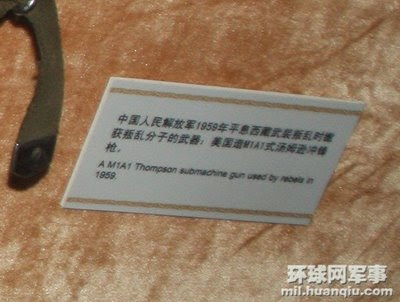
In the report below, a visitor to a Beijing exhibition marking the 50th anniversary of democratic reforms carried out in 1959 in Tibet is described as looking "at guns used by Chinese soldiers". (The 1959 reforms followed an uprising by senior monks and upper class Tibetans and freed the region from its feudal theocratic system. As the head of that system the Dalai Lama, who had pretended to cooperate with Mao Zedong and the Chinese Communist Party, chose to side with the reaction and fled to India.)


Before we look again at this picture and its caption, one might well ask, "What else was on display here? What other exhibits might there be about either the system that was replaced, or the new way of life that emerged in Tibet after 1959? Why was this the only image chosen to represent the exhibition? Are the Chinese so blood-thirsty that they would really display the guns that they had used to 'suppress' the Tibetans? Are they boasting about their 'invasion' and 'dictatorship'?"

But the truth will out! The labels on the exhibition reveal a different reality to that dreamed up by Agence France Presse reporter Peter Parks, and gleefully replicated by other anti-China media.

The label closest to the front actually reads (in Chinese and English) "A Bren machine gun used by rebels in 1959".


The second label, on the bottom of the wall at the rear of the display case actually reads "An M1A1 Thompson machine gun used by rebels in 1959."


The Chinese captions additionally reveal that both weapons were manufactured in England, hinting at connections between the Tibetan reactionary ruling class and the imperialists.
We have seen this sort of deliberate falsehood before: Nepalese police of the old regime attacking Tibetan exiles in Kathmandu being passed off as Chinese police "attacking innocent Tibetan civilians in Lhasa" during last March's shameful campaign against the international passage of the Olympic torch.
Caught out once again, the capitalist press must always be regarded with suspicion as a source of misinformation about workers' struggles, liberation movements...progressive politics of any kind.


Wednesday, April 23, 2008

A Tibetan speaks out!

Introduction: The following statement is taken from the "comments" board of the anti-CNN website that was established to expose the fabrications of the Western media in its reporting on the issue of Tibet. It is written by a Tibetan who describes his treatment as a citizen of the People's Republic of China, and his dismay that several of his overseas relatives have joined the Dalai Lama clique and have made comments supporting Tibetan separatism. The statement has been translated into English and I have kept the translator's comments and notes within the body of the text.

..................................

I am a Tibetan Chinese, but I feel shamed by some of my compatriots!

I am from the Aba County in the Sichuan Province of China, and in my home county, most inhabitants are ethnically Tibetan, Qiang, or Han. I am a Tibetan. Should you have any doubt about my identity, please feel free to look me up by my identification: 51322219*****0473.

(Translator’s note: that identification is similar to social insurance number, so for security reasons the author does not publish the complete identification on a public forum.)

I would love to see some of my Tibetan kinfolks repent about their actions when they read this article.

How alluring is the concept of freedom! It is surely glorious and right to seek one's freedom. However, I do not understand why we have to seek this freedom when we already have it. The actions of some of my Tibetan kinfolks are bringing shame to our brother ethnicities, as well as our government. Yes, it is right for us to value our own history and our own beliefs to continue the majestic spirit of King Gesar. When I was at the Seda Buddhist College, I learned the full Epic of King Gesar from the scriptures, and King Gesar brought pride to all of us Tibetans and us Chinese. King Gesar is a hero, he has brought good lives to all of us, yet is H.H. the Dalai Lama capable of such? I would like to compare the accomplishment of our hero and the Chinese authority. I would not like to talk about the Dalai, because he shames me too much to make such comparison on his behalf. 1. We Tibetans are grateful. Senor, Zhuoda, and Dunzhu*, You often come to this forum, and it appears from your speeches that you have already forgotten the teachings of your parents: when you receive, you give back.

(*Translator’s Note: These are the names of the author’s relatives whom he is addressing. )

Do you still remember the stories the Dedideng Grandpa* told us? In case you forget, I shall remind you: he tells that we Tibetans are grateful.

(* Translator’s note: The author refers the Grandpa as A-Mi in his mother dialect.)

Grandpa said that when the Chinese took over Tibet, we Tibetans were truly liberated. We were no longer suppressed by those aristocrat slave owners, and we were no longer their slaves or serfs. The government gave us livestock and farms, and they even let us share the aristocrats' mansion!

Then the authority sent their troops to build us the road to Lhasa. They really did it, and Grandpa clearly recalled the horrendous hardship while building that road! They had to make their own gun powder to bomb the boulders, and on that day 17 people sacrificed their lives for us. They were buried by the fallen rocks.

The authority transported salt and tea for us, but they did not ask anything in return, and replied that it is given by the government. The villagers carried their own barley to feed the trucks, and said: “It is tough for the trucks to carry so much to us!”

Then the central government left two of those trucks for the village, and asked nothing in return. After the road was built, we could really go to Lhasa on automobiles!

Later on, we had a drought that strained the grass field, so the livestock did not gain enough fat. In the same year, the winter was exceptionally harsh, and countless livestock froze to death. We were hopeless, but right at the time, the authority informed us that the central government was sending us resources. We could not believe it initially, but in two days, the trucks truly brought us food, duvet, and all that we need. Our fathers performed the long prostration on the grass field out of appreciation: they were not thanking the heavens or the Dalai Lama. Instead, they were grateful for the aid from the government, and the support from the rest of China.

2. To the Separatists:

When it comes to the time of our generations, we have experienced the real progress brought by the central government.

Senor, could you please tell me who has installed electric lights to your home, and who has implemented the satellite TV receptor for you? Could you also tell me who has built the hospital for our village, and where the doctors are from? On whose budget do we have a free way, and who has built telephone system for our village? Who pays the tuition for our younger siblings, and who takes care of us during natural disasters? Do you recall that year of landslide? Your uncle's* house was destroyed, and who built him a new house? That is right, you are now distinguished because you study abroad, but do you recall Dr. Zhang from Sichuan University? He supports your studies, but what are you doing while you are abroad? What have you done to our country? Do you care about how your family and Dr. Zhang, your benefactor, thinks about you?

(*Translator’s note: here the author refers to his acquaintance’s uncle’s wife as Mi-er. Mi-er means mother’s brother’s wife in his language.)

Now that we also have the railway, do we still live under poverty? You know we are not impoverished, but Dalai Lama still leeches from us. His adherents sit in the temple, and are inaugurated as Living Buddha’s at his will. Yet all they do is to touch the foreheads of villagers, and our village folks become obliged to send piles and piles of hard earned money to their temple. The central government has helped us Tibetans so much, yet they do not even charge tax from us. They consider our situations difficult, so they cancelled our taxation. We give our money to the temple, and then we go to the government for financial aid. Did the government say anything? No, all they say is that: “We respect the religious feelings of every ethnicity.”

Those who want to separate Tibet from the rest of China, are you really suppressed? Who is slaughtering you? No body does that. Making up such stories will make you despicable to the entire humanity.

3. To International Friends:

I know you are friends with my brothers, and they suggest you to come to this forum, so I would like to a few words to you in the following passage.

In China, we Tibetans enjoy equal rights as every other ethnicity, and in addition we enjoy the minority welfare. I am sure you have heard rumors such as that the Tibetans are ethnically cleansed by the Chinese, or the Chinese government brutally suppresses the Tibetans’ protest. You may have also heard that all Tibetans are protesting for independence, or that the Chinese government does not support actual construction for Tibetans and all they do is for colonization. My friends, those rumors are simply what they are: rumors! Let me tell you what is happening in my homeland. I believe I have more authority to talk about my home than anyone else.

The central government has been supporting Tibet ever since it implemented the “Open Door Policy”, and the following are what I find to be some of its most substantial aid:

1. Tibet is one of the first minority regions where the central government cancels the taxation.

2. It is not true that Tibet lacks freedom. Tibet is one of the autonomous regions of China, and we Tibetans have been ruling Tibet with our own hands.

3. We also enjoy various aids from the central government. The central government gives national funding to encourage college graduates to come to Tibet, and help the construction in education, manufacturing etc.

4. The central government has built a railway for Tibet in order to help Tibet’s economical growth. Meanwhile, during natural disasters, the central government always aids the Tibetan people with all of its power.

I also want to make a few other points:

1. We Tibetans are not discriminated. The other ethnicities treat us as brothers, and we enjoy all the rights and welfare applicable to other Chinese citizens.

2. We Tibetans are truly grateful for the rest of China. It is not true that all Tibetans are protesting for independence. In my hometown, the population is 70% Tibetan, but there are only a few carry ambitious schemes. They are only one out of four thousand, and those people are scorned as trash in my hometown. My friends, you are educated, and freedom embracing individuals, please do not be fooled by those who are despised by even their own people.

3. We Tibetans are not impoverished: Tibet has a higher mean household income level than most of China. In my hometown, on average each household has 40 cattle and 100 goats. The average household’s profit from cattle, wool*, and medicine trade is approximately 100,000 RMB (14,271.44 USD**), while an average person has annual income of 20,000 RMB (2,854.289 USD). Yet because most people choose to donate much of their earning to the temples, they do not appear as well off as their income indicates.

(Translators Note: * The author suggests in the article that in his hometown, cattle wool is also traded in addition to traditional wool from lamb or goats. ** The currency exchange rate is quoted on April 11, 2008)

4. The Tibetans are not suppressed during the recent riot. The illegal protesters are constrained by the different levels of police according to international charter, and only the violent protesters who attack the officers are forcefully arrested. I wonder if the situation is treated any differently in your country. I believe my brothers will not deny the above statements, so please ask them for further clarification.

4. To the 14th Dalai:

Dalai, what have you done? You take our money from cattle trade, and now you are also trying to take away our happiness.

There is a riot this year! Dalai you tell us that we need freedom, we Tibetans need freedom, and that is why we need independence.

Your Holiness, I am referring to you by name* now. I believe you will see my article, because your adherents will show it to you. I would not like to discuss whether the Communist China is right or wrong here, instead I would like to give my analysis of the consequence of Tibet's independence.

(Translator’s Note: * In most traditions to the north east of the Himalayas, one only refers to people of equal or lower rank, generation, or social class by name. )

First of all, Tibet will face economical disaster after independence. You know that Tibet’s principal is from the trade of livestock, their by product, and medicine. Once Tibet declares independence, the rest of China will become politically hostile, and will stop its economical relationship with us. There are 2.62 million* people from Tibet and surrounding areas, yet we can no longer have cattle trade with Lanzhou, Chengdu etc. or with the rest of China proper. In that case who shall we trade with? Perhaps we can trade with India, but India itself is a major agricultural country. You also realize that China can easily employ its present power to force India to stop international relations with us. When that happens, Tibet will be the next Mongolia, and be sandwiched by two major powers without a port. Even if the United States wants to help us, it will not be able to do so directly. Without an economical backbone, will Tibet go back to the theocratic serfdom it used to be?

(Translator’s Note: the author has made a mistake here and quotes the population of Tibet to be 3,000,000. I have corrected it with reference to the 2000 population census. )

In addition to the economical disaster, Tibet also lacks the military power to defend itself. I am sure you are aware that Tibet does not have its own heavy industry, hence unable to construct its own military equipment. Without a reliable economy, what can we use to trade for weapons? Perhaps the U.S. will give us some weapons, but that is far from enough. When facing the tanks and airplanes of the People’s Libration Army, do you plan to defend the “state” with mere infantry? Without our own army, what should you employ to gain that independence? Will India give you aid? Do you recall your last visit to India, and the Indian Prime Minister’s response? He does not support the Tibetan Government in Exile, because he is unwilling to be hostile to China. Our neighbor Pakistan is in alliance with China, and it is extremely difficult to build an international relationship with it, while all the other neighboring countries are in alliance with Russia. Do you really think Russia would give up its relation with China to side with you?

Meanwhile, please do not over estimate the support you have from the Tibetan people. Do you really think that all Tibetans are united under your leadership? If so, you are mistaken. The Tibetans are capable to think for themselves, and to judge which party treats them better. The recent riot fully demonstrates the situation. Your have less than thousands* of loyalists in the entire Lhasa, and you hardly have any ten thousand* adherents in the entire Tibetan region. Let us take the upper bond, and assume that you have ten thousand supporters in Tibet. That will give you the support of one out of three hundred (1/300) Tibetans. If you take away the wage you pay those people, perhaps only 1000 will still be loyal to you, and that gives you the support of one out of three thousand (1/3000) Tibetans. There are rumors that you compare yourself as the Tibetans’ Mao Zedong, yet the brutal fact is that you do not have the people’s support Mao has had**.

(* Translators Note: in Chinese language, the terms like thousand and ten thousand are used as estimate like how in English language we use “hundreds” and “thousands”.
** Historical Note: It may appear impossible to the Western readers for Mao to have the support of the people, yet one needs to realize that without the people’s support it is impossible for the communist government to establish in China in the first place. The fact was that the capitalist government had the support from the U.S., while the communist government lacked analogous support from any external body. Some might claim USSR had supported the Chinese communist part, but the fact remains that the USSR itself was devastated after WII, while the U.S. mainland was literally untouched by the war. )

You are gradually losing on the religions frontier as well. It may appear that you still have the people’s support because your temple still receives donation, yet the fact is that only the older generation gives to your temple. It is advisable for you to count how many of the new generation donate to your temple, and there are not many. Most of the younger generation stops believing in you, because your international actions appear like a circus performance to us. Your Holiness, how much have you earned from that kind of international performance?! How should we believe in you when you lack the proper dignity of a Living Buddha, and when your actions bring shame on us?

(Translator’s note: While the Dalai Lama may be losing on the religious frontier, it does not mean the waning of Buddhism in Tibet. In fact, Tibetan Buddhism has several properly recognized spiritual leaders other than the Dalai Lama.)

In short, Your Holiness, Tibet lacks both the economical and the martial resources to be an independent nation. Further more, you lack the support of the Tibetan people, as well as the religious backing at home to be the leader of the independence movement. *

(This short conclusion is inserted by the translator to make the article more logically comprehensible.)

5. To My Cousins: Senor, Zhuoda, and Dunzhu*,

I would like to inform you that your actions are already violating the legislation, as well as the moral baseline. Despite that the government has laid no charge on you, we as your relatives will not forgive you this easily. If you keep up with your actions, I will be waiting for you in Chengdu, and I look forward to having a really serious discussion with you. Your parents have contacted me, saying that they have lost contact with you for more than a year, and they are concerned for your safety. I did not tell them that you have become adherents to the Dalai Clique, because I fear that they might kill you once they find out. Perhaps you can still contribute to the real progress of our country, but if you keep up with your action, you will be in physical danger from our relatives. I, your cousin, is not a coward, I am simply rational. I understand who is really fit to lead us Tibetans towards abundance.

You have changed your phone number, so I cannot contact you anymore. I know you often come to this forum, so I hope that after you read this article, you will stop your wrong doing. Please do stop. Other wise, our village folks will not forgive you, your parents will not tolerate you, and neither will your close friends. You have brought shame to all us Tibetans.

Nowadays whenever I see reports such as the “The Tibetans so and so”, or “The Tibetans Riot”, I feel like to find a corner and weep. I long to explain that we Tibetans are also one of the many Chinese ethnicities, but who would listen to me? All I can do is to explain to all my friends that we Tibetans are not anarchists as you may perceive us to be.

My cousins, my blood kin, please stop giving the others any more reasons to fear us like that.

Monday, April 21, 2008

Dalai Lama's supporters spread anti-China lies

When it comes to attacking China, there are no more fervent exponents of the cause than US conservatives.

For them, China is still “Red China” and the Chinese people are “ChiComs” (“Chinese Communists”).

These idiots still can’t move on from the Korean War when terms like these gained widespread currency in the Western world.

Nor are they beyond fabricating anti-China propaganda and using emails and blogs to ensure speedy and widespread circulation of their lies.

(In a previous post I referred to the lie circulated by email that a Chinese plane had been grounded in Frankfurt after arriving with safety belts holding part of the jet engine fan blades in place! See http://mike-servethepeople.blogspot.com/2007/10/right-wing-emails-return-to-sender.html )

The latest rubbish comes in the wake of the violent attacks on the citizens of Lhasa by separatist Tibetan thugs in March, and the equally violent attempts by separatists and their supporters to extinguish the “holy flame” of the Olympic relay torch.

Let’s deal with the riots in Lhasa first.

The riots were instigated by supporters of the Dalai Lama and coordinated by the Tibetan Youth Congress and the Tibetan People’s Uprising Movement. The riots were characterized by their lack of support from most Tibetans residing in Lhasa. Only a handful of reactionary monks and their supporters took part, but by burning buildings (including a mosque) and randomly attacking passersby of Han and Hui nationality and causing the deaths of some of their victims, the rioters ensured world-wide coverage of their actions.

The violence and racism of the rioters immediately conflicted with the stereotypical Western belief that the Dalai Lama is a man of peace, and that his supporters are always the victims and never the perpetrators. Caught out by video footage showing the ferocity of the attackers, and further exposed by Western bloggers present in Lhasa who described the violence of the separatists, including that of monks, the Dalai Lama came out with the outrageous statement that agents of the Chinese People’s Liberation Army, the PLA, posing as monks, triggered the riots.

Not long afterwards, the notorious US right-wing activist Gordon Thomas filed a story on Canada Free Press, a conservative “news” website, that “Britain’s GCHQ, the government communications agency that electronically monitors half the world from space, has confirmed the claim” by the Dalai Lama that Chinese soldiers, posing as monks, had instigated the violence.

Thomas claimed that GCHQ possessed proof in the form of satellite images and attached the photo below as evidence. Hundreds of thousands of hits were recorded on the Canada Free Press website before they pulled the article.


The problem was that the photo, while real, was of another time and place.

Chinese bloggers were the first to notice that the uniforms of the soldiers were an older style, replaced in 2005 by a uniform on which there is an arm badge and a chest insignia (see below) both missing in the photo.


That, and the fact that it was obviously not an intelligence signals satellite photo, sent people in search of its source, which turned out to be a file photo taken during production of Michelle Yeoh’s movie, The Touch, in Tibet in 2001. Chinese soldiers are often used as “extras” in films where large crowds or ancient armies are depicted. Somehow, the photo had reached Dharamsala, the Indian seat of the Dalai Lama’s “government-in-exile” in 2003, where it was used on the back cover of the annual report of the “Tibetan Centre for Human Rights and Democracy” (TCHRD).

This discovery was made by a Western Buddhist who was appalled at the dishonesty of conservatives in their attempt to discredit China. In fact, he contacted the TCHRD by email “asking them if they could identify the image. I then received this email this morning from Tashi Phuntsok at the TCHRD:

"The photo you are referring has nothing to do with the recent unrest in Lhasa. It was true that the photo was depicted in our 2003 TCHRD Annual report back cover. The photo was a part of filmshoot (A MOVIE) made in Tibet where Chinese armies wore the monk robes. We received the photos in 2003."

Notwithstanding all this evidence, and a further disclaimer of the photo’s credibility from the “International Campaign to Save Tibet”, the Falun Gong newspaper Epoch Times is still accusing the Chinese of dressing soldiers in monks robes and instigating the Lhasa riots, and conservative websites such as Big Lizards is questioning whether or not it is one and the same photo.
On this issue, I’d say game, set and match to China.

We now turn to the violence of the separatists during the Olympic torch run.

Of all the images captured during the run, none have been as appalling as that of the Tibetan separatist thug who tried to seize the torch in Paris from wheelchair athlete Jin Jing (below).


This photo demonstrated that the pro-Dalai Lama thugs who are bent on disrupting the Olympic torch relay are prepared to endanger athletes and bystanders in order to achieve their objectives.

Again, a major embarrassment for the Richard Geres of the world.

Flushed with the success of their “soldiers in monks clothing” lie, right-wing bloggers in Japan came up with a second photo (below) of the same man on his way to the site of the torch run and labelled it as proof “that our ‘protester’ friend is in fact -- a Chinese agent provacateur”.


They cited the fact that he was discovered in the company of his “true friends” – red flag carrying ChiComs!!! They even labelled the photo "Chinese Fake Tibetan With His Real Friends"!

The fact that he is conversing with no-one, that at least two others in the crowd (behind the left and right shoulders of the woman at the front) are also draped in “Tibetan” flags and that this was obviously a mixed group of Chinese supporters and supporters of Tibetan separatism on their way to the same location apparently escaped these thickheads.

This reactionary website and email campaign complements the same tactics used in the mainstream Western media which has time and again falsified accounts of events in Tibet and used photos of police action in Nepal as evidence of the “Chinese regime’s brutal crackdown in Tibet”.

They are a great education for people who seek to understand China and to promote the friendship of all peoples and nationalities.

As Chairman Mao said, “Seek truth from facts!”

Monday, April 14, 2008

Sydney and Melbourne ralllies support Chinese national sovereignty

Rallies in support of China's national sovereignty and against media bias were called last weekend by groups such as the Australia-China Friendship Society and the New Asian Students Group, resulting in unexpectedly huge turnouts.

The rallies reflect the widespread and just indignation of Chinese and other peoples at the activities of the Tibetan separatist cliques and their reactionary support groups, such as Reporters Without Borders.

They express the disgust at the lies and distortions carried by the mainstream capitalist media on the issues of separatist violence in Lhasa and elsewhere, and the Chinese government's restoration of order in the affected parts of China.

Thousands of Chinese studying in, or citizens of, Australia turned out for the Sunday rallies in Melbourne and Sydney.

Unlike the disruptive activities of the separatists who have endangered athletes and members of the public involved in the Olympic torch runs, the peaceful expressions of support for China received little or no media coverage, highlighting the media's hostility to the People's Republic of China.

There was some coverage on Sunday evening's TV news, but one station minimised the significance of the rallies, saying that "several hundred people attended..." while the multicultural SBS station ended its news report with images of saintly Tibetan monks, ensuring that this was the visual image implanted on the audience and ensuring that the station's loyalties were clearly on display.

As for the print media, there was not one report that I could find in either of the Adelaide Advertiser, Melbourne Age, Melbourne Herald Sun or the Sydney Morning Herald, although I admit that in the case of the latter three papers, I only had access to their online editions.

Here is BBC footage of the Sydney rally. Other Youtube videos are now appearing that expose the Tibetan separatists and their CIA-NED financiers.


Friday, April 11, 2008

Tibetan separatists demand Dalai “step out of the way!”


Whilst they may be gloating over their disruption to the Olympic torch relay, the very success of the Lhasa riots and subsequent relay sabotage have exacerbated contradictions within the Dalai Lama’s clique.

Reference has been made in previous posts to the violent Tibetan Youth Congress and its creation, the Tibetan Peoples Uprising Movement.

Now, one of this faction’s main spokesmen, the writer Jamyang Norbu[1] (right) has openly called for the Dalai Lama and his senior advisors to “Step out of the way”.

What is the basis of these contradictions and why are they being played out now?

The Dalai Lama is spiritual leader of the Yellow Hat Sect (Gelugpa) of Tibetan Buddhism. After he absconded from Tibet, he also assumed temporal leadership as head of the so-called Tibetan “government-in-exile”.

Prior to his leaving Tibet, the CIA (formerly the Office of State Security) made overtures to some of the upper strata Tibetans who feared loss of privilege under Communist Party leadership, and began a program of providing finance to them and to the Dalai Lama.

Armed groups of Tibetan reactionaries dropped by the US into Tibet were quickly dealt with by the local people. Particularly after the smashing of feudalism and the liberation of the serfs after 1959, there were few takers for a restoration of the old system.

After initially approving of, and working with, the CIA and its trained thugs, the Dalai Lama’s evaluation of the situation led him to believe that a violent restoration of the old system was not achievable under the new conditions, and he embarked on a world-wide crusade to garner support for a non-violent movement for Tibetan “independence”.

This was the first crack in the unity within the émigré community.

By the 1970s, the Dalai had accumulated some strength in his position as a “simple monk” espousing a pacifist solution to the problems besetting the exiled upper stratum of Tibet. His cause had a certain appeal to Westerners who rejected their own governments’ violent actions throughout the world and who similarly rejected the consumer society and its values of accumulation and greed. Even certain celebrities began to attach themselves to the Dalai Lama, mirroring the attachment of four young Liverpudlians to an Indian yogi who had taught them to meditate.

Meanwhile, rudimentary services were bringing an elementary level of schooling and health services to the Tibetan former serfs. Agricultural practices were changing following the breakup of the holdings of the landlords and monasteries (see figure below).

The Dalai Lama was still revered by many Tibetans, particularly those of his own Yellow Hat Sect, but there was a shared apprehension of what sacrifices would be required to establish an “independent” Tibet, and what advantages, if any, would flow from such a Tibet, separated from the socialist motherland and placed at the mercy of the capitalist and imperialist powers.

Again, an evaluation of these factors led to a change in tactics on the part of the Dalai Lama, and thus a further estrangement from the violent factions of the upper strata exile community.

The Dalai Lama decided to drop his demands for an “independent’ Tibet, and opted for his Middle Way of “autonomy” within China.

This enraged the Tibetan Youth Congress and people like prominent Tibetan author Jamyang Norbu, who was one of those who had been trained by the CIA. According to Norbu, “not all Tibetans are the Dalai Lama…I’ve met lamas who tell their followers that killing one Chinese is the karmic equivalent of building a thousand stupas”[2].

So a second grand fissure developed within the Dalai Lama-led clique of exiles.

There have been other developments over the years, such as efforts by the Dalai to ban the worship of Tibetan deities of which he disapproves. These have led to demonstrations against the Dalai by Tibetan exiles and to accusations that he has suppressed freedom of worship – hardly the image that he projects of himself and closer to the situation of the pot that calls others black!

The decision to award Beijing the 2008 Olympic Games has now pushed contradictions in the Dalai Lama’s camp to the point where his temporal leadership is being openly rejected.

Leading the way is the Tibetan Youth Congress, the Tibetan Women’s Association and three other right-wing groups that together created the Tibetan Peoples Uprising Movement at the beginning of this year.

It is these groups that have masterminded the riots in Lhasa and some other Tibetan communities in China, inciting small mobs of reactionaries to bash and kill ethnic Han and Hui (Muslim) Chinese.

Seeing his leadership being swept aside, the Dalai has urged these mobs to stop their violence, threatening to resign from his position as head of the “government-in-exile”, thereby removing the prestige of his position from their cause.

And despite the success of the right-wing and US-financed “Reporters Without Borders” and the TPUM in sabotaging the Olympic torch run, the Dalai Lama has stated that the Olympics should not be boycotted.

In fact, the Dalai Lama has even gone so far as to establish a Solidarity Committee under his “prime minister” Samdhong Rimpoche which has ordered Tibetans in exile to stop using the term “Free Tibet” or slogans like “China out of Tibet”.

It is for this reason that Jamyang Norbu on April 5, 2008 issued the demand that the “leaders in the exile government…Step out of the way” (Jamyang Norbu’s emphasis).

With the split in the exile community reaching these proportions, why has Beijing not accepted the (“I’m not a devil”) Dalai Lama’s offer to negotiate?

Well, the Chinese have not ruled it out, but there are a couple of little matters of principle that need to be sorted out first.

One is the Dalai Lama’s definition of Tibet as that part of China in which Tibetans live. It seems a reasonable matter for discussion on the surface, but China is a multinational country with more than 50 nationalities, and there has been migration and resettlement of many of these nationalities over the centuries. Consequently there are Tibetans now living in parts of present-day Yunnan, Sichuan, Qinghai and Gansu Provinces. If a Tibetan Anschluss occurred, and these regions were incorporated into “Tibet”, then its size would easily be doubled. This is not a matter for the Dalai Lama to establish by proclamation.

Another is the Dalai Lama’s reckless approval of independence for Taiwan, Xinjiang Uighur Autonomous Region, Inner Mongolia and Manchuria. The Central Government will certainly reject calls for talks with the Dalai Lama (Kevin Rudd, please note!) while he has an agenda that encompasses such a grand destruction of Chinese territorial integrity.

Thirdly, there is the Dalai Lama’s position as head of the “government-in-exile”. Beijing cannot be expected to deal with the Dalai Lama whilst he occupies such a position. As head of the “government-in-exile” the Dalai Lama is responsible for the actions of such groups as the Tibetan Youth Congress even as they wriggle out from under his control. That is why Beijing still refers to their violent actions as the actions of the” Dalai clique”.

Fourthly, the Dalai Lama still espouses the view that “ours struggle is very much related to dharma. It is not purely a political freedom struggle.” He adds, “the lamas still have control over the people.”[3] The Dalai Lama is still clinging to a concept that most bourgeois states long ago rejected, namely the unity of church and state. He sometimes talks of a democratic future for an “autonomous” Tibet, but his real vision is based on the necessity for theocracy based on the supremacy of the divine laws of Buddhism (dharma).

Lastly, his closest associates have made it perfectly clear that “autonomy” is just a tactic, a means to an end, and that end is still the separation of “Greater Tibet” from China. The TYC and TPUM share this goal but are impatient for its realization and disagree with their spiritual leader over how it should be achieved.
The Chinese Communist Party has a principled stand on the question of Tibet.

The Dalai clique, on the other hand, is rent with division over how best to pursue the separatist agenda.

A formal split in their ranks is only a matter of time, and this – despite their apparent strength in disrupting the Olympic torch run –will weaken their cause irreversibly.

[1] See also his “Non-violence and Non-action” (Dec 27, 2007) at http://www.tibetwrites.org/?Non-Violence-And-Non-Action&lang=en
[2] See Asiaweek magazine, Sept 11, 1988 ‘Fires of Frustration’
[3] http://www.time.com/time/asia/magazine/2000/0717/tibet_sb1.html

Tuesday, April 08, 2008

Reporters Without Borders and the anti-Olympic campaign

It's worthwhile knowing who is the key driver behind many of the protest actions happening in Europe, and what his allegiances are.

Here's an excerpt from Yahoonews the other night, regarding Paris: "Pro-Tibet activists have threatened demonstrations, saying they would not reveal their exact plans until Monday. The head of Reporters Without Borders, arrested in Greece last month for protesting during the flame-lighting ceremony there, said the group had altered its initial plans because of the heavy police turnout. Without giving away details, Robert Menard promised protests would nonetheless be "spectacular".

"Spectacular"? Depends on your point of view. Certainly dangerous to the athletes carrying the torch and to supporters of the torch run who lined the streets to watch it.

So, just who is Robert Menard, who initiated the original Olympic protest in Greece as well? And Reporters Without Borders? Here's a link which exposes him as an extreme right wing media stuntperson with strong US State Department ties, and a long history of anti-Castro activity: http://www.counterpunch.org/barahona05172005.html .

And here's another from ZNet, documenting his, and his organization's support for the CIA-backed coup against Hugo Chavez in Venezuela in 2002: http://www.zmag.org/content/showarticle.cfm?ItemID=13839 .

And here's a site outlining Reporters Without Borders' continued backing for RCTV, the main TV station instrumental in that coup attempt:http://www.venezuelanalysis.com/analysis/2493

It is a pity that this CIA and NED (National Endowment for Democracy)-paid right-wing ideologue isn't honest enough to set up a Reporters for Truth and start tackling the continual misinformation and disinformation and suppression of information epitomised by the Western media and its tired old anti-China campaigns.

Visit http://www.anti-cnn.com/ to see what Menard ignores as he does the dirty work of US imperialism, of the Bacardi company and its various "Free Cuba" emigre fronts, and of the reactionary Tibetan Youth Council and Tibetan Peoples Uprising Movement.

Monday, March 31, 2008

Cinematic Misrepresentation: Kundun

(This review was written shortly after the film Kundun appeared in 1997. I have used parts of it for my earlier post on the Origins of Tibetan Separatism. However, because of the continuing unrest over the issue of Tibet, and the misplaced belief in the absence of violence in Tibetan traditional culture, I have decided to post it here.)


Kundun (1997) begins with a very selective reading of history, and gets little better as the film unfolds.

“The Tibetans have practised non-violence for a thousand years”, we are assured in an introductory note. What? No private armies employed by serf-owners to maintain their ruling position over the serfs? No punishments such as the gouging out of eyes, cutting out of tongues, amputations of limbs? No legions of armed monks engaging in periodic battles between monasteries over control of land and interpretations of scripture? No standing armies to carry out incursions into neighbouring territory or to guard against encroachment by neighbours and, later (1904 in particular) by Britain?

The philosophy of non-violence may be a central tenet of Tibetan Buddhism, but violence has indeed been practised there in the course of the last thousand years. Monks will not kill an animal for meat but they will eat the meat of an animal killed by the outcast butchers whose violence against the animals makes the meat available for consumption.

Kundun opens with the search for the soul boy or reincarnation of the Thirteenth Dalai Lama (left) who had died in 1933. In 1934, the Kashag, Tibet’s local authority, sent search parties to Qinghai, Xikang and southern Tibet. Three such children were initially identified, but the Regent, Radreng, who was opposed to British interference in Tibet’s affairs, based his selection partly on the fact of the soul boy’s family having lived in close proximity to Han Chinese territory, and reported to the Guomindang (KMT) Government of Chiang Kai-shek on all stages of the soul boy’s formal preparation for confirmation as the Fourteenth Dalai Lama. From the point of view of film as a visual medium, one can perhaps understand why slow pans of Moroccan hills are preferable to going into detail of intrigues within the Kashag but this can not be excused when omissions of detail create false interpretations of history.

Radreng is shown embroiled in a minor controversy over whether or not he should receive extra rewards for having discovered the soul boy. This follows the gratuitous insertion of a scene showing him inhaling snuff, a detail unlikely to ender him to audiences. We then see him arrested and jailed. A little later he is reported as having “died” in custody.

The omissions here are enormous. Radreng was probably no angel: in 1934 he had confiscated the property and gouged the eyes out of Lungshar, the pro-British Kashag Defence Secretary. He had dismissed from office others he had considered pro-British and prevented the British from opening schools in Tibet. A clique, backed by Britain, thus formed against him. Radreng, even after his arrest in 1947, remained in favour of close ties with China. He told his captors: “Religiously and geographically, China and Tibet are inseparable.” His arrest prompted much fighting between armed monks from monasteries loyal to Radreng, and the Kashag troops in Lhasa. Many lives were lost and the situation was turning critical. Fearing the consequences of Radreng being set free by insurgents, the pro-British element murdered radreng on May 7, 1947. This incident allowed the separatist elements within the Kashag to hold power and to be in a position to wean the young Dalai away from Radreng’s influence.
The Radreng Incident was a crucial turning point in the orientation of the local Tibetan authority, the Kashag. It now began to pursue a separatist position with the encouragement of the British in India, and of US agents like Lowell Thomas who lived for a while in Lhasa as a representative for CBS. The makers of Kundun deliberately refrain from drawing out the significance of the Radreng Incident because they do not want to show Tibet as ever having accepted or preferred its status as a local authority under the jurisdiction of the central government of China. Nor do they want to openly admit to the methods used to impose a change of direction. They were, after all, hardly “non-violent”!

Another startling omission is any reference to the Banqen Erdeni (or Panchen Lama). The Dalai Lama is not the sole religious leader of Tibetan Buddhism. Historically, there have been two Supreme Living Buddhas in Tibet, the Dalai being one, and the Banqen the other. In their various reincarnations they have sometimes been in conflict; for the most part their cooperation has had the effect of a balancing act and has prevented the creation of vacuums during periods of succession following the death of either the one or the other.

The Tenth Banqen, until his death a few years ago, represented that trend within Tibetan Buddhism that preferred local autonomy within China to the separatism of an imperialist-backed, Western-dependent “independence”.

The makers of Kundun, having obscured the political significance of the Radreng Incident, obviously had no place for the added complication of a Supreme Living Buddha who espoused the unity of a China comprising Han, Tibetan, Mongolian, Manchu and Hui and Uighur (both Muslim) nationalities, among others of the more than 50 ethnic groups that constitute modern China. Far better for director Scorcese to create a “rapture in pictures” (Time) than to get bogged down in details that aren’t going to bother the average cinema-goer in the West, but which are central to an appreciation of the Tibetan issue.

Whilst ignoring historical detail likely to undermine the case for Tibetan separatism, Scorcese makes use of character dialogue to establish the “fact” of Chinese bastardry on a grand scale. They are accused of “trying to rewrite history”; a few minutes later, it’s “Your Holiness, the Chinese have invaded”.

Did the Chinese “invade” Tibet? In 1950, the Chinese PLA advanced into a largely Tibetan-populated area which Chiang Kai-shek, caught up in civil war, had been unable to control. This area, Chamdo, was not at that time a part of Tibet; at the end of the Qing Dynasty it had been incorporated into Sikang Province, which in turn would be incorporated by the new Communist Government into Sichuan Province.
One of the Kaloons, or senior officials of Tibet, the serf-owner Ngapoi Ngawang Jigme, was dispatched at the head of the Tibetan army[1] to block the advance of the PLA. The Tibetan landowners’ response to the advancing revolutionary forces was no different to that of the warlords of large landowners anywhere else in China. Tibetan theocracy was a system of feudal privilege and it panicked at the advance of the revolutionary PLA. When the two armies confronted each other in Chamdo, the Tibetans were defeated.

Ngapoi was treated well by the PLA: this was quite consistent with their treatment of KMT generals who had been captured in battle or who had changed sides. It gave him the confidence to report in full to the Dalai Lama his observations of the behaviour of the PLA towards the Tibetans in Chamdo. The Dalai was at that time in Yadung, near the Indian border, and was being tempted with American and British arms and money to lead a fight against the “Reds”. With the PLA making no effort to push beyond Chamdo, and with Ngapoi’s first-hand accounts of their policies towards the ethnic minorities, the Dalai appointed Ngapoi to lead a delegation to Beijing to negotiate an Agreement with the new Chinese Government.

Kundun shows the Dalai’s shock at the news of the signing of the 17 Point Agreement on the Peaceful Liberation of Tibet. He reels physically at the blow it delivers. Fact or fiction? Would he not have known what it meant to seek an agreement with Beijing when all Chinese Governments since the Yuan Dynasty had regarded Tibet as part of Chinese territory? Would he not have canvassed the options with the man he appointed as his personal representative? Why endorse the May 23, 1951 Agreement in his personal messages to Chairman Mao if it was so shocking and distasteful?

Unfortunately for Mr Scorcese and many of the Dalai’s supporters in the West, China did not “invade” Tibet in 1950. It advanced only to Chamdo in Sikang Province and then halted for eight months whilst an Agreement was negotiated with properly authorized Tibetan representatives. Subsequently endorsed by the Dalai Lama, the 17 Point Agreement on the Peaceful Liberation of Tibet was the basis on which China peacefully resumed sovereignty over Tibet. Tibet was guaranteed local autonomy as were other parts of China where non-Han minorities were dominant.

If the reference to “rewriting history” is not sufficient to revive Cold War anti-Red myopia, a further bit of not so subtle character dialogue is inserted. A naïve Dalai, still vacillating in his attitude towards the Chinese, remarks “We’ve managed the Chinese for many years”, only to be told “These are not the Chinese we have known – they’re Communists!” This avoids a double purpose: it reinforces anti-communism, but avoids alienating the Taiwan authorities who had feted by the Dalai’s elder brother as early as 1952 and in whom the Dalai sees an anti-Beijing political ally[1].

Even the Dalai’s brother is utilized for political point-scoring against the Chinese. He is the film’s vehicle for the Dalai’s own explanation of his co-operation with the Chinese in their resumption of sovereignty over Tibet. They were pretending to be nice at first, and the Dalai genuinely believed that he could work with them, but they soon “bullied people and burnt homes”. Other allegations, later in the film, are that the Chinese “forced children to kill their parents and forced nuns and monks to fornicate”[2].

Some of the characterizations of the Chinese make one want to cringe at their crudity. It is like the 1950’s revisited. I remember an early primary school library book which, alongside a photo of Mao, had a caption that read “In China everyone wears the same clothes, but Chairman Mao’s are made from better cloth”. The intention was to show the “hypocrisy” behind Communist professions of equality for all. Scorcese adopts the same crudities: General Tan, the senior PLA representative in Lhasa, is embarrassed by references to his gold watch that have been heard in popular street songs. Mao’s black patent leather shoes shine in close-up. It is childish film-making, blatantly intended to manipulate the desired response from the audience. Mao is condescending and doesn’t listen, and so it goes on.

In accordance with its guarantees on local autonomy for Tibet, the central government refused to interfere with the social system there until the incitement of a rebellion in 1959 by the upper strata of Tibetan society. These people, serf-owners and the heads of some of the monasteries, had frustrated every effort at gradual reform initiated by the Tibetans themselves, and feared the growing popularity of measures adopted in areas outside of Tibet: land reform, public education, health services and restrictions on the recruitment of young children into religious orders.

With the suppression of their rebellion came the collapse of the local Government in Tibet and the abandonment of Tibet by the Dalai Lama. A Preparatory Committee for the Establishment of the Tibetan Autonomous Region had been formed in 1956 under the chairmanship of the Dalai Lama. The Banqen Lama now became the “Acting Chairman of the Preparatory Committee pending the Dalai Lama’s return”, and he, together with Ngapoi and other progressive Tibetans, began the introduction of long overdue reforms which had been continually blocked by the Kashag.
The old society of Tibet, left in place by the central government until the collapse of the Kashag, was so indefensible, so cruel and so backward that Scorcese has the departing Dalai Lama bemoaning that “The saddest thing is we were about to change”.

The benefit of hindsight is a wonderful scriptwriter for works of fiction.


(Secret Tibet, a 1943 Nazi film depicting the work in Tibet of three Nazi scientists, including Dr Bruno Berger, mentioned in Note 1 below. Hitler believed that the remoteness and inaccessibility of Tibet had protected the "racial purity" of the Tibetan people, and wanted to use the "scientific" studies of Berger and others to prove his theories on race. The Nazi swastika is a religious symbol of Buddhism and is found at Buddhist sites throughout India and China, including Tibet.)


[1] The Dalai went on his first ever visit to Taiwan in 1997, hoping to win Taiwan “independence” activists to the cause of Tibetan “independence”. The central government has therefore insisted that the Dalai must acknowledge Taiwan as a aprt of China before any talks with him begin. Asiaweek reported (Sept. 11, 1988) that this “certainly seems to have put the Dalai Lama in a tight spot.”

[2] Incitement to violence by Tibetan separatists is not a topic dealt with by Kundun. The CIA for many years after the Dalai left Tibet, trained Tibetans in exile as saboteurs and murderers, and parachuted them into Tibet. Tseten Norbu, President of the Tibetan Youth Council, said in a recent interview that “Within our policy guidelines we can choose both violent and non-violent programs.” Jamyang Norbu, one of the Tibetan terrorists trained by the CIA tells overseas audiences that “not all Tibetans are the Dalai Lama and that I’ve met lamas who tell their followers that killing one Chinese is the karmic equivalent of building a thousand stupas”. (Quotes from “Fires of Frustration”, Asiaweek, Sept. 11, 1988.)

[1] There had always been an armed presence in Tibet, often based around the more powerful monasteries, to protect their interests in local wars and to maintain the cruel serf-owning system of Tibetan theocracy. In the anti-British war of 1904, the Tibetan forces fought with distinction. Feted by the Nazis in the lead-up to WW2, the Tibetan ruling class further strengthened the local army. Nazi officer Dr Bruno Berger, then in the Tibetan town of Shigatse, observed with approval the developments taking place. “For a better protection of the country and to maintain their sovereignty, the Government set up a modern army of 10,000 men, whose training could be admired even by us in Shigatse. Everything was obviously done with diplomatic skill to preserve their independence. Even our having been invited was probably due to the Tibetan’s aim to establish a firm contact with the rising ‘German Reich’, which might contribute to the support of their status of independence.” (From Berger’s “Memoirs” on the Dalai Lama’s official website: http://www.tibet.com/Status/bruno.html .) The Nazi Berger’s references to “autonomy” and “independence” should be treated with caution: his memoirs were written after US imperialism had identified Tibetan “independence” as a means of destabilising New China; the terms did not exist in the Tibetan lexicon or were poorly defined at the best at the time Berger was there, according to George Patterson, a translator for the Americans in their dealings with the Dalai clique in the fifties and sixties.

Thursday, March 27, 2008

The Dalai Lama and Tibetan-Chinese History

China is a vast multinational country with more than 50 recognised nationalities including the Han (comprising more than 90% of the population), Tibetans, Zhuang, Mongols, Manchu, Uighurs, Khazaks, Hui and Dai. Some were followers of the sanjiao or “three schools” of Buddhism, Daoism and Confucianism; others were Muslim; at various stages there were small numbers of Zoroastrians, Jews and Christians.

A political entity exercising authority over the Tibetan region had come into existence by the early 7th century AD. This was based on the economic and political convergence of interest between Tibet’s landowning nobility and the senior lamas of the great monasteries of Lama Buddhism which had violently supplanted the indigenous animism of the practitioners of Bon.
The emerging organs of authority in Tibet appeared at the time when the Tang Dynasty ruled the vast central plains of China. Relations between the Tibetan and Han regimes waxed and waned. Armed Tibetan incursions occurred at various points along the Silk Road causing Han Chinese to attempt to pacify and neutralise the Tibetans. An alliance of sorts was put in place during this era following the marriage of the Tibetan leader Songstan Gambo and Princess Wencheng of the Tang Dynasty.

Over the next four centuries this rather tenuous alliance between the ruling houses of the two regions slowly strengthened through political, economic, cultural and religious exchanges, laying the foundation for unification under the Mongol regime of Genghis Khan. This unification was based in part on the Mongolian’s adherence to Lama Buddhism. The Mongol regime became formalised as the Chinese Yuan Dynasty (1206-1368).

The Mongols negotiated an agreement with members of the Sakya Sect in Tibet requiring them to give allegiance to the Mongols. The terms of allegiance were agreed in 1247. Following Kublai Khan’s accession to the throne in 1260, Tibet became one of the administrative regions under the direct jurisdiction of the Yuan Dynasty Central Government. Under both the Ming (1368-1644) and Qing (1644-1911) Dynasties the central government’s sovereignty over Tibet was further strengthened. A Resident Commissioner’s Office was set up there by the Qing Dynasty, whilst the Yonghe Palace in Beijing was rebuilt as a lamasery in 1744 and given over to the Bainqen and Dalai Lamas and other high Tibetan figures for their use on visits to the capital.

Tibet has been an administrative region of China since the Yuan Dynasty. The question of Tibetan “independence” or of Tibet and China as separate countries, did not arise until after China’s defeat in the British Opium War. Once the reality of Qing Dynasty weakness had been revealed, various empires began to attempt to carve China up into spheres of influence and to annex unto themselves the territory of China. Czarist Russia was active in various areas including, for a while, Tibet; the Germans, and later the Japanese, were active in Shandong province; the Treaty Ports and extraterritorial rights for foreigners became notorious (eg the “No dogs or Chinese” sign on the Bund park in Shanghai).

In this context, manoeuvres by the British to extend their control of the Indian sub-continent by politics and war at the expense of China should not be interpreted as having laid the basis for the existence of an “independent Tibet”. Armed attacks by the British on Tibet took place in 1888 and 1904. Later, taking advantage of the disintegration of political authority in China after the 1911 Revolution, the British tried by various diplomatic and political means to separate Tibet from the Central Government and bring it within Britain’s sphere of influence. Although sections of the Tibetan theocracy vacillated at this time there was no organised indigenous movement for the independence of Tibet, and the so-called issue of “independence” was really one of separation from, and dismemberment of, China for the sake of a foreign colonial power. (See my earlier post on the origins of Tibetan separatism here.)

The 1911 Revolutionled by Dr Sun Yatsen brought to an end the exclusive control of China by one of its major nationalities, the Manchus (ruling as the Qing Dynasty). Dr Sun was no narrow Han chauvinist, and stressed the multinational nature of the new Republic in this declaration of January 1912:

The foundation of the state lies in the people’s power to incorporate the areas inhabited by the Hans, Manchus, Mongolians, Huis and Tibetans into one country and to unite the Han, Manchu, Mongolian, Hui and Tibetan nationalities into one nation. That is called national unification.
The flag of the new Republic was initially a five-coloured flag, symbolising the unity of the five major ethnic groups of the Chinese nation.

The Nationalist Government of Chiang Kai-shek likewise upheld the historical relationship between the central government and Tibet. On June 1, 1931 the Nationalist Government issued the provisional Constitution which stipulated that “The territory of the Republic of China covers the various provinces, Mongolia and Tibet”, and “The local systems of Mongolia and Tibet shall be enacted separately in legal forms according to the local conditions.”

During this period, the Tibetan local authorities attended a series of meetings convened by the Nationalist Government and conducted condolence-offering for the thirteenth Dalai Lama, and the reincarnation and enthronement of the present fourteenth Dalai Lama under the supervision of, and with the approval of, the central government.

After World War 2, the United States took over Britain’s role as leader of the Western pack and embarked on an anti-Communist crusade. They campaigned vigorously against the 17-Point Agreement on the Peaceful Liberation of Tibet signed in 1951 by the local Tibetan authorities and the Central Peoples’ Government. The Dalai Lama actually acknowledges in his book, Freedom in Exile, the involvement of the US Central Intelligence Agency in training anti-communist Tibetans for separatist guerrilla activity and in parachuting trained insurgents into Chinese territory. This culminated in an armed rebellion by the upper classes of Tibet in March 1959, the suppression of which was accompanied by the Dalai Lama’s flight into exile.
Tibet is an autonomous region of the People’s Republic of China. It is time for the “yellow peril”-like Cold War myth that the “Chinese Communists invaded the neighbouring country of Tibet” to be laid to rest.

For his part, the Dalai Lama has successfully cultivated an image of gentleness, peace and simplicity which ahs an undeniable appeal to Westerners sickened by their own countries’ involvement in or support for exploitative and oppressive relations with the Third World, or alienated by the dehumanising nature of technological change and the general rat race of urban living. The Dalai is a “living Buddha” who has won acclaim, including a Nobel Peace Prize, for his rejection of violence.

The Dalai is also a clever and sophisticated politician, a wily manipulator of media opportunity and celebrity support.

However, he is not so clever that he cannot conceal his splittist intentions as regards China, nor his sham “patriotism” and “independence”.

These sound like harsh words, but they can be substantiated through the Dalai’s own materials.

In his autobiography Freedom in Exile the Dalai produces several maps, the first of which purports to be “Tibet and her Neighbours”. In this map (see below), the People’s Republic of China is shown to be about one quarter of its present and actual size. Tibet as an “independent country” is shown occupying an area two to three times the size of the present Tibetan Autonomous Region, whilst such new “countries” as “East Turkestan”, “Inner Mongolia” and “Manchuria” are declared to have an actual existence. (The Japanese militarists were universally condemned by the democracies when they created a puppet “independent Manchuguo” in the late 1930’s under the last Emperor of China, the Manchu Puyi.)


The Dalai, who is presented by the Western media as an idealist in the mould of Gandhi and Martin Luther King Jnr, is shown by this map to be very much a man of worldly concerns, and not one above inciting nationalist hatreds and the violence that would inevitably be required to give life to the various “neighbours of Tibet” which he has unilaterally carved out of Chinese territory.

That such a fragmentation of the territory of the People’s Republic of China also accords with the world outlook of certain sections of the international business community who are increasingly threatened by the growing prosperity and prestige of China, is not entirely coincidental. The Dalai has his own agenda, to be sure, but in order to implement it he must travel the world stage seeking recognition and financial support.

Enjoying the benefits of our Australian multicultural society, and appalled by the ethnic cleansing and cultural intolerance of the Balkans, we should take more of an interest in the Chinese model of autonomous regions and counties for its major religious and ethnic groups and ask ourselves what is really served by separatist elements rejecting such a model. Certainly the Dalai’s map is an incitement to monoculturalism with its attendant hatreds and violence.


The second map, simply titled “Tibet” purports to show in greater detail the boundaries of an “independent Tibet”. As previously mentioned, it seizes from China an area significantly bigger than the present Tibet Autonomous Region. This is done by incorporating those parts of other Chinese provinces into which Tibetans, peacefully or otherwise, migrated from the Tang era onwards. Incidentally, this explains the fabulous figures produced every now and then by the Dalai’s propaganda machine to convince the world that the Han Chinese are “swamping” the Tibetans and hence practicing cultural genocide: the Dalai’s “Tibet” incorporates many majority Han areas and dishonestly represents these population statistics as applying to the Tibetan Autonomous Region. Furthermore, when the Dalai Lama dishonestly claims that he no longer seeks “independence” for Tibet, but rather “autonomy” within the People’s Republic, it is autonomy of this greatly enlarged “Tibet” that he makes a precondition for his talks with Beijing.

What is of equal significance on this map, however, is the surrender to India in the south of the entire area below the so-called “McMahon Line”. This “line” was the product of a long period of British aggression against China on several fronts, including the area of China’s Tibet.
In 1888 the British mounted an invasion of Tibet which was resisted by Tibetan patriots at Lengtu and other places. Further aggression took place in 1903 and 1904 with heavy fighting occurring at various sites inside Tibet.

As the victors in this conflict, the British moved immediately to formalise their seizure of parts of Tibet’s territory, using the threat of increased indemnities against Tibet for every day of the local authorities’ delay in signing an unequal treaty, and the generally submissive and appeasement-like attitude of the Qing court, as a means of pressuring the Tibetans.

Not content with this, the British plotted to completely sever Tibet from China so as to turn it into a dependency of the British Empire. These efforts culminated in the Simla Conference of 1913-14 when a group of pro-British Tibetans were invited by the British to participate in a discussion over the future of Tibet. It was a very one-sided affair, with the British demanding acceptance of a south-eastern boundary deep within Tibet’s territory which they dubbed the McMahon Line.

Naturally, the Central Chinese Government, a representative of which had attended the Conference, refused to ratify the so-called Simla Convention.

The Dali’s claim for there having been a brief period of Tibetan “independence” at this time rests upon an acceptance of the propriety of the local Tibetan authorities of 1914 entering into an unequal treaty with an imperial power, a treaty which no Chinese government has ever recognised.

In 1959, the Dalai Lama told an Indian audience: “If you deny sovereign status to Tibet, you deny the validity of the Simla Convention and therefore deny the validity of the McMahon Line” (The Times, 8/9/59). The converse is also true: in order to maintain the fiction of Tibetan “independence” the Dalai must trade off Tibetan territory in the form of the whole area south of the McMahon Line. One might ask how the Dalai can claim to champion Tibetan “independence” and at the same time engage in such a shameful surrender of sovereignty over a piece of Tibetan territory.

In 1962, the Chinese Central People’s Government was forced to despatch troops of the People’s Liberation Army to defend the area of Tibet south of the McMahon Line from encroachment by India. The Australian journalist Neville Maxwell gave the world a convincing account of Indian responsibility for the conflict, and of China’s having acted in defence of its own territory in his book India’s China War (Penguin Books 1972). I have included a third map, taken from his book, the shaded area of which shows the territory of Tibet defended by the Chinese Government and surrendered by the Dalai.


The Dalai has switched his tactics since originally taking up the old British, and more recent US, agenda for the dismemberment of China. But we need to remember that his talk of “autonomy” is premised on a major expansion of what he deems to be “Greater Tibet”, and that within his clique this is clearly seen as part of a strategy for the eventual separation of this huge area, encompassing other Chinese provinces, from China.

During an interview by French reporter Pierre-Antoine Donnet, Tendzin Choegyal, the Dalai Lama's younger brother, said: "We will first seek autonomy, and then run the Chinese out! Just like Marcos was run out of the Philippines, and the British were run out of India! We are thinking of the world, of coming generations. Autonomy, or self-rule is the start."

The Dalai Lama's elder brother, Gyalo Thondup, who served as a link to the CIA in 1952 when it was initiating the arming of Tibetam reactionaries (see my post The Birth of Tibetan Separatism here), explained greater autonomy like this: "Twenty years after greater autonomy, a referendum is to be held in the 'Greater Tibet' region to push Tibet from 'semi-independence' to independence."

This is why the Chinese reject the Dalai Lama's so-called "Middle Way" of seeking talks on "autonomy under Chinese rule". They know what is his real agenda.

We also need to keep in mind that behind his words of “non-violence” are a growing number of violent reactionary groups with direct ties to US neo-conservative foundations and politicians. These groups, mentioned in my previous post on the origins of Tibetan separatism, are now funded by the US National Endowment for Democracy, which in turn is a front for the CIA. (For a report on NED's involvement in financing these groups, see here: http://www.news.com.au/mercury/story/0,22884,23423457-5006550,00.html)

These groups are like a shark, hiding below the surface and waving the “drowning hand” of their spiritual leader, the Dalai Lama.


Certain people in the West, many of them well-intentioned and otherwise progressive persons, may want to jump in and help “His Holiness”, recipient of the Nobel Peace Prize, but they would do well to look below the surface before they do.


Tuesday, March 25, 2008

The Birth of Tibetan Separatism

The Tibetan separatist movement is a creation of US imperialism. It is not a product of an “independent” Tibet having been overrun by “occupying” Chinese. It is a product of US imperialism refusing to accept the reality of the People’s Republic of China and instead creating, through its interference in China’s internal affairs, an “issue” that would assist in the destabilization and overthrow of the “Chi Com regime”. Aiding US imperialism is an emigre community that could not reconcile itself to social changes that swept Tibet, and which saw in US imperialist plans for Tibetan “independence” a political cause to advance their socially regressive agenda.

This interpretation is fully consistent with the testimony of John Kenneth Knaus[1], a CIA operations officer who worked from 1958 to 1965 to create an “independence” issue for Tibet out of the fallout from the incipient moves towards democratic change demanded by Tibetan serfs under the protection of the Chinese government. China had said that it would let Tibet change at its own pace, but it could not prevent resistance to change from the feudal theocracy made up of a landowning nobility and the senior lamas of the great landowning monasteries. It was these latter classes that instigated an armed rebellion against the People’s Republic of China in 1959 and it was them and their supporters that the CIA subsequently shaped into an “independence” movement under the Dalai Lama.

As Knaus notes, prior to the founding of the People’s Republic of China in 1949, the US had taken virtually no interest in Tibet. “By March 10, 1959,” said Knaus in reference to the day on which the feudal theocrats began their rebellion, “the US Government had been involved in the affairs of Tibet for almost a decade.”

US meddling began in June 1950, two weeks before the outbreak of the Korean War. The US State Department initiated talks with the British around a proposal to “encourage and support Tibetan resistance to Communist control.” This was not a proposal relating to demands for Tibetan “independence” - that was to come later – but for the creation of an anti-Communist guerilla force to be secretly armed by the Indians. “The US was ready to assist in the procurement and financing of such military assistance,” said Knaus.

However, contradictions between US and British imperialisms resulted in nothing coming of the US proposal for interference in China’s internal affairs. So, according to Knaus, “Washington had decided by January 1951 that it was time to take more active measures concerning Tibet, unilaterally if necessary…” Thus, the US informed Britain that it was considering “recognition of Tibet as an independent state”.

Note that this new development, the spectre of an “independent Tibet”, originated in the US State Department. It did not originate with Tibetans, although some recalcitrants would later be found to lend this US progeny their support in return for financial assistance and the promise of a restoration of their class privileges under US imperialist protection.

This was the time when the new Chinese Government was securing its hold over parts of China that were still held by remnant forces of the defeated Guomindang (KMT) or which had suffered ruptures in their relations with the Guomindang Government during the three decades of civil war and the War to Resist Japan.

Early in 1950, the Chinese PLA advanced into a largely Tibetan-populated area which Chiang Kai-shek had been unable to control. This area, Chamdo, was not at that time a part of Tibet; at the end of the Qing Dynasty it had been incorporated into Sikang Province, which in turn would be incorporated by the new Communist Government into Sichuan Province.

One of the Kaloons, or senior officials of Tibet, the serf-owner Ngapoi Ngawang Jigme, was dispatched at the head of the Tibetan army to block the advance of the PLA. The Tibetan landowners’ response to the advancing revolutionary forces was no different to that of the warlords or large landowners anywhere else in China. Tibetan theocracy was a system of feudal privilege and it panicked at the advance of the revolutionary PLA. When the two armies confronted each other in Chamdo, the Tibetans were defeated.

Ngapoi was treated well by the PLA: this was quite consistent with their treatment of KMT generals who had been captured in battle or who had changed sides. It gave him the confidence to report in full to the Dalai Lama his observations of the behaviour of the PLA towards the Tibetans in Chamdo.

With the PLA making no effort to push beyond Chamdo, and with Ngapoi’s first-hand accounts of their policies towards the ethnic minorities, the Dalai appointed Ngapoi to lead a delegation to Beijing to negotiate an Agreement with the new Chinese Government. Chinese troops did enter Tibet, but eight months later, following the signing of the May 23, 1951 17-Point Agreement on the Peaceful Liberation of Tibet between the Chinese and Tibetan negotiators. Subsequently endorsed by the Dalai Lama, the Agreement was the basis on which China peacefully resumed sovereignty over Tibet. Tibet was guaranteed local autonomy as were other parts of China where non-Han minorities were dominant.

As soon as the terms of the 17-Point Agreement became known, “the US embassy in India, fully backed by Washington, undertook a campaign to persuade the Dalai Lama to renounce the agreement and seek asylum abroad” (Knaus). Part of the problem for the team of US interpreters, led by George Patterson, was that “the Tibetan language at that time made no distinction between the concepts of autonomy, self-determination and independence and terms like suzerainty and sovereignty were not in the Tibetan lexicon” (Knaus).

Loy Henderson, the US Ambassador in India, captured some of the confusion surrounding the US presentation of its requirements to the Dalai Lama when he told officials of the Dalai that while the US government recognized Chinese suzerainty over Tibet, the Dalai Lama would be received in the United States as a “great religious leader and as leader of an autonomous state.” According to Knaus, US support was “contingent upon the Dalai Lama leaving Tibet, disavowing the agreement his negotiators had been coerced (sic) into signing, and continuing his opposition to Communist aggression (sic). Implicit in the understanding was US support for his return to Tibet ‘at the earliest practical moment as head of an autonomous non-Communist country’.”

Despite these overtures, the Dalai Lama, who had been for some time at Yadung near the Indian border, returned to Lhasa. In 1954, he went to Beijing where he was received by Mao Zedong who assured him that the peaceful liberation of Tibet “would be implemented at a pace acceptable to the Tibetans” (Knaus). However, Tibetan communities in Sichuan, Gansu and other Chinese provinces would be subject to the social and economic changes being implemented in the wake of the Chinese people’s revolution and some of these policies, such as the confiscation of weapons and of land belonging to the nobles and the monasteries were already in evidence by 1954. The national minorities policies of the new Government respected cultural and religious practices but assisted the serfs to emerge from the cruelty and poverty of feudalism, and that was at the expense of the nobility and the senior lamas.

In this situation, the Dalai Lama had a clear choice: to use his authority as the Dalai Lama to support the transition from feudalism and help in the emancipation of the serfs, or to prevent the break-up of the feudal estates and lands of the monasteries and keep the serfs under the control of the nobility.

In 1956, the Dalai Lama visited India to celebrate the 2,500th anniversary of the birth of Buddha, but he then returned to Lhasa, despite the urgings of his two brothers who were working with the US imperialists. One of the brothers, Gyalo Thondup, who had left Tibet in 1952, was approached the same year by Guomindang officials offering arms for an anti-Communist guerilla army. He decided instead to accept US imperialist support for the same purpose. The CIA eventually undertook the military training of a nucleus of reactionary Tibetans who were parachuted into Tibet in 1957. One group met up with Gompo Tashi, who Knaus describes as “a wealthy trader from the Kham area”, who was active in the area between Lhasa and the Indian border. In 1958 and 1959 the CIA dropped rifles, hand grenades, machine guns and 26,000 rounds of ammunition to Gompo Tashi’s “army”.

The Dalai Lama made the fateful decision to desert the Tibetan people and throw in his lot with the US imperialists and the Tibetan reactionaries during an uprising by the social elite in Lhasa in March 1959. Although the PLA quickly put down this uprising of the nobles, it took no action to prevent the Dalai Lama from leaving Lhasa and heading to India.

With the Dalai Lama in its pocket, the CIA stepped up its support for violent counter-revolutionaries amongst the Tibetan émigré community, training them at Camp Hale, Colorado and in Nepal. More reactionary armed groups and huge quantities of weapons were dropped by the CIA into Tibet between 1959 and 1961, but, as Knaus acknowledges, “the guerillas were unable to establish bases inside Tibet.” The CIA financed the Tibetan émigrés to the tune of $US1.7 million a year for operations against China, and put the Dalai Lama on a $180,000 annual retainer. This support for violent émigré actions against China continued until the early 1970s, and ended in this form with Nixon’s visit to China in 1974.

Meanwhile, other developments were occurring in the Tibetan émigré community in India. As spiritual head of Tibetan Buddhism, the Dalai Lama could not advocate violent counter-revolution for the restoration of feudalism in Tibet. Such advocacy, despite his record of cooperation with the CIA, would have quickly eroded his credibility as a religious leader with the masses of Tibetans inside and outside of Tibet.

Having followed their spiritual leader into exile, however, there were some in the émigré communities that grew impatient with the Dalai. They supported his separatist agenda, but were for the violent methods espoused by the US imperialists. Such persons tended to gravitate around the Tibetan Youth Council, which was established by critics of the Dalai Lama in 1970. Relations between this group and the Dalai’s faction were exacerbated after 1988 when the Dalai dropped his 29-year long demand for full Tibetan independence, and put forward instead the tactic of “autonomy”.

The Tibetan Youth Council has taken over the role of “organizing military training for young exiles in jungles surrounding Tibetan settlements in India”[2]. One of its leaders, Jamyung Norbu, came to India as a child and joined the CIA-trained Chushi Gangdruk guerilla force that operated in Tibet from bases in Nepal. Jamyung says straightforwardly that “not all Tibetans are the Dalai Lama…I’ve met lamas who tell their followers that killing one Chinese is the karmic equivalent of building a thousand stupas”[3].

The current (2008) President of the Tibetan Youth Council is Tsewang Rigzin (centre, at right). He was elected in December 2007. In January 2008, the TYC and several other hard-line groups set up the Tibetan People’s Uprising Movement (TPUM). The TPUM has called for precisely the sort of violence that occurred in Tibet and elsewhere this March. However, its leaders have tried to conceal its role so as to make the killings and the burning and looting carried out by separatists in Lhasa, Sichuan and Gansu appear to be “spontaneous” reactions to Chinese “brutality”[4].

It is the activities of the TYC and the TPUM that prompted the Dalai Lama to threaten to resign – not as Dalai Lama, for that is a birthright through reincarnation – but as head of the so-called Tibetan Government-in-Exile. The Dalai was quite specific in linking his threat to violence committed by Tibetan separatists who were rejecting his leadership of their movement.

It may turn out to be one of history’s ironies that the Dalai Lama, the leader of Tibetan separatism, is consigned to the dustbin of history, not by the People’s Republic of China, but by violent factions among his own émigré community.

The separatist agenda, created by US imperialism to destabilize what was then the newly born People’s Republic of China, will then enter a new phase, and so will relations between China and the US imperialists.

[1] See John Kenneth Knaus’ Statement at the House International Relations Hearing on Tibet, March 11, 1999 at http://www.tibet.ca/en/newsroom/wtn/archive/old?y=1999&m=3&p=21_1

[2] Ajay Singh, Fires of Frustration, Asiaweek September 11, 1998.
[3] ibid
[4] See “Black Days for the Dalai Lama” at http://chinamatters.blogspot.com/2008/03/black-days-for-dalai-lama.html

Monday, March 17, 2008

Tibetan issue must be dealt with correctly

In recent days, the world has seen an uspurge of activity by forces loyal to the Dalai Lama, and to some of the extremist elements in the Tibetan emigre community.


The attempt is being made to embarrass China in the lead-up to the 2008 Olympics.


As an aside, the imperialists hope to use the disturbances created around the issue of Tibet to embarrass the Communist Party of Nepal (Maoist), which is set to contest, and probably to win, the April 10 elections in neighbouring Nepal. Some of the more violent agitations by emigre Tibetans have occurred in Nepal's capital, Kathmandu.


The relations between Han and Tibetan Chinese reflect a set of social contradictions that require mutual respect and understanding if they are to be resolved peacefully.

In his day, Mao made it clear that the unity of the Chinese nation required the Han majority to renounce chauvinism and to practice equality among all the nationalities of the People’s Republic.


China is a lop-sided multicultural phenomenon with 95% Han, and some 50 or so other national minorities making up the rest. In a comparison with Australia, it could be said that some of these minorities live in vast, remote (from urban centres) territories. The difference is that we are an island continent, whilst some of the major ethnic regions of China are shared through common borders with China's neighbours.


We use the word "Chinese" when we commonly mean "Han". For the Chinese, the equivalent term to "Chinese" simply means "person of the Middle Kingdom" and could equally apply to a Bai, Mongol, Naxi or Tibetan minority inhabitant of China, as well as to the Han.


It follows from this that if the argument based on the existence of a separate culture and language that is used by Westerners to advance claims for Tibetan separatism held true, then it should equally apply to Bai, Naxi, Uighurs and so on, and then we may as well give up any hope of growing into social maturity through multiculturalism and revert to the primitive purity of total ethnic separation.


In the past couple of decades, the ideological clarity and authority of the Party has been weakened. Deng’s “It is glorious to get rich” may have unleashed the most energetic market economy the world has seen, but he needed to add “…in line with the ethics of a socialist society.” In the absence of such a caution, get-rich-quick merchants have done untold harm generally, and in Tibet, have treated the Tibetans with the assumed superiority that many non-indigenous Australians display towards Aboriginal Australians.

Having said that, old Tibet was not the paradise of peace that it is claimed to be by supporters of the Dalai Lama. One on-line commentator, for example, has said: “Buddhism is not a religion with a heirarchical structure; rather it is a way of life, an attitude to one's existence. There is no "ruling" group, unlike many of the religions with dogma and a graded seniority structure.”

There was certainly a rigid seniority within the ranks of the Tibetan monks, just as there was an armed group of monk “police” (armed with poles and knives) who imposed discipline on the monasteries. From time to time various sects even had their own “armies” and there are recorded battles between the monasteries to defend or extend control of land and “taxes” as well as to impose scriptural interpretations and orthodoxies. (Frederick Spencer Chapman's 1936 photo of Tibetan soldiers in Lhasa, left.)


There was also a secular (not the best word, but can’t think of an appropriate alternative) nobility, a ruling class of great landowners, whose powers complemented those of the senior monks, and who could and did buy, sell and otherwise trade the serfs who tilled their lands. Punishments for serfs were arbitrary and horrific: tongues cut out, ears removed, limbs amputated (see right), and death. A small clique of officials managed the affairs of the nobility and the senior monks.


(Wooden leg shackles used on slaves and serfs in old Tibet, left)


I am truly sad to see conflict instigated in Tibet by followers of the Dalai Lama. Tibetan culture is one of the treasurers of the world, as is Han culture. Both have their positive and negative aspects, but both share the inevitable human curiosity about our conditions of existence, the meanings we can give to it, and the purposes or use to which we can put it.

In supporting the peaceful resolution of contradictions among the people, we can not turn a blind eye to the actions of those who instigate violence, burning and looting in order to restore the privileges of the past.