Saturday, May 26, 2012

Rinehart decision a disgrace!


When Julia Gillard replaced Kevin Rudd as Prime Minister in the midst of the campaign by mining monopolies to prevent the Resources Super Profits Tax, she announced that she had opened the door to the mining industry.
She not only opened the door, she then rolled herself out as the carpet over which they could tread underfoot the aspirations of the Australian people to benefit from the extraction of their sovereign wealth.

The RSPT was abandoned and a watered-down Mineral Resource Rent Tax was substituted.
The RSPT was to be levied at 40% and applied to all extractive industry including gold, nickel and uranium mining as well as sand and quarrying activities.  The MRRT will be levied on 30% of the super profits from the mining of iron ore and coal only, and the mining company will only have to pay the tax when its annual profits reach $75 million.  The MRRT is proposed to be introduced from 1 July 2012.

Enterprise migration agreements a product of unplanned capitalism
Having capitulated to the big miners on the RSPT, the Gillard government has now capitulated to their demand to import foreign workers, with Immigration Minister Chris Bowen granting the world’s richest woman, Gina Reinhart an “enterprise migration agreement” that will see some 1700 workers, or 21% of the workforce, brought in  to her $9.5 billion Roy Hill project in Western Australia.
This is a disgrace.  It is an indictment of capitalism.

Capitalism can operate individual workplaces that are strictly regulated by the boss and run to exacting plans designed to maximise the individual capitalist’s realisation of surplus value, or proft.
But the economy as a whole defies planning and regulation.  Capital flows globally in search of the quickest means of making a profit, leaving governments scrabbling to devise ever-newer “incentives” to attract capital into less profitable but socially useful areas. 

If we could really regulate and plan under capitalism we would long ago have had an even stronger RSPT in place and it would have funded the establishment of a Mining Industry Skills Institute where trainees on a living wage learned the skills required in mining and thereby obviated the need to bring in foreign workers to meet a “skills shortage”.
The MISI would have enabled those who had lost jobs in manufacturing, as well as youths fresh out of school, to transition into new areas on employment in the extractive industries.

But no, just as we send raw materials out of the country for others to value-add, so we send unemployed manufacturing workers and too many of our young people onto the scrapheap of unemployment.
The mining industry runs its self-congratulatory propaganda about being a creator of jobs.  In fact, it will increasingly turn to technology to destroy jobs in its sector, such as the introduction of driverless trucks and driverless trains.
And if it is not destroying jobs, it will replace them by importing workers trained at another society’s expense and ready to be returned to it when they are no longer needed.

Gillard has no excuses
Gillard has offered the weak excuse that she knew nothing of the enterprise migration agreement approved for Rinehart.
If that is true, then she is too busy sucking up to US imperialism and NATO to know what is happening in her own backyard.

This is not some minor announcement: it is the first-ever enterprise migration agreement and one that was always going to embroil the government in controversy.
ACTU secretary Dave Oliver said that home workers had been "overlooked" and called on Ms Gillard to intervene in the situation immediately.

"We think it’s a reprehensible situation," Mr Oliver said.
Outspoken MP Bob Katter also faulted the Government's move, branding it a ludicrous decision which erodes confidence in the national economy.

"These people are so lacking in patriotism and so committed to looking after the interests of corporations that invariably are foreign owned or foreign financed, that they have agreed to fly in people from overseas," Mr Katter said.
"They will undermine our awards and they will take your jobs, and I don't just mean in mining - it'll spread beyond that.

"The Australian people will not stand for this."
CFMEU Construction National Secretary, Dave Noonan said that this decision was a disgrace, as the company had not been required to try and employ local workers before being granted the EMA.

“Today’s decision is disgraceful and unnecessary. At a time of high youth unemployment in many parts of Perth and Western Australia, job losses in the non-mining states, and declining construction employment, Immigration Minister Chris Bowen has written a blank cheque to Australia’s richest woman.
“Instead of standing up for Australian workers and requiring her to advertise these positions or train workers for them, Chris Bowen has fallen over himself to help Gina Rinehart bring in cheap bonded overseas labour,” Mr. Noonan said.

Mr. Noonan said that the new agreement will mean that at least 21% of the total construction workforce for this project will be temporary foreign labour.
“Apart from the impact on local workers, the CFMEU is also very concerned that these workers owe their temporary visas to their employer, and are under constant threat of deportation if they stand up for their rights or complain about dangerous conditions,” Mr. Noonan said.

Demand the Resources Super Profit Tax be brought back!
Make the rich pay every inch of the way!

Take away the power of the ruling class and run the country ourselves!
For national independence and socialism!


Thursday, May 24, 2012

Toro - Keep your poison out of Adelaide!


Adelaide-based Toro Energy (office address: 3 Boskanna Ave, Norwood) earlier this week received approval from the WA Environmental Protection Authority to mine 1200 tonnes of uranium ore from its Wiluna operations, 520km north of Kalgoorlie, and to truck it in 200-litre drums across the Nullarbor to Adelaide.

From Adelaide, the ore will be exported by ship through Port Adelaide, or transferred to trains and sent by rail to Darwin and its port.

This is an intolerable imposition on communities and road users between Wiluna and Kalgoorlie, and Kalgoorlie and Adelaide, and, if the rail link is used, on communities between Adelaide and Darwin.

It must be opposed!

Fremantle says No!

The immediate cause of the decision to send WA uranium ore to SA and possibly the NT is the policy of the Fremantle local government to declare "no uranium, nuclear waste or other material connected with the nuclear power industry may be stored or transported in or through the municipality".

Fremantle has s Greens mayor and voted in a Greens member to the WA parliament in 2009. Adele Carles received the highest primary vote result for the Greens in any state or federal election in Australia, but was forced to resign after she admitted having an affair with a Liberal politician. She now sits as an independent.

Carles and Mayor Brad Pettit were the recipients of community backlash after 2009 concerns about potential lead pollution after the state government gave approval to Magellan Metals to export lead carbonate through Fremantle from its mine at Wiluna, almost 1000km east of Perth. Magellan Metals' lead carbonate dust blew all over the southern West Australian town of Esperance in 2007, killing hundreds of birds and causing high levels of lead in the blood of children and other residents.

Although WA’s Liberal Party defeated the incumbent Labor government over the issue of approval for uranium mining in the state, it is not willing to take on the community over the export of yellowcake from the state’s ports.

After initially pledging that uranium ore would not be shipped from ports near residential areas, Liberal Premier Barnett has extended that to all ports, saying that they do not have container facilities.

Wiluna’s traditional custodians not happy

Toro is negotiating a mining agreement with two native title groups from the Wiluna region. Managing director Greg Hall said he believed residents and traditional owners who had taken part in talks were onside with the project.

The Toro website refers to visits to the area by traditional owners to map sites of cultural significance.

However, Wiluna locals have sent letters to both WA Environment Minister Bill Marmion and Federal Environment Minister Tony Burke inviting them both to Wiluna to discuss the proposed uranium mine by Toro Energy. Wiluna local and senior law man Glen Cooke has been very critical of the consultation process, saying in the letter that “many people in Wiluna feel that they have been excluded from the public process”.

Mr Cooke said “Toro Energy they only talk to a few people, always the same people. It’s not right, the people from Bondini’s (the community closest to the proposed mine) sometimes they don’t know about meetings, or they’re not invited to meetings or they can’t get to meetings. This is not right.”

“Marmion and Burke they will be making a big decision that will affect our community our dreaming and our health. Before they make a decision on what happens in our community, before signing away our country from many thousands of kilometers away they should come and look us in the eyes.”

Kado Muir, Chairperson of the West Australia Nuclear Free Alliance and a Ngalia man  said “The decision by EPA to approve the mining and transport of uranium has sent a shiver of fear through Aboriginal communities in the Goldfields. Our families in Wiluna face the prospect of having their country and environment poisoned by the Toro mine, while those of us living in Leonora and Kalgoorlie can only live in fear and hope that the road trains driving through our town does not have an unfortunate accident.

“The trucking of uranium down the Goldfields highway, sneaking around the back of Kalgoorlie and scurrying out of the State to South Australia along the Eyre highway is a striking commentary on the ‘not in my backyard syndrome’. Lead exports through Esperance and Fremantle demonstrated that industry and Government owned ports can’t cope with Lead, how will they ever transport uranium safely, it’s like playing Russian roulette with a loaded gun.

“This is an irresponsible politically motivated decision by the EPA to pander to Barnetts ‘development at all costs’ agenda for Western Australia. “The EPA needs to redeem its legitimacy and hold a full public enquiry as provided for under their Act into the wider environmental and public health consequences of uranium mining in WA” Mr Muir concluded.

How much is too much?

Yellowcake is already exported through Port Adelaide and Darwin from mines in SA and the NT.

That is bad enough.

For them to have to also be the ports responsible for exporting yellowcake from WA is simply too much!

The Wiluna uranium mine is only the first to receive WA government approval.


There are at least 46 companies searching for uranium and seven others are awaiting exploration licenses. Four other proposals for uranium mines are under consideration.

One of the biggest is being pursued by Cameco Australia, the Australian subsidiary of the large Canadian integrated nuclear energy company, Cameco Corporation, which is developing the Kintyre deposit in a joint venture with Mitsubishi Development on the western edge of the Great Sandy Desert.

Energy and Minerals Australia, an ASX-listed company, is developing the significant Mulga Rocks deposit northeast of Kalgoorlie.

Mega Uranium, a Canadian-owned company has partnered with Japanese companies to develop the Lake Maitland project in the east Goldfields.

BHP Billiton's Yeelirrie deposit is the second-largest known uranium deposit in Australia with a mine life of at least 30 years. But the project, 500km north of Kalgoorlie, is thought to be on hold.

Should the other four mines proceed to export yellowcake – and with the possibility of other mines going ahead in WA given the frenzy of exploration – then Toro’s planned delivery by truck of four to five containers of uranium oxide concentrate to Adelaide each month will pale into insignificance.

Adelaide residents must unite against the dangers of increased transport of yellowcake through their suburbs and out of their port.

No uranium exports through Port Adelaide!


Sunday, May 13, 2012

Growing rivalry between China and the United States is having unwelcome repercussions in Australia


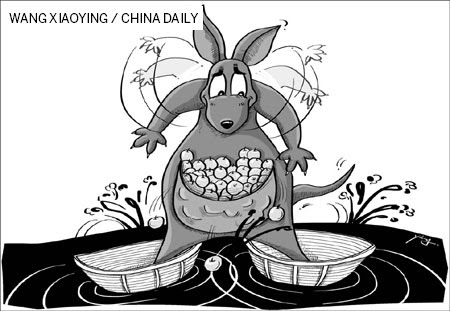
(Above: Chiese cartoonist Wang Xiaoyang portrayed Australia as being unable to maintain a foot in each - Chinese and US - camp over the Huawei and NBN controversy discussed below)


Both the US and China are approaching this rivalry from different perspectives. They are like the yin and yang of the famous Chinese symbol, pushing into and encircling one another, each looking for ways to outdo and outsmart the other. The US is in decline economically but maintains the largest armed forces in the world. Its rivalry with China is manifest in the white yang of a military squeeze, of military pressure and military pose-striking. China’s rivalry with the US is manifest in the black yin of economic and financial strength, of economic alliance with emerging powers, of attempts to knock the US further off balance with suggested new international financial architectures. The US has a little bit of black yin as well, particularly the US dollar as an international currency and continued controlling influence in the World Bank and the International Monetary Fund. China has a little bit of white yang as well, for although its capacity to project its military power internationally is currently quite limited, it is growing.


The struggle for the redivision of the world into areas for the most profitable investment of export capital has direct implications for the Australian people. We are cemented into a subservient political and military relationship with US imperialism on the basis of an economic situation that is fluid and changing. Part of that change involves the only significant potential challenger to US “full spectrum domination”, and that is China. “Australia is China’s top foreign direct investment destination...China is Australia’s largest trading partner and will remain so for the foreseeable future” (see http://www.lowyinstitute.org/Publication.asp?pid=1616 ). However, China is no longer free of the contradictions and crises of capitalism, its Gini coefficient (a measure of the gap between rich and poor) is one of the highest in the world, and there is an underlying social discontent amongst its working and peasant classes. These circumstances mean that the current struggle for economic redivision of sources of raw materials and markets between the US, Western Europe and China (with smaller but significant input from India, Russia, Brazil) is directly involving Australia and that the political and military loyalties of the Australian bourgeoisie will confront expanding economic ties with China; moreover, this contradiction will sharpen at a potentially huge expense to our people and our class.


Growing the yang


In addition to the many military bases and port facilities maintained by the US imperialists in our region, the US wants additional capacity to put the squeeze on China. It is poised to use a new naval base South Korea is trying to impose on the heroic people of Jeju Island which lies close to the entrance to the Bohai Sea and close to the shipping lanes into Tianjin, the major port city servicing the region around Beijing. (To complicate matters, the Bohai Sea is oil-rich; the US ConocoPhillips, in partnership with the China National Offshore Oil Company has two platforms in the Bohai Sea. Last June they began to leak. The US company initially tried to cover up the leak but by October there was a major oil spill which polluted the seas and coasts around Penglai in Shandong Province.)


The US is also after a renewed military pact with Japan and additional bases there. It has considerable military force on Japan’s Okinawa Island as well as on the Chinese separatist province of Taiwan. In the Philippines it is seeking to boost its military presence and it has conducted joint naval exercises with Vietnam.


The US is currently negotiating the stationing of four littoral combat ships (LCS) in Singapore. These developments are being closely watched by Lockheed Martin Corp, Australia's Austal, General Dynamics Corp and other arms makers that are building two models of the new warships for the U.S. Navy, and hope to sell them to other countries in coming years.


The Singaporean proposal (and similar proposals involving the Philippines and the HMAS Stirling naval base outside Perth) conveys something of the dilemma the US faces as a declining economic power trying to expand its military reach.


"Because we will probably not be able to sustain the financial and diplomatic cost of new main operating bases abroad, the fleet of 2025 will rely more on host-nation ports and other facilities where our ships, aircraft, and crews can refuel, rest, resupply, and repair while deployed," Chief of Naval Operations Admiral Jonathan Greenert wrote in the naval magazine Proceedings last November.


That is the US dilemma in a nutshell – its inability to sustain the financial cost of its military activity.


Hence the 2500 marines to be stationed outside of Darwin will be in a base that is ostensibly under Australian control and contributed to financially by Australian tax-payers.


There is also the plan to use the coral atolls of the Cocos (Keeling) Islands as a launch pad for US Global Hawk surveillance drones and the P-8 surveillance aircraft. These fragile atolls are in the Indian Ocean and provide access to the South China Sea.


The significance of the Indian Ocean and the South China Sea was captured in a piece by pro-imperialist US journalist Robert Kaplan, now working for intelligence analysts Stratfor. In America’s Pacific Logic (April 2012) Kaplan wrote:


The Indian Ocean is the world's energy interstate, across which passes crude oil and natural gas from the Arabian Peninsula and Iranian Plateau to the burgeoning, middle-class urban sprawls of East Asia. Though we live in a jet and information age, 90 percent of all commercial goods that travel from one continent to another do so by container ship, and half of those goods in terms of global tonnage -- and one-third in terms of monetary value -- traverse the South China Sea, which connects the Indian Ocean with the Western Pacific. Moreover, the supposedly energy-rich South China Sea is the economic hub of world commerce, where international sea routes coalesce. And it is the U.S. Navy and Air Force, more than any other institutions that have kept those sea lines of communication secure, thus allowing for post-Cold War globalization in the first place. This is the real public good that the United States provides the world.


In abandoning the Marxist path of anti-imperialist independence and self-reliance, the architects of China’s “reform and opening” have sacrificed both the state power and the labour power of the Chinese workers and peasants. The latter have “enjoyed’ the fruits of a process of primitive accumulation – unbearably long working hours, starvation wages, prohibition of union activity, unsafe conditions, lack of civil rights as migrants in their own country. The beneficiaries include multinational investors, a new Chinese bourgeoisie, and a state apparatus in China that purports to address new inequalities for the sake of social harmony but whose every move widens the gap between rich and poor.


The construction of China as the sweatshop of the world created a trading environment in which China’s central banks amassed huge amounts of US dollars. But a hoard is dead capital. China has released its dollar reserves back into circulation through the purchase by those dollars of US Treasury securities making it the largest single holder of US government debt, with 26 percent of all foreign-held US Treasury securities (8% of total US public debt).


To put China's ownership of U.S. debt in perspective, its holding of $1.2 trillion is even larger than the amount owned by American households. U.S. citizens hold only about $959 billion in U.S. debt, according to the Federal Reserve. (Other large foreign holders of U.S. debt include Japan, which owns $912 billion; the United Kingdom, which owns $347 billion; Brazil, which holds $211 billion; Taiwan, which holds $153 billion; and Hong Kong, which owns $122 billion.)


China continues to buy huge amounts of US Treasury securities, although it is seeking to diversify and become less dependent on the future convertability of US bonds. In fact, it became a net seller of U.S. Treasuries in the second half of 2011. China’s holdings of U.S. Treasuries accounted for 54% of its foreign-exchange reserves as of June 30, 2011 according to a U.S. Treasury survey released in March 2012. That is down from 65% in 2010 and a record 74% in 2006 and no doubt partly prompted by a growing awareness of what its leaders have derided as the US “addiction to debt” and the possibility of a downgrade in the rating of US debt. The latter came to fruition last August courtesy of Standard and Poors and was a nightmare come true for China which has 1.2 billion reasons for not wanting to see a drop in the value of the US dollar.


Whilst China is in a strong position economically, both in terms of its own ability to sustain GDP at a relatively high rate and by virtue of its ownership of substantial US debt, it needs a new international financial system in order to bring the yuan into play as a competitor to the dollar.


China has signaled on a number of occasions its desire to have the yuan achieve reserve currency status. It has taken some initial steps with proposals for the inclusion of the yuan in the IMF’s special drawing rights (a basket comprising dollars, euros, pounds and yen). On a bilateral basis it has set up currency swaps with countries including Argentina, Belarus and Indonesia, and has allowed letting institutions in Hong Kong issue bonds denominated in renminbi (yuan). China is supporting itself and other countries to diversify their reserve holdings away from the dollar, knowing that this will weaken the US.


Nouriel Roubini sees the Chinese goal in these terms: “Now, imagine a world in which China could borrow and lend internationally in its own currency. The renminbi, rather than the dollar, could eventually become a means of payment in trade and a unit of account in pricing imports and exports, as well as a store of value for wealth by international investors. Americans would pay the price…”


In 2009, China supplanted the US as Brazil’s largest trading partner. Brazilian President Lula visited China that year, observing “Between Brazil and China, we need to establish a trade that is paid for in our own currencies. We don’t need dollars. Why do two important countries like Brazil and China have to use the dollar as a reference, instead of our own currencies?....It’s crazy that the dollar is the reference, and that you give a single country the power to print that currency.”


In our own region, China has supported the 2009 Chiang Mai Initiative Multilateralization (CMIM) Agreement, which took effect on March 24, 2010, marking the official establishment of regional currency swaps as a crisis prevention measure in the wake of the 1997 regional financial crisis. Although Japan was the lead player in the early stages of establishing CMIM, its place has now been taken by China. When the CMIM established the ASEAN+3 Macroeconomic and Research Office (AMRO) in 2011 to provide it with a regulatory arm, Wei Benhua – who had until then managed China’s foreign reserve funds - became its first director. AMRO represents the Ministries of Finance, Central Banks and Monetary Authorities of ASEAN countries, China (including Hong Kong, China), Japan and Korea. The latter three countries contribute 80% of the $120 bn. held by CMIM regional currency swaps, with 20% contributed by the other 10 (ASEAN) members.


Economic commentators note that AMRO’s creation is a reflection of the “unrepresentative and unaccountable character of the global economic governance architecture…. it may also eliminate the need for a global lender of last resort—a role currently fulfilled by the IMF” and that if Western powers continue to exercise “unfair” control of bodies like the IMF, then they “risk further delegitimizing their current guardianship of the global economy” (K. Nachiappan and M. Joksic for the Carnegie Council).


Covering all bases


Of course it would be foolish to think that US imperialism relies on military muscle alone and that China is restricting itself to a game of financial chess. The US will probably have to make some changes to governance arrangements at the IMF and the World Bank to prevent the rise of more regional financial rivals based on the AMRO model in areas like the Middle East and Latin America. It is also waging an aggressive campaign to force the Chinese into increasing the value of the yuan, arguing that it has been kept artificially undervalued, giving China an unfair trade advantage by making China’s exports to the US cheaper and imports from the US more expensive. This turns into populist domestic rhetoric about Chinese responsibility for US job losses.


US imperialism can also be expected to place further pressure on China to deregulate its financial sector – a key neoliberal objective throughout the world. In March 2012 the World Bank President Robert Zoellick delivered a report, China 2030, which set out a comprehensive plan for restructuring the nation's State-owned sector to allow more private participation, and emphasising the need for the Bank of China to lose its monopoly position and accept competition from local and foreign financial institutions. The release of the report was disrupted by a lone protester, Du Jianguo, (above) who distributed anti-World Bank leaflets titled “Go home with your poison!” The incident prompted furious on-line criticism of any further opening of China to imperialist finance capital. Nevertheless, Premier Wen Jiabao called on April 3 for the nation’s biggest state-run banks to be broken up “because they earn far too much money”.


In Australia, US economic retaliation against China takes the form of pressuring our puppet government to deny China opportunities for investment here. This year’s rejection of the Huawei bid for participation in the National Broadband Network echoed the 2009 Government rejection of Chinalco’s US$ 19.2 billion bid for a stake in Rio Tinto. Like the earlier decisions to block Chinese investment in mines in the Woomera Prohibited Area and the Hawks Nest mining area in WA, the Huawei rejection was justified on national security grounds. The 2011 FIRB decision to order Chinese mining giant Shenhua to sell the 43 farms it had bought for $213m near Gunnedah in northen NSW if they were not used for mining was justified in terms of Australian agricultural interests . China justifiably complains of unfair treatment, although none of these contending groups of investors proceed from the interests of the Australian people. Forces loyal to US imperialist domination of Australia are certainly not beyond whipping up xenophobic and racist sentiments to obstruct and delay Chinese investment here.

For its part, China has been accused for over a decade of secretly building military bases in Burma as part of a planned extension of its influence into the Indian Ocean. These allegations are without foundation (see Andrew Selth, Chinese Military Bases in Burma: The Explosion of a Myth, Griffith Asia Institute, 2007). However, it has sent destroyers, frigates and supply ships to combat piracy in the waters off the coast of Somalia (for their part Somali pirates defend their actions as necessary to combat illegal fishing and the dumping of toxic wastes, including nuclear waste, in Somali waters). The presence of even a small escort flotilla so far from China has some in China calling for the creation of overseas military bases with Pakistan, the Seychelles, Sri Lanka and Madagascar as possible sites (see Prof. Shen Dingli, Don't shun the idea of setting up overseas military bases, http://www.china.org.cn/opinion/2010-01/28/content_19324522_3.htm  ). Indeed, Pakistan has asked China to build a naval base at its south-western port of Gwadar and expects the Chinese navy to maintain a regular presence there, according to Chaudhary Ahmed Mukhtar, Pakistan’s defence minister.


The main venue for a Chinese naval presence, quite legitimately, is the South China Seas and the US, through its Filipino proxy, has recently created a serious incident, the Huangyan Island incident, to test Chinese resolve. Where China is in the right, particularly in relation to US imperialism, we must unswervingly support it. Where China extends its naval presence into international waters, we should assess the situation according to its circumstances, and if China ever uses its military or naval power to practice interference, subversion, bullying or control, we should denounce it as China itself called on us to do in 1974 (Deng Xiaoping, Speech at the Special Session of the UN General Asembly, http://www.marxists.org/reference/archive/deng-xiaoping/1974/04/10.htm  ).


Conclusion


The growing rivalry between the US and China is having unwelcome repercussions in Australia. The primary responsibility for increasing tensions in our region is US imperialism which is strategically threatened by China’s economic strength and consequently seeking to expand its military encirclement of that country. As a willing participant in the imperialist globalised economy, and with substantial and growing economic interests abroad, there is capacity and motive for China to complement its economic might with the ability to project its military strength into the international arena.


The task of Australian communists is to develop the movement against US imperialism, to force the Australian bourgeoisie into ending its dependence on and alignment with US imperialism, and to propagate the ideal of Australia as an independent force in world affairs capable of making judgements and decisions that reflect the will and the interests of the Australian people.


The rivalry between the US and China will develop unevenly and we must make tactical adjustments as required, but our strategic goal must be anti-imperialist Australian independence and socialism.

Growing the yin

Wednesday, April 25, 2012

Former Prime Minister Fraser opposes new US bases in Australia

Malcolm Fraser (left) became Australia's Prime Minister in 1975 a constitutional coup that saw the Queen of England's representative in the supposedly sovereign nation of Australia withdraw the commission granted to the elected Whitlam Labor Government.  Fraser had provoked a crisis by using the Liberal-National Coalition's majority in the Senate to block the Supply Bills that were required to provide money for the Whitlam Government's Budget.

With the support of the Murdoch press, Fraser quite convincgly won the next election and set about dismantling many of the welfare measures enacted by Whitlam, and in particular, the universal health care scheme Medibank.  he also tightened the penal provisions against industrial action.

With his rich squatter background, and his aloof patrician demeanour, Fraser further alienated working class Australians when he infamously said in parliament that "Life wasn't meant to be easy".

Although he lost the 1983 election to the former head of the Australian trade union movement, Bob Hawke, he had taken several steps that revealed a certain far-sightedness as a member of the ruling class.  He introduced land rights legislation to pacify Aboriginal and Torres Strait Islander activists who were becoming more militant and directing their political anger at giant multinational pastoral and mining companies.  And he took a stand against apartheid in South Africa and against white minority rule in Rhodesia, now Zimbabwe.

In recent times he worked closely with Gough Whitlam, his former political adversary, on issues ranging from the argument for a republican Australia to the humane reception of asylum seekers.  He was openly critical of John Howard's neo-liberalism.

Fraser's latest comment, below, has been taken from the Fairfax press, and follows a submission to a Government White Paper on Australia's relations with Asia in which Fraser stated that if Australia continued to be "a compliant ally of a virtually defeated super-power", then it risked "being taken as a prize by China".

All of which underscores the contemporary validity of Lenin's method of exploring the contradictions between imperialist powers for the redvision of the world into spheres of influence, sources of raw materials and markets for the export of capital. So long as imperialism exists, warned Lenin, so does the danger of war. 

US Marine 'Base' Is a Mistake, Says Fraser


The Age (Australia)

Tuesday, April 24, 2012


THE former Liberal prime minister Malcolm Fraser (above) says the new American marine "base" near Darwin is a mistake, and that Australia's grovelling to Washington is hampering ties with Asia.


In a strongly worded submission to the federal government's white paper on future relations with Asia, Mr Fraser has criticised Australia's subservience to the US as a product of misguided assumptions America offers a security guarantee.

"Over 20 years now we have given the impression of doing that which America wants," Mr Fraser writes.

"We seem to believe that our security can be best assured if we do what we can to win brownie points with the US. This is a mistaken assumption.

''No country can really win brownie points with great powers. Great powers follow their own national interests and we should follow ours."

Mr Fraser is highly critical of the deployment of US marines in the Northern Territory, saying it fuels Chinese concerns over a policy of containment. He also dismisses claims by Labor and the Obama administration that the presence of the marines does not amount to a "base".

"For America to say that 2500 troops do not constitute a base is nonsense, indeed a fabrication," Mr Fraser writes.

"In military terms, a base does not have to be bricks and mortar. If  2500 troops are stationed in a particular place then the language makes it quite plain that they are based in that place. It is a base.

"To say that they are just passing through and that it is not a base is deceptive and misleading. It sends the wrong message, not only to China, but to countries like Indonesia."

He told the Herald he was also concerned Australia would lose more of its independence in Asia should the US turn Cocos Island into a base for unmanned surveillance drones, as reported last month in The Washington Post.

The Prime Minister, Julia Gillard, commissioned a white paper last year guided by the former head of Treasury, Ken Henry, titled Australia in the Asian Century.

Mr Fraser said he had only decided to put his thoughts on paper after the marines' presence in Darwin was announced and reports of plans for a US military presence in the Cocos Islands emerged.

In his submission, he said he was not against the US alliance but for Australian independence.

He said in assessing what to do in the future, Australia should conscious of our history and a dependence on Britain before World War II: "We believed that Britain would be able to secure our future," he writes. "It never occurred to us that Britain would be so preoccupied, so beleaguered, that in a situation of emergency she would not be able to help."


Thursday, March 29, 2012

Gina Reinhart shows wealth no obstacle to ignorance

Gina Reinhart has taken to poetry to express her embrace of multiculturalism and migrant workers.

It is genuine humanitarianism at its finest, and has nothing to do with Australia’s richest person’s desire to exploit cheap labour at rates below those paid to Australian workers.

This is part of what Gina wrote:

The Globe is sadly groaning with debt, poverty and strife
And billions now are pleading to enjoy a better life ...
Embrace multiculturalism and welcome short term foreign workers to our shores
To benefit from the export of our minerals and ores.

(From the ABC News website: http://www.abc.net.au/news/2012-03-29/rinehart27s-overseas-worker-push-facing-union-rebellion/3921700 ).


It is such a fine expression of empathy for the poor in high literary form that it has attracted its own lit crit (http://theworstofperth.com/2012/02/13/la-gina/ ).

Of course, the reason why the “Globe is sadly groaning with debt, poverty and strife” has nothing to do with the accumulation of capital by the 1%.

A workmate of mine has uncharitably responded with a poem of her own:

Gina R, Gina R, who the hell do you think you are
With your mate Twiggy and his driverless trucks
You obviously don’t give two flying fucks
Who’s driving a dozer or wielding an axe,
So long as you don’t have to pay any tax.

She claimed to have been an “award winning” poet, having won a competition at Hamilton Secondary College!

I did point out that I’d beaten her to the gun with this effort that I posted on June 13, 2010:

Twiggy Forrest in his workman's clothes
(With his workman's bank account - as everybody knows!)
Will be forced to live on the bones of his arse
If he's taxed at the level of the working class.

Gina Reinhardt, looking very sad,
"It's all my money - I got it from my Dad";
But that bastard pinched it from the labouring crew -
The work of the many for the wealth of a few.
A resource profit super tax
Such a mild move for all their wild attacks
When we socialise the mines at a later hour
Then we'll see them weep 'cos we'll hold state power.

And we'll dress Mr Twiggy like a working man,
And he can irrigate the desert with a watering can
Which we'll fill forever down the years
With Gina Reinhardt's well-deserved tears!

If anyone else is inspired by Gina “Mother Theresa” Reinhart’s new-found compassion for the wretched of the earth, please hit the comments box below and send it in!


Monday, March 26, 2012

US out of the Cocos Islands!


The US imperialists are placing a further squeeze on their compliant puppets in Canberra.

Not satisfied with the “offer” for US marines outside Darwin, and the promise of access to the Stirling Naval Base outside of Perth, they are nosing around the Indian Ocean territory of the Cocos (Keeling) Islands.

The islands were annexed by the British in 1857 and transferred to Australian control on 23 November 1955 under the Cocos (Keeling) Islands Act 1955 (an Australian Act) pursuant to the Cocos Islands Act, 1955 (a UK Act).

The islands are strategically placed and were the subject of inter-imperialist rivalry in both World Wars.

Today, they are tourist destinations, with pristine shallow waters around two atolls, with some 24 islets. There are no rivers or lakes, and fresh water is drawn from natural underground storage of rainwater.


U.S. and Australian officials said the atoll could be an ideal site not only for manned U.S. surveillance aircraft but for Global Hawks, an unarmed, high-altitude surveillance drone. The U.S. Navy is developing a newer version of the Global Hawk, known as the Broad Area Maritime Surveillance drone, or BAMS, that is scheduled to become operational in 2015. Aircraft based in the Cocos would be well-positioned to launch spy flights over the South China Sea.

That this is an imperialist attempt to circle and contain China is quite obvious.

Like the naval base proposed for Korea’s Jeju Island (conveniently omitted from the map below), it is tantamount to setting up camp on your neighbour’s doorstep and then accusing him of threatening you.


There will be no consultation with the people of the Cocos (Keeling) Islands. But they have an interesting demographic which may not welcome being taken over for aggressive US military purposes.

In 2010, the population of the islands is estimated at just over 600. The population on the two inhabited islands generally is split between the ethnic Europeans on West Island (estimated population 100) and the ethnic Malays on Home Island (estimated population 500). A Cocos dialect of Malay and English are the main languages spoken, and 80% of Cocos Islanders are Sunni Muslim.

The US imperialists are hell-bent on controlling the South China Sea and are making the Chinese out to be the baddies.

For domestic consumption, the Washington Post frames the latest development in these terms: “Although U.S. officials say the regional pivot is not aimed at any single country, analysts said it is a clear response to a rising China, whose growing military strength and assertive territorial claims have pushed other Asian nations to reach out to Washington”.

Look at the map again to see a case of the pot calling the kettle black.

It is the US imperialists who are making assertive claims on Australian (and other) territory to advance the interests of the Empire.

Keep the Cocos clean!

US imperialists out!


Neo Liberalism under attack in China - Introducing a People's Proposal for China by Zhun Lu


(Above: Only socialism can save China - one of a series of posters issued after June 4, 1989)


The March 2012 edition of The Deal, the glossy business magazine of Murdoch’s Australian newspaper revealed that as early as 1980, the year after Deng Xiaoping formally cemented his hold over the Chinese Communist Party, an appeal was made to the World Bank "for help to develop its economy".


The President of the World Bank and major strategist for US imperialism, Robert McNamara, appointed his right-hand man, the Brazilian-born German Caio Koch-Weser "to bring China into the Bank’s development programs as the first step in an engagement that has since transformed the global economy". It has also transformed China, forcing it from the socialist road to the capitalist road and replacing the socialist ideological outlook with the ideology of neo-liberalism which is the most reactionary and aggressive expression of the interests of finance capitalism.


The text that follows is a re-post from the Democracy and Class Struggle blog (see link at the end or in the links column at left).


................................


In 1997, the World Bank published a long report "China 2020" calling for privatization of public owned enterprises and further liberalization of market. There was very little dissent from the Chinese people; in fact, very few of them knew what was going on in the policy making circles. The later history suggests that the Chinese government followed the advice from the World Bank very closely. Not only had the bureaucrats privatized almost all the public owned enterprises, they also provided "market solution" to education, health service and residential housing issues.

Recently, the World Bank and the research institution under the Chinese State Council published a new report "China 2030". This report gives basically the same prescription as 15 years ago. But the reception is different this time. In the World Bank news conference, Du Jianguo, an independent scholar stood up and protested against the structural reform doctrine advocated by the World Bank. He condemned the report as "poison" and demanded the World Bank to leave China. This protest was reported by several independent media and received enormous support from the online communities.

Interestingly enough, just a short while ago, the authoritative People’s Daily published an editorial calling for further reform while acknowledging the potential oppositions as "trivial critics". In the Chinese context, "further reform" in the mainstream media means neoliberal reforms like privatization and marketisation. This article attracted lots of critique from Marxists and the left wing in general, the scale of which is very unusual in the last 20 years.

All these widespread oppositions to the market reform give us a clear signal: the Chinese people are now explicitly hostile towards neoliberalism (even though not all of them have even heard of this term). There are several major reasons worth mentioning. First of all, we "have been there". The last wave of neoliberal reform has laid off millions of workers and destroyed millions of families. The marketisation of education, health service and residential housing made the life of the working class miserable. Second, the leftist movement has grown much stronger since 1990s. Several large leftist websites are more and more visible in public discussions and all of them explicitly oppose the reform plans from the World Bank and the central government. Many grass-root worker/peasant organizations have come into being and they are in nature anti-neoliberalism.


Last but not least, neoliberalism is in crisis all over the world. The recent economic crisis refreshes the memory of those Chinese people whose mentality remained at the "end of history" more than 20 years ago.

These oppositions and discussions gave birth to a People’s Proposal on China’s future development. The first draft was written by a writer on one of the largest online forums in China. Red China website quickly edited them into a concise version. After that, people have been enthusiastically discussing the proposal all over the Internet and have been adding other things. The China Study Club in UMass Amherst (which I belong to) collectively translated the Red China version into English to give people a sense of what the proposal looks like. This achievement is definitely a milestone in the working class movement in China in that for the first time in the recent three decades so many people are consciously questioning the whole program of the ruling class and have begun discussing what they want. The proposal does not use any Marxist terms, nor does it mention socialism, but everyone can see where it is heading towards.

A SIXTEEN-POINT PROPOSAL ON CHINA’S REFORM


1. That the personal and family wealth of all officials be publicised and their source clarified, and all "naked bureaucrats" be expelled from the Party and the government. ("Naked bureaucrats" refers to those officials whose families live in developed countries and whose assets have been transferred abroad, leaving nothing but him/herself in China.)

2. That the National Congress concretely exercises its legislative and monetory function, comprehensively review the economic policies implemented by the state council, and defend our national economic security.

3. That the existing pension plans be consolidated and retirees be treated equally regardless of sector and rank.

4. That elementary and secondary education be provided free of charge throughout the country; compensation for rural teachers be substantially raised and educational resources be allocated on equal terms across urban and rural areas; and the state assume the responsibility of raising and educating vagrant youth.

5. That the charges of higher education be lowered, and public higher education gradually become fully public-funded and free of charge.

6. That the proportion of state expenditure on education be increased to and beyond international average level.

7. That the price and charge of basic and critical medicines and medical services be managed by the state in an open and planned manner; the price of all medical services and medicines should be determined and enforced by the state in view of social demand and actual cost of production.

8. That heavy progressive real estate taxes be levied on owners of two or more residential housings, so as to alleviate severe financial inequality and improve housing availability.

9. That a nation-wide anti-corruption online platform be established, where all PRC citizens may file reports or grievances on corruption or instances of abuse; the state should investigate in an openly accountable manner and promptly publicise the result.

10. That the state of national resources and environmental security be comprehensively assessed, exports of rare, strategic minerals be immediately cut down and soon stopped, and reserve of various strategic materials be established.

11. That we pursue a self-reliant approach to economic development; any policy that serves foreign capitalists at the cost of the interests of the Chinese working class should be abolished.

12. That labour laws be concretely implemented, sweatshops be thoroughly investigated; enterprises with arrears of wages, illegal use of labour, or detrimental working condition should be closed down if they fail to meet legal requirements even after lawfully limited term for self-correction.

13. That the coal industry be nationalised across the board, all coal mine workers receive the same level of compensation as state-owned enterprise mine workers do, and enjoy paid vacation and state-funded medical service.

14. That the personal and family wealth of managerial personnel in state-owned enterprises be publicized; the compensation of such personnel should be determined by the corresponding level of people’s congress.

15. That all governmental overhead expenses be restricted; purchase of automobile with state fund be restricted; all unnecessary travelling in the name of "research abroad" be suspended.

16. That the losses of public assets during the "reforms" be thoroughly traced, responsible personnel be investigated, and those guilty of stealing public properties be apprehended and openly tried.

ORIGINALLY PROPOSED BY Hanjiangchunmeng on bbs.people.com.cn
EDITED BY RED CHINA WEBSITE (http://redchinacn.com)
TRANSLATED BY CHINA STUDY CLUB IN UMASS AMHERST.

Thursday, March 08, 2012

US out of Jeju Island!

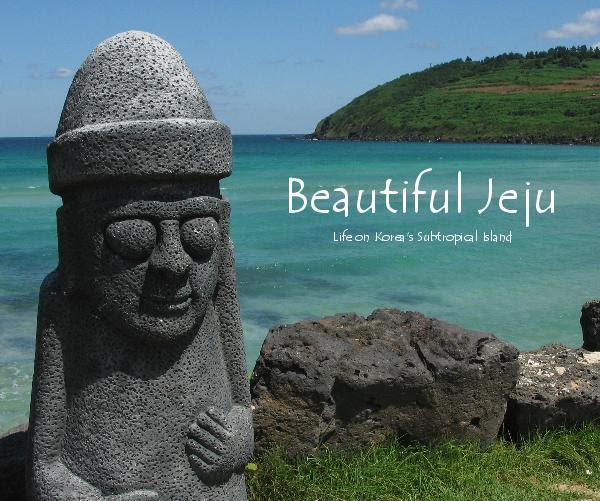
(Above: Tourism industry promotion of Jeju Island)

South Korean authorities have moved against the people of Jeju Island to begin blasting the precious Gureombi coastline to make way for a naval base to serve the US imperialists. The first round of detonations began on the morning of March 7 2012 in Gangjung (also known as Kangjung), a village on the southern coast of Jeju

The blasting was to have begun on November 18 last year, but permission was refused by the island’s Governor Woo after local residents gained international support for a campaign to stop the blasting and the base.

On this occasion, Governor Woo has also denied permission for the blasting, but this has been ignored by the authorities.


(Above: location of proposed blast sites along the Gureombi coastline)


Background

Jeju Island lies just off the southern-most tip of the Korean peninsula. It lies in pristine waters containing beautiful coral reefs and is an iconic and beautiful setting for peaceful traditional industries and tourism. It was recently voted one of the New Seven Wonders of the World and has a World Heritage Listing.


For several years, its people have been waging a mass struggle against the building of a naval base, to be used by both the South Korean and US navies.


The interests of the US imperialists lie in the strategic positioning of the island which oversees the shipping lane used by China for 80% of the oil it imports by ocean tankers.


Heroic struggles repressed by South Korean regime


More than 95% of the residents of Jeju Island oppose the construction of the naval base.
They have a long history of resistance to occupation by, amongst others, China’s Yuan Dynasty, the Japanese militarists and US imperialism. In 1948 more than 80,000 islanders were massacred by the Syngman Rhee fascist clique following their usurpation of power and decision to divide Korea.


In deciding to oppose the naval base, the Jeju island residents point to the apology they were given five years ago by South Korea for the 1948 massacre. At the time, the government declared Jeju an “Island of Peace”, hardly compatible with the forced imposition of a naval base to serve the interests of US imperialism.


For the past four years, the Jeju people have maintained a protest site at Jangjeong Village adjacent to the proposed naval base.


On May 19 2011 the police and the military attacked the protest site and arrested eight of its leaders. However, the residents protected their site and its banners.


Then, at the crack of dawn on Friday 15 July undercover police arrested three more leaders of the resistance and declared that 76 others were banned from public waters or land near the Joongduk coastline where the base will be constructed.


Gangjeong Village Chief Kang Dong-Kyun, one of those arrested in the dawn raid, was fined $5,000 for each violation of an order requiring the removal of all facilities from the protest site.

US imperialism’s aggressive posturing against China

US imperialism is a declining economic power but is still the world’s No. 1 superpower. That is a dangerous mix.


US imperialism wants to threaten and intimidate China.

This is how a Stratfor analysis presented the matter a couple of days ago:

China also faces a primarily military problem. China depends on the high seas to survive. The configuration of the South China Sea and the East China Sea render China relatively easy to blockade. The East China Sea is enclosed on a line from Korea to Japan to Taiwan, with a string of islands between Japan and Taiwan. The South China Sea is even more enclosed on a line from Taiwan to the Philippines, and from Indonesia to Singapore. Beijing's single greatest strategic concern is that the United States would impose a blockade on China, not by positioning its 7th Fleet inside the two island barriers but outside them. From there, the United States could compel China to send its naval forces far away from the mainland to force an opening -- and encounter U.S. warships -- and still be able to close off China's exits.

(George Friedman, Assessing China’s Strategy, March 6, 2012)


(Above, elderly resident vociferously opposes the blasts and the base. Below, a group of Jeju Island grandmothers join the protest)


Build respect and understanding, not US bases

The blasting of Gureombi is an act of great environmental vandalism and fails to respect the wishes of the people of Jeju Island. At the present time, US imperialism is working through loyal allies in the region, including, regrettably, the government of my country Australia, to build up its military presence in the Pacific region. This is unwelcome and destabilises our region.


We want to see friendly relations based on mutual respect and understanding in our region, not increased military tensions based on vainly trying to maintain the privileges and power of the declining United States. The US risked nuclear war during the Cuban Missile Crisis. They would not like it if the Chinese Navy built a base in Cuba either. So why do they think the Korean and Chinese peoples want them to build a base for US Navy Aegis missile destroyers and aircraft carriers on Jeju Island?

We want to see respect for our global environment and particularly for the treasured coastline of Gureombi.


(Above: nuns blockade the road to be used by contractors employed to carry out the blasting)


(Above and below, heroic residents defend th coastline against the police)


“Free trade” backed by gunboat diplomacy

The Korean people are also incensed that their economic interests are being taken away in the name of “free trade”. As the online Korea Times (a pro-government and pro-US publication) wrote on March 8:

“It is regrettable to see the nation sharply divided over the plan (for the naval base on Jeju Island). The controversy is among hot-button campaign issues such as the Korea-U.S. free trade agreement (FTA). The main opposition Democratic United Party (DUP) has already threatened to revise or nullify the trade deal if it takes power.”


(Above and below: police deployed against the people)


We support the Jeju residents, environmental activists, and opposition lawmakers say the naval base will make residents vulnerable to potential military skirmishes and destroy the island’s natural beauty.

US imperialism out of Korea!
For friendship and understanding among the peoples of our region!


(Above: police violence will not break the heroic spirit of the Korean people!)


Tuesday, March 06, 2012

Fair Work Act threatens Great Barrier Reef


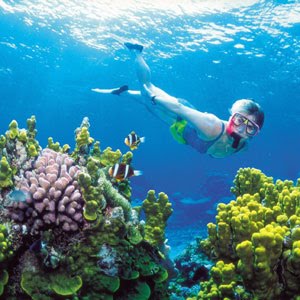
Climate change, ocean acidification, shipping, and now the proposed mining of coal seam gas are factors leading to the decline of coral cover on the Great Barrier Reef, but it is the government’s industrial legislation, the so-called Fair Work Act, which threatens it with continued destruction.

A recent article, published in the scientific journal Coral Reefs last year, found coral cover on the Great Barrier Reef had declined by up to 50 per cent since the 1960s.

Not sure how a law governing industrial relations can harm coral growth?

This pernicious legislation only allows “protected” industrial action by unions – that is, action during a limited bargaining period in support of a new agreement or award. The action has to be approved and can only relate to “matters pertaining” to the employer-employee relationship.

The Australian government exercises custodianship over the Great Barrier Reef for all of humanity, a fact recognised in the GBR’s listing under all four natural World Heritage criteria for its outstanding universal value.

But the government also exercises state power on behalf of the infamous 1% - the core of which is foreign monopoly capital. In that capacity, the government has declared that coal seam gas developments would have minimal impact on the Great Barrier Reef, an assessment labelled as untrue by the visiting coordinator of the UNESCO World Heritage Centre’s marine program, Fanny Douvere.

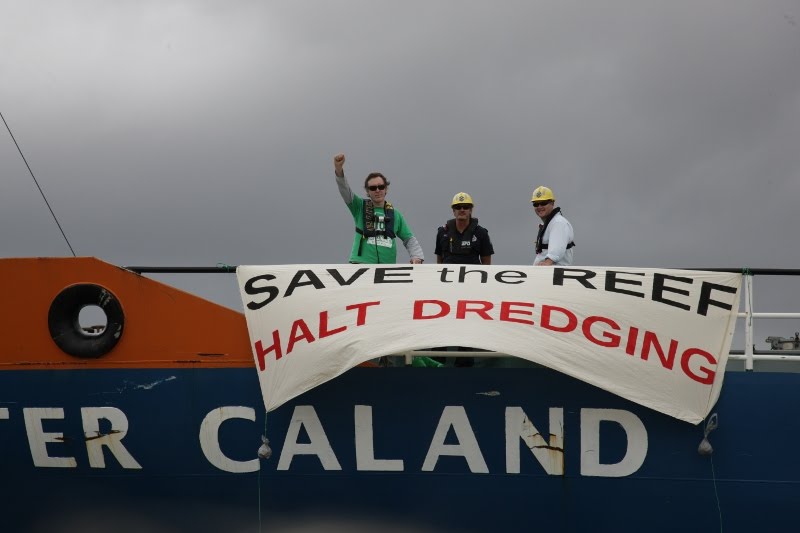
It has also given approval to Gladstone Port Authority to dredge 46 million cubic metres inside the reef's world heritage area over the next 20 years, on the site to facilitate export of coal.


The Australian government invited a delegation from the Centre to inspect the reef after it failed to alert UNESCO's World Heritage Committee of its plans to approve a liquefied natural gas port development on Curtis Island last year.

How can a government, tied in a thousand and one ways to corporate interests and corporate agendas, be forced to take a contrary stand and act in the interests of the people and their environment?

In the past, this has occurred when working people have told them to do it by refusing to lend their labour power to the destruction of their environment.


Take these two examples from Humphrey McQueen’s recently published We Built This Country: Builders’ Labourers And Their Unions (Ginninderra Press, 2011).

Coral battleground 1970

After tenders to drill for oil on the Great Barrier Reef went out during 1969, the Queensland branch levied its members to bring a US expert to testify about the threat to the Reef. In speaking for the proposal, secretary Delaney pointed out that the Queensland Trades and Labour Council (T&LC) and the ALP were the ‘only working-class organisations to interest themselves in the [Royal] Commission’ into the Reef. In July, the T&LC placed a total ban on drilling. Until then, poet and activist Judith Wright had feared that the conservationists had lost. She declared the union action ‘spectacular and unprecedented’. That ban remains spectacular. It also set a precedent. Henceforth, environmentalists hoped that unions would win their battles for them (p. 290-1).

Fraser Island - 1975

In 1975, the Bjelke-Petersen regime allowed mining on the world’s largest sand island. The damage was inflicted by the US construction giant, Dillinghams, the foe of BLs around the world. When Federal Council debated how to save this natural wonder, Queensland secretary Dobinson feared the loss of its perched lakes. Victorian assistant secretary Norm Wallace recalled enjoying the ‘crystal clear lakes above sea level which had outlets but no inlets. There is pure water, clean white sand, good rain forests and beautiful timber. Fraser Island must be preserved’. From Tasmania, Morgan pictured Fraser as the southern anchor of the Reef. All delegates opposed Dillingham’s vandalism. Gallagher urged them to gather support from other unions. The Federation joined the BWIU in banning all Dillingham projects until an official assessment had reported. After visiting the island late in May, Gallagher observed: ‘Experience has taught us that when the pressure is off, companies usually go for maximum profit’ (p. 293).


Both Fraser Island and the Great Barrier Reef were saved by union action which is now illegal under Fair Work Australia.

There is no more urgent task than for people interested in saving their environment to also work for the restoration of the right to withdraw one’s labour as one sees fit!