Monday, October 30, 2006

Noonkanbah

TRUCKS OF AMAX

Like Nazis marching
into Poland
comes this convoy
from the city:
snake of chrome

with snake-evil task,
the trucks of Amax,
going to Noonkanbah,
place of the goanna,
to rip and tear.

In this time and place
a Nazi raid
into the lands of those who
with sacredness and gentility
uphold civilisation
against the perfidious
god of profit.

With conqueror’s sneer
at the roadside few
the police drive straight
at the camera crew

Superiority – so base, so low,
as on the trucks of Amax
go…

In my dull routine
far from the jellied
heat of the road,
an aching to fight:

to swoop from the skies
in wedgetail glory
leaving the trucks of Amax
gory

But police stand guard
with batons hard
along the road
to Noonkanbah…

Under the banner of plunder
the Nazis march today
all through the great
Down Under
if Amax has its way.

And a fight it shall be,
for in these things -
incompatibility!

Compassion and the greed of the plunderer
Respect and the superior man’s contempt
Understanding and the arrogance of the profiteer
Independence and prostitution to the foreign dollar
Freedom and police in the pay of traitors
No - there are no
swastikas, only dollar signs
but like Nazis
marching into Poland
go the trucks of Amax


I wrote the poem above in 1980. This is the background:

Australia is a nation created by British colonialism, which seized the southern continent from its indigenous owners in 1788 and succeeding years. Ruling class historians describe this as "discovery" and "settlement" and even today try to deny that the process was one by which one group of people, the colonialists, used violence and the threat of violence to overturn the traditional rights of another people, the tribal communities of Aboriginal Australia.

As a Second World country, Australia is denied its full rights to independence by imperialism. The injustice of this is visited many times over on the indigenous peoples, many of whom live in worse than Third World conditions.

Twenty-six years ago, the Texas-based multinational Amax decided that it wanted to drill for oil on the Noonkanbah pastoral lease near Fitzroy Crossing in Western Australia. The traditional Aboriginal owners saw themselves as custodians of the land and it’s Dreaming sites and resisted this encroachment on their land. The labour movement swung into action behind them.

The right wing Premier of Western Australia mobilised the state forces behind Amax and a vicious police presence was used to guard a convoy of 49 Amax trucks on their journey from Perth to Noonkanbah, 3000 kilometre to the north.

The arrogance of the reactionaries and their contempt for indigenous culture is seen in the cartoon.
Twenty-five years later, in December 2004, the Noonkanbah community won a native land title claim to 1811 square kilometres of their traditional land.
The "place of the goanna" refers to an indigenous belief about a part of the mining lease being sacred to the large Australian lizard called the goanna.
The wedgetail eagle is a magnificent and majestic bird, the largest of Australia’s birds of prey.
(For a history of indigenous struggle in the 70’s and 80’s, see here)

Friday, October 27, 2006

Ted Hill

Comrade Haisanlu referred to Comrade E. F. (Ted) Hill, late former Chairman of the CPA(M-L) in his reply to my blog on North Korea.

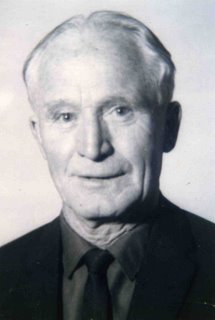
I remember Ted Hill well. He was an older generation of communist to most of my contemporaries, but he was the undisputed leader of the CPA (M-L) and had a thorough grasp of Marxism-Leninism-Mao Zedong Thought. He provided active leadership over many years politically, ideologically and organisationally. I still go to his writings for guidance.

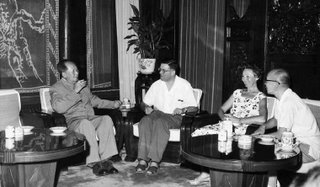
Ted Hill and Mao Zedong had many discussions over the years. This is an early photo of the two.


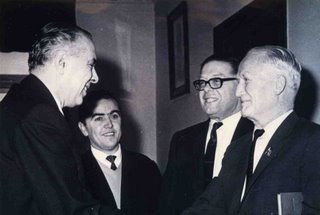
I mentioned Charlie McCaffrey in an earlier blog. Here, he and Ted meet with Comrade Enver Hoxha.


Great servants of the people, all of them!


Thursday, October 12, 2006

Hands Off North Korea!

This then is the insomniac’s nightmare:
The monster’s claw above the face
The black emptiness of terror
The mind’s frantic paralysis
The pounding of the rigid body
The frozen palpitations
The shivering warmth of sweat
The sleepless fear
Of the eternal second
When, with undue haste
To beat the morning sun
The world is bathed
In the final light
Of the megaton

I am no lover of nuclear weapons.

I wrote the poem above in 1990, when it still seemed possible that nuclear conflict might occur.

Why then do I salute the Democratic People’s Republic of Korea for conducting an underground nuclear test on October 9, 2006?

Because this tests was done in revolutionary defiance of threats from US imperialism.

Defiance of imperialism is not a bad thing, but a good thing, even when it means a proliferation of nuclear weapons in the world.

My view is that we should continue to call for the complete prohibition and thorough destruction of all nuclear weapons. The onus must be on the biggest nuclear powers to destroy their stockpiles first to a level at which a general process of destruction in all nuclear weapons possessing states can occur.

Only twice used in conflict, the massive stockpiles of nuclear weapons in the world have long been used as a means to bully and oppress small nations striving for independence from imperialism.

Nations not wanting to be controlled by US imperialism are inevitably designated "rogue nation" status, or are declared to be part of an "Axis of Evil". They are subjected to every form of threat and sanction from US imperialism and its followers.

They are told that it is the right of US imperialism to initiate "pre-emptive first strikes" against sovereign nations so as to effect "regime change". They are openly told that they are on the US imperialist hit-list.

When they offer to talk on a one-to-one basis with US imperialism or to sign pacts of mutual non-aggression with US imperialism they are spurned.

North Korea would willingly sign a "no first use" of nuclear weapons clause with US imperialism, but the latter will not agree.

The response of Australia’s politicians, who are out and out lickspittles of US imperialism, has been to spur the US on to retaliation against North Korea. Foreign Minister Alexander Downer has upgraded North Korea from "rogue state" to "outlaw rogue state" status. One wonders how much worse they can get! Prime Minister Howard declares North Korea to be a "seriously crazy regime" and warns that a military strike against it may be necessary!

Meanwhile, the common sense of the people rises to the surface. Nearly all letters to the editor of the local capitalist press blame the US for provoking North Korea into conducting a nuclear test. Many direct ridicule and scorn at Bush and Co.

We need to state quite clearly:

Hands off North Korea!

For the complete prohibition and thorough destruction of all nuclear weapons!

Monday, September 25, 2006

HUGO CHAVEZ TELLS US WHERE WE’RE HEADIN’

In the song Senor (Tales of Yankee Power) on his 1978 Street Legal album, Bob Dylan asks an unidentified "senor" if he "knows where we’re headin’?"

This is one of the most overtly political songs of a writer who has spent most of his creative life trying to escape from the "protest singer/ spokesman of a generation" label that was placed upon him early in his career.

And it’s an interesting one, because the words in parentheses, which do not appear in the song, yell out for this to be read politically.

I’ll return to the song in a minute.

But first of all, Hugo Chavez.

The Venezuelan President made two speeches at the United Nations in recent days. The first was a strong denunciation of US imperialism which "echoed his mentor Fidel Castro's historic 1960 debut address before the General Assembly". It was well-received by many delegates and "generated the loudest burst of applause for a world leader at the summit".

In my little corner of the US empire (South Australia), it was completely ignored by all branches of the capitalist media. (What do you expect given that this is the home of former Aussie Rupert Murdoch’s News Corporation?)

However, the second speech, on September 20 was a media sensation.

Aussies will know what I mean when I say that Chavez was as game as Ned Kelly, and that his speech was a latter-day Jerilderie Letter.

"The devil came here yesterday," Chavez said, referring to Bush, who addressed the world body during its annual meeting Tuesday. "And it smells of sulphur still today."

"As the spokesman of imperialism, he came to share his nostrums to try to preserve the current pattern of domination, exploitation and pillage of the peoples of the world. An Alfred Hitchcock movie could use it as a scenario. I would even propose a title: 'The Devil's Recipe.' "

Chavez held up a book by Noam Chomsky on imperialism and said it encapsulated his arguments: "The American empire is doing all it can to consolidate its hegemonistic system of domination, and we cannot allow him to do that. We cannot allow world dictatorship to be consolidated."

Chavez was audacious, irreverent and defiant. I loved it and I’m pleased that Chomsky’s book sales skyrocketed in the aftermath.

But back now to Dylan.

In the song Senor, Dylan addresses a series of questions to an unidentified Hispanic male. He is seeking direction and guidance, confused and bewildered by the reactionary orientation of the US ruling class.

I’m expressing it in those terms. Dylan probably wouldn’t. He’s not a Marxist nor even consciously anti-imperialist.

In his youth, he referenced Castro for shock effect ("I like Fidel Castro and his beard" yelled the protagonist in Motorpsycho Nightmare). And he cited the ban on boxing in Cuba approvingly in Who Killed Davey Moore?

In Senor, the first question he asks is:

…do you know where we’re headin’
Lincoln County Road or Armageddon?

The reference to "Lincoln" in the first of the two choices works for me as a reminder of early American values of democracy and equality as personified by Abraham Lincoln, although Lincoln County was also the site of a murderous frontier conflict between two factions of white settlers. William Bonney, later known as Billy the Kid, had a part in this.

So, on another level, maybe the choice is no choice at all. Violence and destruction, or the violent destruction of the world?

I think I still prefer the first interpretation.

In the second verse, Dylan asks about a woman who is hiding somewhere, and there are flashes of Wild West cinema in the images. Dylan locates the song geographically in those open spaces where the rich industrialised North meets the poor agrarian South.

In the third verse, it seems as though the "she" might be the spirit of the real America that Dylan has conjured with his reference to Lincoln. I feel pretty confident about this because the verse contains references to the upper layer of society and its orientation towards wickedness, to an "iron cross" (symbol of Prussian and German militarism in particular, but of fascism and reaction in general), and to a marching band (in my mind I see it leading a military parade and arousing pro-war enthusiasm amongst the observers):

There’s a wicked wind still blowin’ on that upper deck
There’s an iron cross still hanging down from around her neck.
There’s a marchin’ band still playin’ in that vacant lot
Where she held me in her arms one time and said "Forget me not".

The fourth verse is ominous, threatening:

…I can see that painted wagon
Smell the tail of the dragon.

The painted wagon continues to build the Wild West landscape, but the" tail of the dragon" suggests something evil. This is the medieval European dragon, not the friendlier Chinese version.

This is how the symbolism of the European dragon is explained:

"The Devil is likened to a dragon because he is the worst of all serpents. As the dragon makes the air shine, so the Devil makes himself appear as the angel of light to deceive the foolish. The crest of the dragon represents the Devil crowned with pride. As the dragon's strength is not in its teeth but in its tail, the Devil, deprived of his strength, deceives with lies."

Those who are reactionaries (‘their hearts is as hard as leather") and those who are swayed by them ("trainload of fools") seem so set in their ways that Dylan is ready to leave with his South American guide. But it’s no passive withdrawal:

Senor, senor, let’s disconnect these cables
Overturn these tables.
This place don’t make sense to me no more.
Can you tell me what we’re waiting for, senor?


This is revolutionary. Dylan’s response to reaction in the US is a righteous anger, and he sees himself in an act of justifiable defiance and overthrow. He’s not threatening socialist revolution, however, but recreating that scene in the Bible where Jesus "entered the temple and began to drive out those who were selling and those who were buying in the temple, and he overturned the tables of the money changers and the seats of those who sold doves; and he would not allow anyone to carry anything through the temple...." (Mark 11:15-16).
Nevertheless, Dylan’s sentiment is Chavez’s. Reactionary abuse of power by the US ruling class should be defied. It is right to rebel.

Chavez, in his speeches as the United Nations, has answered Dylan’s appeal for guidance and direction.

Sunday, September 24, 2006

Charlie

In a previous post, I mentioned having written a poem for a comrade who had died. This was back in 1987, but that comrade still influences my attitude towards political work and activity. His name was Charlie McCaffrey. This was the poem:


We stand like red gums
at the river’s edge;
witness to his silent passing.
branched arms outstretched…
reaching…
unable to touch.


Man-river,
old man river.
no shallow traps.
no hidden snags,
no currents of treachery,
only life flowing strongly,
vastly,
deeply,
but flowing…

Oh, we saw his anger –
like a torrent in flood;
satisfaction –
like a pond at dusk;
laughter –
like a morning stream.

With the river’s passing
the bed is dry.
Dry and waiting,
waiting for younger waters,
already poised,
taking up where he left off,
anticipating the distant promise of thunder
and the cleansing of the rain.