South Australian construction worker Ark Tribe will return to court on July 20 to face charges that he refused to attend a secret inquisition conducted by the notoriously anti-worker Australian Building and Construction Commission.
If convicted, Ark faces a mandatory six months in gaol, and Julia Dullard will try and lead the Anti Labour Party (ALP) to victory in a federal election with a rank and file worker rotting in a cell for standing up to the intimidation and harassment of the boss class.
In the video, Ark reflects on the circumstances that led to him facing charges and on the tremendous support that has been forthcoming for the stand he has taken.
Wednesday, July 07, 2010


Monday, July 05, 2010
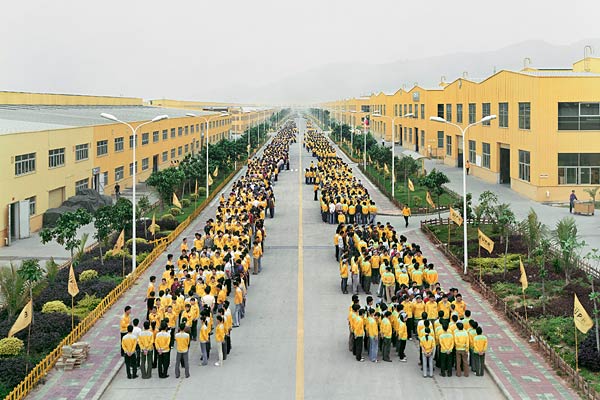
The parasitic consumption of China's new rich

The first half of 2010 in China has been characterised by an eruption of strike activity by China’s workers (see previous post).
This points to the antagonistic nature of social contradictions in the supposedly socialist Chinese society.
Under capitalism, workers are exploited because a part of their working day consists of unpaid labour time during which they produce a surplus value in the form of additional commodities for sale. This unpaid labour time is hidden by the apparent payment of a full day’s wage by the capitalist. The capitalist realises this surplus value as a profit through sale of the commodity. The contradiction that is inherent to capitalism exists between the socialised process of production and the private appropriation of surplus value.
Surplus value continues to be created in socialist societies where commodity production and the law of value continue from capitalism. However, surplus value is transformed into a component of the total social product. It is appropriated as profit from the sale of commodities by the working class itself and returned to the state as the owner of the means of production. Through its party (Communist) and government, the working class decides on the appropriate social distribution of the social product. Exploitation is removed from the equation when the private appropriation of surplus value is undertaken by the social agency of the creators of the surplus value.
However, socialist societies can undergo regression. If a group forms within the party and government that seeks to use its decision-making power to divert surplus value for private purposes (expanding top level salaries, introducing bonuses and incentives that go to those at the top, transforming state-owned enterprises into joint ventures or forcing their private sale through bankruptcy provisions) then it is possible for a new bourgeois class to emerge. Once any part of the total social product is appropriated for the private benefit and enjoyment of a privileged elite, the socialist society is taken on the capitalist road and the social product is broken apart into its exploitative form, with surplus value taken from the working class for the parasitic consumption of the new elite.
This is sadly the state of affairs in China.
The reforms begun under Deng Xiaoping took China down this path. The question was never whether it mattered if it was a black cat or a white cat that caught the mice; the real question was for whom the mice were caught.
Deng’s reforms enabled the appropriation of surplus value by party and government upper echelon bureaucrats, by enterprise managerial staff, by owners of privatised industries and services, by foreign and domestic investors, by the receivers of corrupt payments for favours, by shareholders and market manipulators. These were the beneficiaries of the mouse-catching of Chinese economic activity in the post-Mao era.
Look at last year's case of Wen Qiang, former Director of the Chongqing Justice Department. He had managed to corruptly receive 20 million yuan which he had tried to conceal by wrapping the entire amount in waterproof oilskins and placing it at the bottom of a pool (see retrieved money on display below). Unfortunately, corruption on this scale is all too common in China. This is money created by the labours of the working class but diverted from them and hoarded away at a time when many of the Chinese people can no longer afford education or health care.
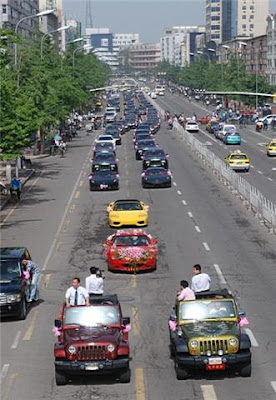
 Look at the extravagant and boastful weddings of the super rich of the new Chinese bourgeoisie. The fleet for the wedding of a coal bosses’ son on June 20, 2009 in Datong, a major city in Shanxi, included a camera team of 6 Jeeps, 4 Ferraris as lead vehicles, a main fleet of 4 Rolls Royces, and a retinue comprising 6 Mercedes, 6 Bentleys, 20 Audi A8s, a Hummer bringing up the rear, and Porsche Cayennes for "odd jobs” (below).
Despite press campaigns against ostentatious displays of wealth, lavish banquets are still thrown with enormous waste of food and ritual displays of status associated with the provision of rare and endangered species as food. Mo Yan, the novelist who provided us with Red Sorghum in 1987, satirised this culinary elitism in 1992 with The Republic of Wine, a story in which selected boy babies are fattened as “meat boys” and served as the highlight at banquets. It was an effective satire because it dealt with a real and growing abuse of position and power.
 A recent report on the East South West North blog refers to a copy of a restaurant bill posted on the Internet, according to which four customers ate: four servings of abalone with list price of 8,800 yuan each; four orders of braised truffles/shark fin soup with list price of 13,888 yuan each; four orders of South African bird's nest soup with wild honey at 9,860 each; 1980 vintage Lafitte red wine; 50-year-vintage Maotai; ... These items alone already amounted to more than 180,000 yuan. There were also some other miscellaneous items such as beef with
 pepper, braised tofu, etc which were offered free of charge. The customer signed the bill for the round sum of 200,000 yuan.
The report continued:
 “Could this be real? Many netizens have their doubts, because they think that this is yet another promotional gimmick.
“From the telephone number listed on the bill, our reporter contacted the restaurant and spoke to the manager named Yang.

“Manager Yang confirmed that this was true. He told the reporter what happened: ‘There were four customers who showed up for lunch. They ate so late that the restaurant workers had to work overtime. They drank a lot. For some reason, they got into an argument with the servers. The attitude of patrons is that if you don't think that we can afford it, we will deliberately make it hard on you. So this patron had two carloads of one yuan bills delivered to pay the bill. He wanted to cause us grief [by counting the money bills one at a time].’

“This restaurant specializes in serving bird's nest, abalone and shark fin, with an average expenditure of 1,500 to 2,000 yuan per capita. The patrons are mostly coal mine owners, company bosses, etc. Apart from the food and wine, the restaurant also imposes a 10% service charge. They provide side dishes and fruits for free.
“Is this a promotional gimmick by this restaurant? Our reporter tried hard but was unable to reach this "most awesome restaurant patron ever.”
Whether or not it was a promotional gimmick or a real display of ostentation and arrogance by coal mine owners and company bosses, the fact remains that such a restaurant exists to satisfy the parasitic consumption of an exploitative class in China whilst workers are reduced to fighting for shorter working hours and higher wages and are denied access to free medical and educational services.
The Gini Coefficient for China (an international measure of the disparity between a nation’s social poles of wealth and poverty) rose from 0.25 in 1983 (measured by Chen Jiandong and others in The Trend of Gini Coefficient in China http://www.bwpi.manchester.ac.uk/resources/Working-Papers/bwpi-wp-10910.pdf ) to 0.47 in 2008, according to Zhou Tianyong, senior economist of the Party School of the Central Committee of the Communist Party of China. The larger the coefficient the wider the social polarisation. Going beyond 0.5 is usually taken as an indicator the imminent social breakdown of the society concerned.

(Above: at the start of the world financial crisis laid off migrant workers in southern China rally under signs saying "I want to go home". Destitute and without means of transport despite long hours creating surplus value, profit, for bosses.)
China's transformation from a socialist society to a capitalist society will invariably see its emergence as an exporter of capital and a purveyor of neo-colonialism.
The Australian resource sector is in the forefront of this development.
Australian workers and Chinese workers have a shared interest in eliminating all forms of exploitation and greed. Their friendship and understanding will grow in struggle.
Old revolutionaries call for support of Chinese workers' struggles

(Sourced from the China Study Group website http://chinastudygroup.net/)
Translator’s note: “Regarding the present upsurge of worker action in China, liberals have used their discursive power in the overseas media to frame the strike wave as a tale of workers’ struggle for ‘independent unions,’ as if this were a repetition of Solidarnosc. What do Chinese workers want? What is the direction of the Chinese workers movement? Those who support the movement and are concerned about the fate of the working class should provide an account matching the reality of the movement. This letter of support provides a perspective different from those predominant in the mainstream media.”
Uphold the Constitution, Respect and Ensure Human Rights, Support Honda Workers’ Just Struggles, Condemn Foxconn’s Inhumane Management
(June 6, 2010)
(June 6, 2010)
To:
General Secretary Hu Jintao and Members of the Central Party Committee,
Chairman Wu Bangguo of the People’s Congress
Premier Wen Jiabao, Vice Premiers, and Members of the State Council
Compatriots throughout China, and all Media Outlets:
General Secretary Hu Jintao and Members of the Central Party Committee,
Chairman Wu Bangguo of the People’s Congress
Premier Wen Jiabao, Vice Premiers, and Members of the State Council
Compatriots throughout China, and all Media Outlets:
There have recently occurred numerous incidents in our country that signal intensified social contradictions. According to media reports, Shenzhen-based Foxconn with Taiwanese investment have treated workers as machines (or worse, just spare parts!) to generate profit for the company and instituted an inhumane management system that destroys the health and spirit of workers to the extent that some have felt that life is not worth living. Thirteen workers in this company have jumped to their own deaths in a short period of time. Their tragic deaths break our hearts. It is a situation that has shocked the world!
Based in Foshan, Guangdong, Honda Auto Parts Manufacturing Co., Ltd. is a Japanese-owned company. While the capitalist owner has made a huge profit, the wages are too low to support workers’ livelihoods and the company’s union does not represent the interest of the workers. Nearly two thousand workers have gone on strike in their struggle for wage increases and to initiate a reform of the union. But the Japanese management only agreed to a small increase, far from what the workers have asked. Moreover, the management unjustifiably demanded workers to sign a “no strike” commitment and threatened to fire workers who take part in the strike. They indeed fired two leaders among the workers.
Other incidents in the media also show increased conflict between capital and labor. Some workers in Chongqing Qijiang Gear Transmission Co. Ltd were forced to work overtime during weekends and died from overwork. The long-term exhaustion, low pay and management corruption led workers to strike. Close to 1700 workers from Taisheng Furniture Company, based in Dongguan, Guangdong Province, had a three-day strike to protest against overstress and low pay. Over a thousand workers in the spare parts factory that supply Beijing-based Hyundai went on a strike to demand a pay raise. Workers at Lanzhou Vinylon Company went on strike because they cannot sustain a basic livelihood. In Datong City (Shanxi Province), the state-owned enterprise Xinghuo Pharmaceutical Company was forced into bankruptcy and its laid-off workers had their numerous petitions refused. Following this, over 10,000 people staged a sit-in at the municipal government building; some of them were beaten up by armed police. Workers on strike from Pingdingshan Cotton Spinning Mill (Henan Province) were brutally beaten by thugs brought in by police vehicles, resulting in injuries of many women workers. In Shenzhen workers who are taking the lead to demand back pay or protect workers’ rights have had their names placed on various blacklist, which makes it difficult for them to obtain employment. These are just some of the recent incidents that illustrate the scope of the problem.
On the whole, the bourgeoisie have transferred the burdens of the economic crisis onto the workers and have waged a more fierce attack on them. The working class is forced to rise up and resist. But as workers have become a weak social group in recent years, and with the deprivation of basic rights prescribed by our country’s constitution, they are in the sad situation where their deaths are unanswered, their strikes unsupported, and their grievances unheard. According to our country’s constitution, particularly the four basic principles and the basic rights accorded to citizens, we issue the following appeal to address the current situation and problems.1
First, we should firmly support workers in Foshan Honda and other factories in their just struggles for survival and against oppression. Article 33 of our country’s constitution states, “the state respects and ensures human rights.” The right to strike is an inseparable part of human rights and is also a basic civic right prescribed by constitutions around the world. We firmly support all reasonable demands that Honda workers have raised so as to change their harsh working conditions and low wages. We are strongly opposed to the management’s threat to fire workers. The two leaders who were fired should be immediately given back their jobs.
We believe that our call will be supported by all those who uphold the authority of the constitution, respect human rights and stand for justice.
Second, we should demand Foxconn and other similar enterprises to immediately stop their inhumane and harshly exploitative management methods. We demand that the management respect workers’ integrity and dignity, obey the state laws, improve working conditions, strictly implement a 8-hour working day and compensate workers’ for overtime. They must ensure that workers are paid wages that are enough for their own sustenance and their reproduction. This is the only way to ameliorate labor-capital conflicts and reduce or prevent the so-called “psychological” problems. To elide the fundamental labor-capital contradiction by one-sidedly emphasizing “psychological counseling” is to intentionally cover up the contradiction and to confuse cause with effect. It has been reported by the media that some who committed suicide also showed signs of bodily injuries caused by beating. There was also suspicion of some being pushed off buildings. These already warrant a criminal investigation. Government agencies should deal with it seriously and find out the truth.
Third, unions should clearly stand on the side of the working class to represent and uphold the interests of the working class as prescribed by the constitution. If any union organization ignores the constitution and “take the boss’ shillings and do the boss’ bidding,” then they will be spurned by the working class. The leadership of the union in each enterprise must be democratically elected by its members. Relatives and representatives of the bosses should not be allowed to take any leadership position in the union. If such a case is found, it should not be approved by the union at higher levels. The union at higher levels should instead help such enterprise-based unions organize an all-members meeting and help rebuild the enterprise’s union through democratic election.
Fourth, government at all levels, particularly the local government should protect civic rights by strictly following the law, earnestly resolve labor-capital conflicts and ensure citizens’ freedom of speech. Government should administer according to the law and should prevent and stop incidents that violate basic civic rights prescribed by article 33 of the constitution and other related regulations. It should actively deal with cases of labor-capital conflicts according to the law. Ignoring workers’ reasonable demands either through inaction or siding with management should be resolutely corrected. In order to ensure people’s right to information and right to supervision, media should be allowed to freely and truthfully report on labor-capital conflicts and other cases and convey people’s voices without obstruction and interference.
Fifth, we call for the restoration of the working class as the leading class of our country and the re-establishment of socialist public ownership as the mainstay in our national economy. Article 1 of our country’s constitution states, “The People’s Republic of China is a socialist state led by the working class on the basis of a worker-peasant alliance.” Article 6 of the constitution states, “The basis of socialist economy of the People’s Republic of China is socialist public ownership of means of production, that is, all people’s ownership and laborers’ collective ownership.” “In the primitive phase of socialism, the state should build an economic system with public ownership as the mainstay and co-development of the economy through other ownership forms. Distribution should be based mainly on each according to his/her labor, with co-existence of other distributive methods.” The Chinese Communist Party must be the real vanguard of the working class, strengthen its leadership of the people’s polity, and reinforce the people’s democratic dictatorship. We call for a reestablishment of public ownership as the principle part of the national economy. Only in this way can workers, peasants and people in general become masters of enterprises and the country and truly implement a distribution system primarily based on labor contribution. At present, it is imperative to improve working conditions and increase wages and benefits in the private economy (funded by domestic and foreign investments). It is completely just to actively support workers’ struggles towards that end. But in so far as the capitalist privately-owned economy rather than the socialist publicly-owned economy dominates, the working class cannot change their weak position under structures of exploitation, nor the unfair distribution system and the disparity between the rich and poor. Under this condition, it is also impossible to transform our export-oriented economy to one that is independent, self-reliant and seeks to satisfy the material and cultural needs of people in the country.
Based on the present conditions, it will only be through a long-term struggle that the working class can restore its leadership position and the national economy can be transformed into one primarily based on public ownership. We have the guidance of Marxism-Leninism-Mao Zedong Thought and have the constitution, particularly the four basic principles at its core, as our legal instrument. All members of the Communist Party and all people should abide by the constitution. The socialist modernization that we uphold fits the interest of the broadest range of people and corresponds with historical development of mankind. If all people who support socialism, love their country, and abide by the constitution are united and persistent, then through a long-term struggle, we will be able to realize our goal.
Signatories:
Li Chengrui (Former Director of the State Statistic Bureau)
Gong Xiantian (Professor of Beijing University)
Han Xiya (Former Alternate Secretary of the Secretariat of All-China Federation of Trade Unions)
Liu Rixin (Former Researcher at the State Planning Commission)
Zhao Guangwu (Professor at Beijing University)
Wednesday, June 30, 2010
Shane Howard sings of the "Black Eureka"
(Warning to indigenous persons: contains images of persons now dead).

 The first bars of the album’s opening track, Earth Is Singing, slowly unfold from Howard’s intimate acoustic guitar and the Mexican Jarana of Francisco Gonzales, (one of the founding members of Los Lobos), building to a Goanna-esque rockin’, celebratory, crescendo. The song tells the back story of Howard’s first pilgrimage, all those years ago, to Uluru when he wrote the Australian classic, Solid Rock.
The Western Australian Aboriginal Pastoral Workers Strike of 1946
 Over 200 people attended, some travelling thousands of kilometres, from as far away as Halls Creek, Darwin and Alice Springs. There, at Skull Springs, they sat in council to discuss the shameful conditions that their people were living under, all through that central and western desert country. The meeting lasted for six weeks. There were 23 languages spoken and 16 interpreters.

The people discussed what they could do to improve the future for their children. Work and iiving conditions were appalling for all Aboriginal people at the time but in the Pilbara, being so remote, it was particularly harsh and ‘out of sight and out of mind’. Aboriginal people were under the Native Administration Act and they were slaves in their own country. No wages, no housing, no freedom of movement and meagre rations. McLeod was appointed executor and the group became known as The Mob.
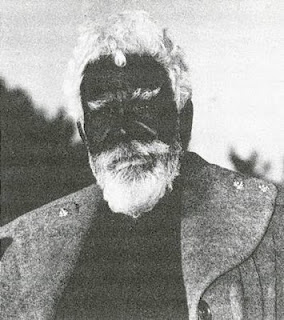 The people waited until the World War II ended, but on 1 May 1946, 800 Aboriginal workers went on strike and walked off sheep stations in the north-west of Western Australia. Under the guidance of McLeod, Bin Bin (left) and McKenna, the strike was well organised and initially stunned the authorities. All three were arrested and jailed and persecuted. Although the strike effectively lasted for at least three years, it never officially ended.
The Mob had solid supporters like the Communist Party, some of the churches, womens groups and a small group of artists. The Fremantle branch of the Seamen's Union refused to load the squatters wool on boats while the strike was on and eventually the Australian Workers Union supported the Mobs claims for wages and better conditions.
When Western Australia was first established as a State by the settlers, the constitution made provision for a small percentage of State revenue to be allocated for Aboriginal people. McLeod turned bush lawyer and went on to argue that this had been illegally changed and continued to agitate for restitution for the West’s Aboriginal population.
He also went on to support other actions for justice for Aboriginal people, including the fight against oil drilling on Aboriginal land at Noonkanbah in the Kimberley region of WA in the late 1970s.
At one level the strike collapsed, but like the Eureka Stockade, it was a victory won from a battle lost. Many gains were made. There are so many characters in this heroic story that this song is not enough to give a full picture of the remarkable efforts by a small group of disempowered people. There was Peter Coppin, the songman Donald Norman, Daisy Bindi, Ernie Mitchell and so many more heroes of this struggle and they can take credit for giving birth to the Aboriginal Land Rights movement and inspiring the Gurindji walk off at Wave Hill in the 1960’s.

Progressive singer-songwriter Shane Howard is releasing his new album Goanna Dreaming this month, touring nationally from July 2.
For South Australians, Shane can be seen on Saturday 18 September 2010 at the Singing Gallery at McLaren Vale and on Sunday 19 September at the Church of the Trinity on Goodwood Road, Clarence Park.
 The first bars of the album’s opening track, Earth Is Singing, slowly unfold from Howard’s intimate acoustic guitar and the Mexican Jarana of Francisco Gonzales, (one of the founding members of Los Lobos), building to a Goanna-esque rockin’, celebratory, crescendo. The song tells the back story of Howard’s first pilgrimage, all those years ago, to Uluru when he wrote the Australian classic, Solid Rock.
However, the song that has caught my interest is the rollicking Clancey & Dooley & Don McLeod which retells the remarkable, hidden story of Australia’s Black Eureka, when 800 Aboriginal pastoral workers, in Western Australia's Pilbara region, walked off the pastoral stations in 1946 and went on strike for pay and better conditions and gave birth to Australia’s contemporary Aboriginal resistance movement.
Here is how Shane Howard describes those events in the booklet accompanying the CD:
CLANCEY & DOOLEY & DON McLEOD
The Western Australian Aboriginal Pastoral Workers Strike of 1946
In 1942, on the western side of the Pilbara, Western Australia, a great meeting of the Aboriginal desert law men was organised by Dooley Bin Bin and Clancey McKenna (below).
Over 200 people attended, some travelling thousands of kilometres, from as far away as Halls Creek, Darwin and Alice Springs. There, at Skull Springs, they sat in council to discuss the shameful conditions that their people were living under, all through that central and western desert country. The meeting lasted for six weeks. There were 23 languages spoken and 16 interpreters.One whitefella, the prospector Don Mcleod (above), was invited to that meeting. McLeod was one of the first whitefella’s to be born in Marble Bar, one of the most remote towns in Australia. He’d been invited because of the help he’d once given an Aboriginal elder who needed to be taken to hospital. None of the whitefellas at the time would help to transport him, but McLeod took him as a matter of course and thought nothing more of it. His empathy was noted and as a result he was summoned to attend the great desert council.
The people discussed what they could do to improve the future for their children. Work and iiving conditions were appalling for all Aboriginal people at the time but in the Pilbara, being so remote, it was particularly harsh and ‘out of sight and out of mind’. Aboriginal people were under the Native Administration Act and they were slaves in their own country. No wages, no housing, no freedom of movement and meagre rations. McLeod was appointed executor and the group became known as The Mob.
 The people waited until the World War II ended, but on 1 May 1946, 800 Aboriginal workers went on strike and walked off sheep stations in the north-west of Western Australia. Under the guidance of McLeod, Bin Bin (left) and McKenna, the strike was well organised and initially stunned the authorities. All three were arrested and jailed and persecuted. Although the strike effectively lasted for at least three years, it never officially ended.
But the strike was about much more than 30/- a week wages and better conditions. They began agitating for rights, dignity and proper entitlements in their own country.
In order to survive away from the stations, The Mob established their own camps and traded kangaroo and goat skins. Initially under Don McLeod’s direction, they began alluvial mining with yandys until they could afford equpment. Ironically, their succesful mining operations drew attention to the mineral wealth of the Pilbara. They supported themselves this way for over 20 years, acquired three stations, established schools and began developing a way of life based on Aboriginal communal organisation.
The Mob had solid supporters like the Communist Party, some of the churches, womens groups and a small group of artists. The Fremantle branch of the Seamen's Union refused to load the squatters wool on boats while the strike was on and eventually the Australian Workers Union supported the Mobs claims for wages and better conditions.
When Western Australia was first established as a State by the settlers, the constitution made provision for a small percentage of State revenue to be allocated for Aboriginal people. McLeod turned bush lawyer and went on to argue that this had been illegally changed and continued to agitate for restitution for the West’s Aboriginal population.
He also went on to support other actions for justice for Aboriginal people, including the fight against oil drilling on Aboriginal land at Noonkanbah in the Kimberley region of WA in the late 1970s.
At one level the strike collapsed, but like the Eureka Stockade, it was a victory won from a battle lost. Many gains were made. There are so many characters in this heroic story that this song is not enough to give a full picture of the remarkable efforts by a small group of disempowered people. There was Peter Coppin, the songman Donald Norman, Daisy Bindi, Ernie Mitchell and so many more heroes of this struggle and they can take credit for giving birth to the Aboriginal Land Rights movement and inspiring the Gurindji walk off at Wave Hill in the 1960’s.
In the foreword to Max Brown’s book, Black Eureka, the writer Dorothy Hewett wrote, “A little mob of Nor’-West Aborigines without status, funds, or human rights, challenged the feudal strongholds of squatters, missions, courts, newspaper barons and governments, all the way up to the United Nations. It is a classic story of the underdog and his uncountable resources. It records the birth of the militant Aboriginal movement and it is part of Australian history now.”
This is one of the remarkable stories of Australian history that should be taught to our school children, as a chapter we should never forget. Remember.
Shane Howard
.......................
Shane Howard occupies a place of honour in the struggle for a progressive Australian culture. His early albums with the band Goanna took up democratic and indigenous themes and expressed them through a distinctively Australian-sounding musical ambience.
 Defying the racist Howard (ie John) Government's dismissal of progressive histories that revealed the truth of the violent colonial dispossession of the Aboriginal and Torres Strait Islander peoples as a "black armband" view of history, Howard (ie Shane) created the Black Arm Band Ensemble, travelling to world festivals, most of Australia’s major arts festivals and into remote and regional Aboriginal communities, helping to take the ensemble’s musical message of hope. He produced Archie Roach’s last studio album, Journey and collaborated with the young Street Warriors and Shannon Noll for a new, Hip Hop version of Solid Rock. For 30 years Howard has eloquently pleaded the case for Aboriginal justice.
 Defying the racist Howard (ie John) Government's dismissal of progressive histories that revealed the truth of the violent colonial dispossession of the Aboriginal and Torres Strait Islander peoples as a "black armband" view of history, Howard (ie Shane) created the Black Arm Band Ensemble, travelling to world festivals, most of Australia’s major arts festivals and into remote and regional Aboriginal communities, helping to take the ensemble’s musical message of hope. He produced Archie Roach’s last studio album, Journey and collaborated with the young Street Warriors and Shannon Noll for a new, Hip Hop version of Solid Rock. For 30 years Howard has eloquently pleaded the case for Aboriginal justice.
Last year he returned to Uluru to work with the school children from Mutitjulu, Imanpa and Docker River communities, to create illustrations for a soon to be released childrens book of Solid Rock, in English and Pijantjatjara.
In 2000 he was awarded a Fellowship by the Music Fund of the Australia Council in acknowledgement of his contribution to Australian musical life. During this Fellowship period he began researching and writing a screenplay based around the events that led to the Eureka Stockade. In 2004, he was a special guest at the ceremonies to mark the 150th anniversary of the Eureka Stockade, in Ballarat. The events of the Eureka Stockade are close to Howard's heart as his great Grandfather was arrested at the Stockade battle.
Thursday, June 24, 2010
Gillard ditches Rudd, opens doors to mining billionaires

“That’s it - the RSPT is dead!” screamed the headline for Mike Mangan’s commentary piece in the online Business Spectator on 24 June 2010.
He was referring to the palace coup that saw the demise of Kevin Rudd as Australian Prime Minister, and his replacement by DPM Julia Gillard (left).
The resource super profits tax proposal had seen the government outclassed and out-advertised by the local and foreign mining monopolies.
Clive Palmer, billionaire capitalist, boasted that “This is the first time in Australia’s history that a prime minister has been defeated by a civil campaign of anger.”
Like, as if Clive Palmer, billionaire capitalist and member of the ruling class, would ever tolerate a real civil campaign of anger!
But Dullard has confirmed even these wild ravings by saying that she has “opened the door of the government to the mining companies”.
Now, that’s very reassuring for those of us who have to actually work.
Didn’t someone once say that under capitalism, government was merely the executive committee of the bourgeoisie?
Tuesday, June 22, 2010
Death robs Australian people of justice

"The bodies of six Australian mining executives killed in a west African plane crash remain at the site of the wreckage as recovery personnel continue to clear thick rainforest. The wreckage of the CASA C-212 aircraft chartered by Perth-based Sundance Resources was discovered on a ridge in jungle in Congo on Monday afternoon. The plane was flying from Yaounde, the capital of Cameroon, to Sundance's Mbalam iron ore project near Yangadou in the Republic of Congo when it went down on Saturday, killing all on board. French military personnel and Sundance's emergency response team on Tuesday began the difficult recovery, which involves clearing a 10km track to enable the retrieval of the bodies. Australian mining contractors and trucks have been brought in to hel p bulldoze dense jungle. Cameroon's aviation authority has said it retrieved and identified all 11 bodies from the plane, but Sundance and Australian foreign affairs officials said the recovery work was continuing on the ground." - AAP
The death of Queensland coal mining magnate Ken Talbot in a plane crash in Africa has robbed the Australian people of the chance of seeing him prosecuted and jailed over corruption charges.
Talbot was to face charges of paying some $360,000 in bribes to former Queensland Labor minister Gordon Nuttall who has already been tried and convicted and put into a cell.
If Talbot was prepared to engage in bribery in a nice "clean" country like Australia, one wonders what opportunities may have presented themselves in the Democratic Republic of the Congo which currently sits at no. 162 out of 180 countries rated for their level of corruption by Transparency International!
Talbot has a personal fortune estimated to be close to $1 billion and has been an active partner with the Chinese Government's CITIC Australia in a number of exploration and mining ventures.
In all the crap now being written about Talbot in the obsequious capitalist press there is no mention that he and CITIC were the major shareholders in the grubby little Marathon Resources company that has already despoiled the Arkaroola Wildlife Sanctuary, and has plans to mine the killer mineral uranium from this iconic wilderness area.
Now we will never see a South Australian independent commission against corruption (ICAC) - even assuming the ostrich-like Premier Rann would set one up - investigate the crony capitalism that seems to have embraced former Labor Senator Schacht, (a Marathon executive director), CITIC, Talbot and his nominees within Marathon, and the SA Labor government.
There are indeed good reasons to feel sad at this news.
Ark Tribe case proceeds

Adelaide construction worker Ark Tribe fronted the magistrates court on Tuesday June 15, Wednesday June 16 and Friday June 18. He is charged with failing to attend an interrogation by Gillard's "tough cop on the beat" - the notoriously anti-worker Australian Building and Construction Commission (ABCC). If convicted of failing to dob in his mates who had attended with him a meeting on safety violations on their building site, he faces a mandatory six month jail sentence.
On Tuesday, a crowd of around 500 construction workers and supporters from various other unions formed an arch of honour with union flags and the beautiful rebel flag of Eureka for Ark to march through as he entered the court.
A large tent had been erected opposite the courts and dedicated as the "Ark Tribe Embassy". A Spirit of Eureka banner was hung on the side of the "embassy" with the oath of the Eureka rebels of 1854: "We swear by the Southern cross to stand truly by each other and fight to defend our rights and liberties".
Taking up the theme of the fight against injustice were international guest speakers Paddy Hill and Gerry Conlon. Hill was convicted as a member of the Birmingham Six in 1975 and sentenced to life imprisonment for alleged involvement in an IRA bombing campaign in England. Conlon was convicted in 1975 as a member of the Guildford Four on similar charges and also sentenced to life imprisonment. Hill was released in 1991 and Conlon in 1989 - both had been framed by the police to secure quick convictions that would serve to intimidate those fighting British imperialism in Ireland.
Ark Tribe's defence lawyers challenged the right of the magistrate to hear the charges on the grounds that the person laying them was not appropriately authorised to do so by the fascist Australian Building and Construction Commission (ABCC).
It took until Friday for the magistrate to reject this line of appeal and declare "game on".
Ark has yet again had his case adjourned - until July.
A smaller crowd of several hundred people (see pictures below) supported Ark as he entered the courts on Friday.


Thursday, June 17, 2010
Reject miners' scare campaign - tax the rich!

Yesterday there was a full-page advertisement on page 8 of Murdoch’s Advertiser (17 June 2010).
The ad featured retired Whyalla road sweeper Ross Bray and the comment attributed to him that “The average worker is getting great benefits from the mining industry through the superannuation they have”.
This is because super funds are major shareholders in many mining companies.
Beyond a reference to “somebody (throwing) a hand grenade in amongst it all now”, the ad specifically avoids stating that the proposed resources super profit tax (RSPT) will cut superannuation returns.
This is because the Association of Superannuation Funds of Australia has “rejected mining industry claims that the federal government’s resource tax would hurt superannuation returns” (Financial Review, Friday 11 June 2010 - the Fin Review is a paper for the business community in which the elite of the community generally are somewhat freer with information than in the tabloid press circulated for the masses).
The ad, and similar TV ads featuring working class Australians saying how they will be hurt by the RSPT, are part of a deceptive scare campaign by local and foreign-owned mining companies.
Presenting working Australians as the face of a multinational campaign to avoid paying a fair rate of tax is the height of hypocrisy.
Nor is Bray quite the gormless piece of anonymity depicted in the ad. He is quite well-known in Whyalla as President of the Association of Independent Retirees Ltd, railing against the Superannuation, Retirment and Savings Division of the Australian Treasury for having "shown uncharacteristic favour to the big end of town in the finance industry" in relation to pensions in small super funds.
However, the big end of Whyalla, a town of 23,000 residents, is the major employer OneSteel. The company mines iron ore and manufactures steel products at its Whyalla steelworks.
However, the big end of Whyalla, a town of 23,000 residents, is the major employer OneSteel. The company mines iron ore and manufactures steel products at its Whyalla steelworks.
According to a report in the Australian, Bray leases property to OneSteel contractors and has children who work for the company.
"If the taxation of mining is the demise of OneSteel, we'll be wiped out," he is reported as saying.
So a victim of a local scare campaign (OneSteel has prated about having to close the steelworks if the RSPT goes ahead) lends his services to a national scare campaign.
But it is not just the comments of the Association of Super Funds that show what a scare campaign this is....mining companies crying poor have been exposed too.
Treasury figures released today (again in the Fin Review) reveal that resources company profits more than doubled to $91 billion last year.
The unprecedentedly high demand for resources, particularly from China, has seen profits in this industry surge in such a way that the proportion of taxes and royalties paid has diminished against what is called "resource rents" (ie income from mining sales and services less operating costs and "an allowance for corporate capital").
In 2004 taxes and royalties comprised 76.6% of resource rents, falling in successive years to 61%, 47%, 45.8%, and 37.4%. Last year, it went down to 26.5%.
Profits skyrocket, taxes plummet in proportion, and still they have to drag out the Ross Brays of the world to defuse the indignation of the people.
Tuesday, June 15, 2010
Arkaroola: a frog in Marathon's froat!

The Arkaroola Wilderness Sanctuary continues to reveal previously unknown secrets of biodiversity. It must be immediately protected, completely and without ambiguity, from threats of mining. The environmental despoiler Marathon Resources, must be unceremoniously kicked out of the place.
The latest discovery is of a species of frog. There will be some who will scoff at the value of a new frog in the scheme of things. But frogs are the one of the most important barometers of climate change as well as being valuable sources of new DNA that complement pioneering work in the medical sciences. Besides, they’re pretty cute…..
It certainly sticks like a frog in my throat that the second-largest shareholder in the "cowboy outfit" Marathon Resources is the Chinese state-owned investment company China International Trade and Investment Corporation. Yes, it's nice to go and see the endangered pandas in the Adelaide Zoo, gifts to the people of Australia from the Chinese government. But has CITIC no shame in financing the destruction of the environment needed for the survival of our endangered species, including the beautiful yellow-footed rock wallaby?
The article below is from the capitalist press, from Murdoch’s Adelaide Advertiser (June 16 2010).
Note the reference to Marathon continuing to throw its weight around and bully the Spriggs who own the Arkaroola sanctuary.
They are desperate for some development to justify continued investment in the company, shares in which currently stand at a miserable 44 cents.
The main shareholder is Queensland coal magnate Ken Talbot. He has recently increased his holdings by $400,000 – not much for a multimillionaire – in fact, it’s only $100,000 more than jailed Labor politician Gordon Nuttall accepted from him in bribes.
But it does underscore the desperation to support the share price, to stop its southerly trajectory, in order to hopefully get back some of what they have invested. The problem is though, who would want to buy?
Hence the need to appear to be continuing exploration activity – anything to keep the shareholders from fleeing the sinking ship.
Meanwhile, a cute little frog adds meaning to the ark in Arkaroola!
(The Advertiser article follows:)
...............................
A YOUNG scientist has discovered the state's first new frog species in 45 years.
Kaya Klop-Toker, 23, was invited to study frogs, bouncing back after the rain, in Arkaroola Wilderness Sanctuary.
She found lots of "cute" little tree frogs with "fantastic camouflage" and took specimens to the University of Adelaide expert, Associate Professor Mike Tyler.
Straight away, he knew this "pretty little thing" was special. The brand new frog species will bring the total number in South Australia to 29.
"This is the first new species to be found in South Australia since 1965, when another species unique to the Flinders Ranges called Crinia riparia, or the Flinders Ranges froglet, was described," Prof. Tyler said.
"The Flinders is very important in terms of the frog fauna, because there are species that are unique to the area, they don't occur anywhere else in Australia."
Associate Professor Tyler called Sanctuary owners Marg and Doug Sprigg with the exciting news. It was a very different phone call to the one they'd received earlier that day from the chairman of Marathon Resources. The uranium exploration company has served Arkaroola with notice of further work on site.
This is the same company that illegally buried about 35 tonnes of low-level radioactive material in 22,800 plastic bags at Mount Gee back in 2007.
Ms Sprigg has "serious concerns" about the potential impact of uranium mining on many little known and as yet undescribed species.
"Last year a giant gecko was found in the Northern part of Arkaroola, again undescribed," she said.
"We just wonder what else is here that could be under threat from exploration and mining."
Ms Klop-Toker said she wanted to work in conservation and frogs were the "most at-risk type of animal that we have at the moment". "We've lost more frogs than any other type of species in the last 50 or 100 years, so that makes me want to try and save them," she said.
The species' name will be confirmed by an international naming committee.
Sunday, June 13, 2010
Twiggy Forrest in his workman's clothes

(This is a bit of doggerel directed at two of the richest people in Australia, Andrew "Twiggy" Forrest, left, and Gina Reinhardt, below. Twiggy has been the richest man in Australia, but has currently dropped to a miserable third place. Gina, the daughter of vile reactionary Lang Hancock, is Australia's richest woman. Both have made their billions from the realisation of the surplus value created by working people employed in the extraction of Australia's vast mineral wealth. Both addressed the recent rent-a-crowd of shareholders and other selfish nobodies assembled in Perth to oppose the proposed tax on mining super-profits.)
Twiggy Forrest in his workman's clothes
(With his workman's bank account - as everybody knows!)
Will be forced to live on the bones of his arse
If he's taxed at the level of the working class.

Gina Reinhardt, looking very sad,
"It's all my money - I got it from my Dad";
But that bastard pinched it from the labouring crew -
The work of the many for the wealth of a few.
A resource profit super tax
Such a mild move for all their wild attacks
When we socialise the mines at a later hour
Then we'll see them weep 'cos we'll hold state power.
And we'll dress Mr Twiggy like a working man,
And he can irrigate the desert with a watering can
Which we'll fill forever down the years
With Gina Reinhardt's well-deserved tears!
Thursday, June 10, 2010
Some thoughts on Foxconn and the Honda strike
(Sourced from http://chinastudygroup.net/2010/06/some-thoughts-on-foxconn-and-the-honda-strike/)
by Lang Yan 9 June 2010 One Comment Last modified: 9 Jun 2:05 pm
While I was walking around the Shanghai World Expo on a weekday a couple of weeks ago I met a group of workers from a nearby clothing sweat shop. Their company had sent them to the Expo for the day (for which they had to trade their only day off, Sunday). They were too tired to enjoy the Expo as they worked 14 hours a day, six days a week. While this may seem like a nice gesture on the part of the company, the workers also explained that the company was moving much of their production to another building that week, because a worker burned much of the factory down after not being paid on time. I heard this story just as the news of the Foxconn suicides began to break into the media and shortly after that the Honda strike began.
Within public discussion, the Honda wildcat strike has transformed the meaning of the Foxconn suicides. Early interpretations of the Foxconn suicides tended to argue that the suicides should either be understood as individual psychological issues and as copycat suicides, on the one hand, or a result of the particularly brutal and alienating conditions at Foxconn, on the other. Some marshaled statistics to show that there were no more suicides at Foxconn than the social average when one considers the size of Foxconn (for example, see Tom Holland “Why there’s less to the suicides at Foxconn than meets the eye” and Michael R. Phillips “Foxconn and China’s Suicide Puzzle Workers: may not be taking their own lives for the reasons everyone thinks”). Statistics average out, in other words, the social difference of the militarized factory space; Foxconn was treated as a normal social space, a city. (For a discussion of suicide rates and Foxconn, see EastSouthWestNorth #19. Notable also is that the Chinese rate of suicide for people 15 to 34 is quite high. See Suicide main cause of death in 15 to 34-year-olds.)
Analysis of the social and work conditions at Foxconn also appeared. The particularly militarized and alienating work environment at Foxconn is a result of capital’s relentless drive to lower assembly costs and the Asian subcontracting regime; reform-era China and the CCP have been a willing partner in that effort. Activists and scholars have argued that Foxconn is one of the worst factories in terms of it labor regime, with a very long (usually about 70 hours) work week (since the pay structure means that workers must work a lot of overtime) and a very rapid assembly line. Foxconn was able to become the world’s largest assembly company exactly because of its harsh Taylorist production process, which cuts up the process into highly regimented movements, its ability to intensify labor exploitation and its repressive management style (See this article by Andy Xie for some analysis and background on the Taiwanese management style). There are reports that Foxconn initially responded to the suicides by pushing workers to sign contracts that they would not commit suicide, and stating that their families would not receive compensation if they did. It went so far as to state that suicide harmed Foxconn’s reputation.
But the successful Honda wildcat has changed the discussion. The suicides and the strike are being put into the context of changing labor relations in China, with many now arguing that Chinese labor is at a turning point.
For example, NPR’s Marketplace (Honda, Foxconn workers demand more power) argues that a “labor shortage in China is empowering workers to demand better wages and treatment at their workplaces….” In a discussion of the Honda strike, Reuters notes that “[s]ome other foreign companies have begun to address workers’ discontent over pay and working conditions. Taiwan’s Hon Hai Precision Industry Co Ltd for instance plans to raise salaries by about a fifth at its Foxconn International unit, maker of Apple Inc’s iPhone, as it struggles to stop a spate of suicides and quell public anger.” Foxconn has said that it will raise base salaries by 30% now with more raises to come in the near future. Clearly this wasn’t only caused by the suicides, however. Foxconn was planning a salary increase earlier in the year in response to the difficulty hiring workers due to labor shortages.
The Honda strike (workers’ demands included wage increases from about 1,500 yuan (less than $220 US) to about 2,300 yuan ($337 US) for higher paid workers) is likewise getting more press than any other worker action in recent years.
China’s economic stimulus has given large subsidies for car sales, and car manufactures are attempting to rapidly increase production in China. Honda plans to add a third to its Chinese production by 2012. But its integrated production process is vulnerable to strike activity. This is particularly true of transmission plants, which are highly automated and expense to construct. Thus they are usually put in the most stable regions, notes the New York Times. But the stability of the Chinese working class is now in doubt. According to the Wall Street Journal:
“The strike has exposed unexpected vulnerabilities in Honda’s China supply chain. Because of the relative absence of labor unrest in China, Honda makes do with only one source of transmissions there, the Foshan factory that supplies roughly 80% of demand, according to Mr. Fujii. The rest are brought in from Japan. Typically, Honda insists on at least two suppliers of parts, partly to protect against any industrial action that might cripple production.”
While quick to tamp down any political interpretation of the workers’ activity, the New York Times argues that in the beginning the state allowed media coverage of the strike because it wants to push up internal demand. On the other hand, the China Daily (in an article now taken off their website) used the strike to editorialize that the Chinese state needs to do more to raise the wages of workers. Since the end of the strike, Chinese media coverage has continued while broadening its analysis. At the same time, the government seems to be increasing its efforts at raising the wages and internal consumption. This follows several years of increased investment for rural China, which means there is less pressure for peasants to migrate out for work.
Broader Implications: First question looking forward:
What does this mean in terms of the changing Chinese political economy? A few points: Increasing wages in China could help rebalance the global economy. As their wages increase Chinese workers will be able to spend more (the wage share of GDP fell from 56.5 percent in 1983 to 36.7 percent in 2005). A rise in internal demand will mean a drop in the savings rate in turn forcing a rise in the savings rate in the US. This will likely also mean inflation, which is already a problem with the huge Chinese stimulus, yet inflation is also another way–other than a direct change in the exchange rate–for the Chinese state to rebalance its trade relationship with the US. The power of the export manufacturers in China seems to have been able to keep the state from changing the exchange rate to any great extent, but inflation might help take care of this for the state. Of course inflation will eat into wage increases and possibly lead to more social unrest. Meanwhile, the Beijing government announced on June 3rd that it was raising the minimum wage by 20% in response to inflation–the past few years it was raised about 10% per year. Other regions are following suit.
The June 7th issue of The Economic Observer (Jingji guancha bao) has articles on the labor situation noting that both the Honda strike and the situation at Foxconn are symptoms of a broader change going on in the Chinese labor market. One article argues that China has reached the “Lewisian turning point”. Arthur Lewis argued in 1954 that, for a period of time, developing countries could rely on rural surplus labor to keep wages from rising. This would allow them to industrialize without wage inflation. But once rural surplus labor is absorbed by the industrial economy and the labor market unifies wages will begin to increase more rapidly. The influential economist Cai Fang has been predicting this shift for some time, and in 2007 edited a volume on the turning point called “The Coming Lewisian Turning Point and its Policy Implications.”
Arthur Kroeber argued in the March issue of China Economic Quarterly that China’s cheap labor regime was coming to an end and that wage inflation will drive up the consumption share of GDP. In the planning for the 12th Five Year Plan, the CCP itself emphasizes this rebalancing and the important role that raising the wage share of GDP should plays in the process. At the same time, some commentators seem to be taking this argument a bit too far. Andrew Peaple states that “the dynamics of China’s economic development are moving inexorably in favor of the country’s workers.” While this will change the shape of the Chinese economy, its effect on capital will be mixed. Higher wages will mean more consumption, helping many companies as much as it hurts. But the assembly and clothing industry in the Southeast will be hit hard, as those plants are both more easily moved to other, cheaper-wage countries and have thinner profit margins. It is too early to say what this transition (of the Chinese economy and of the Chinese labor process) might mean more globally.
A second question looking forward:
Does the Honda strike indicate increasing self-activity of the working class in China? Certainly the example of the success of workers in the Honda strike in winning some wage increases (initially about 24% but in the end much more) might spread to other workers in China. Also, the strike itself was very highly organized, leading to the participation of about 1,900 workers (including a large number of low-paid interns). The workers seemed split, however, when they gave in to a lower wage increase than initially demanded. The People’s Daily reports that the hold out group was involved in a confrontation with representatives of the state union, the ACFTU. (The local ACFTU seems to be playing a more conservative role–by protecting Honda–than even the state-run media.) The World Socialist Website details the attempts by the company to split the workers by putting pressure on the interns to sign no-strike pledges in return for smaller wage increases. According to The China Daily, the strikers also demanded changes in work conditions, more transparency in company finances (this seems like a reflection of the history of worker democratic involvement in enterprise management in China), and a change in union representatives. The New York Times points out that workers complained that Japanese employees at the Honda plant make about 50 times that of Chinese workers. It is likely that nationalism has also played a role in how this strike has been reported in China. Most of the workers held out, however, and the agreement reached will lead to high wage increases. Kroeber talking Reuters stated that “Foreign investors have been lulled into a false sense of security that China has a docile work force. There’s nothing intrinsically docile about the Chinese labor force. There was a period when everything was kind of fine; now we are entering a period of more constraint.” Following the Honda strike, workers at a Hyundai factory near Beijing went on strike, but returned to work after they were immediately promised wage increases. Over 5,000 textile workers in Pingdingshan, Henan have been out on strike since May 14th at a factory privatized in 2006.
As the WSWS notes of the Honda strike:
The strike is a sign of sharpening class tensions in China amid the worsening global economic crisis. While China’s economic growth rate continues to be high, propped up by huge stimulus spending, the gulf between rich and poor is widening. Last year there were 98,568 labour disputes filed in Chinese courts, up 59 percent on the previous year. Most disputes, however, were not reported.
It remains to be seen, however, how successful the CCP’s attempt at economic transition will be. We need to know how much of China’s growth and job creation is due to the stimulus and how sustainable it is. The unsustainable property market is creating an investment bubble. Just as likely as transition to a consumer-based economy, inflation could lead to stagflation once the property bubble bursts and the initial affects of the stimulus wear off. The real question is what then for the activity of the Chinese workers. They are clearly learning important lessons now. The fundamental question is whether their new found strength will lead to a break from the domination of capitalist accumulation or not.
Wednesday, June 09, 2010
Billionaire Twiggy a capitalist piggy...

"Twiggy" Forrest is the billionaire Chairman, CEO and major shareholder of Fortescue Minerals Group (FMG).
Yesterday in Perth he confronted Prime Minister Kevin Rudd and noisily denounced the government's proposed Resources Super Profits Tax (RSPT).
Speaking to a rent-a-crowd of shareholders and blue t-shirted Liberal Party hacks, Forrest said Australia was adopting communist-like policies while China was becoming more market-oriented.
"This day is about your opportunity to change Australia's history from where Kevin Rudd would take it, a largely socialist distribution of capital over creation of value," he told the crowd.
All we can say is "If only...."
For there is nothing socialist about an ordinary rearrangement of taxation policies within capitalism. Forrest is merely saying that the wealth generated by the labour of Australian working people belongs to him and his class of rich parasites to whom he delusively ascribes the "creation of value".
His reference to China is interesting. On February 25, 2009 Chinese steel maker Hunan Valin Iron and Steel Group made application for a A$636 million stake in Fortescue Metals. This was approved by Australian Tresurer Wayne Swan on March 31 2009.
Under the agreement Fortescue issued shares to Hunan Valin to fund the expansion of its iron ore mining operations in the Pilbara. Swan also capped Hunan Valin’s stake in Fortescue to 17.55 percent. Hunan Valin's Chairman and vice president of China Iron & Steel Association Li Xiaowei became a non-executive director of FMG.
Hunan Valin is one of Fortescue’s biggest customers. Fortescue currently ships 1 million tonnes of iron ore to Hunan Valin subsidiary Xiangtan Steel but plans to quadruple that amount to 4 million tonnes during 2010.
Li is in the forefront of a "more market-oriented China" having published four books over his career including The Group Management after Local Iron & Steel Enterprises Restructure. He is part of an ascendant group of managerial leaders who are advancing the resoration of capitalism in China.
FMG's top ten shareholders show that besides Forrest and Hunan Valin, a sizeable group of shares are held by banks acting for owners of securities and shares (the names of the FMG shareholders are followed by the number of shares they won and the percentage of total FMG shares):
1 THE METAL GROUP PTY LTD
936,828,300
30.15
936,828,300
30.15
2 LUK-FORTESCUE LLC
247,986,000
7.98
247,986,000
7.98
3 VALIN INVESTMENTS (SINGAPORE) PTE LTD
228,007,497
7.34
228,007,497
7.34
4 ANZ NOMINEES LIMITED
205,816,609
6.62
5 HSBC CUSTODY NOMINEES (AUSTRALIA) LIMITED
169,691,290
5.46
6 VALIN RESOURCES INVESTMENTS (SINGAPORE) PTE LTD
154,267,590
4.97
7 VALIN MINING INVESTMENTS (SINGAPORE) PTE LTD
152,724,913
4.92
8 NATIONAL NOMINEES LIMITED
149,116,692
4.80
9 JP MORGAN NOMINEES AUSTRALIA LIMITED
106,843,102
3.44
10 EMICHROME PTY LTD
91,753,282
2.95
Commentary by citizens in the capitalist press is currently divided between would-be capitalists supportive of the billionaires' rights to remain rich and class conscious workers and others outraged by the selfishness and greed on display.
Here are some examples of the latter:
Leon of Glandore Posted at 9:13 AM Today
And there's Twiggy Forrest in a workman's shirt like he just emerged from the mine to give a speech. He's one of the richest men in Australia. Don't believe the lies people. He every much a charlatan as any of the politicians.
And there's Twiggy Forrest in a workman's shirt like he just emerged from the mine to give a speech. He's one of the richest men in Australia. Don't believe the lies people. He every much a charlatan as any of the politicians.
Derek of Seaview Downs Posted at 10:20 AM Today
The majority of these "protesters" were employees of Mining companies who were 'told' by the companies to be there, or else. I have a friend who works for one of these companies , in Perth. All hot air. The CEOs flew in on their private jets. They have been ripping off this Country for longer than I can remember and up to 80% of pre tax profits going overseas.
Mike of Balhannah Posted at 11:34 AM Today
As a person who works in the Pilbera I can see it is very good logic to slow down the resource boom, as it is now there is not sufficient qualified labour to service exsisting projects. Companies are already importing labour from overseas this will have a devestating effect on local employment in the long term. Prices are out of control my hotel was $145.00 per night two years ago it is now $300.00 plus a surcharge if you use a credit card. Resources left in the ground are an investment in the future of the nation. If the mining companies want to move to such places as Angola or Yemmen good luck to them - they'll need an awful lot of it.
As a person who works in the Pilbera I can see it is very good logic to slow down the resource boom, as it is now there is not sufficient qualified labour to service exsisting projects. Companies are already importing labour from overseas this will have a devestating effect on local employment in the long term. Prices are out of control my hotel was $145.00 per night two years ago it is now $300.00 plus a surcharge if you use a credit card. Resources left in the ground are an investment in the future of the nation. If the mining companies want to move to such places as Angola or Yemmen good luck to them - they'll need an awful lot of it.
Grumpy of Fulham Posted at 11:56 AM Today
We have a small population and natural resources that are the envy of the world. Why should we have waiting lists in hospitals and 650,000 people on public dental waiting lists across the country? The mining bosses are the new squattocracy - squatting on mineral leases and holding the nation to ransom by threatening not to develop them until the government gives in and surrenders its right to impose a fair level of taxation.
We have a small population and natural resources that are the envy of the world. Why should we have waiting lists in hospitals and 650,000 people on public dental waiting lists across the country? The mining bosses are the new squattocracy - squatting on mineral leases and holding the nation to ransom by threatening not to develop them until the government gives in and surrenders its right to impose a fair level of taxation.
James of Roxby Downs Posted at 1:35 PM Today
If mining expansion projects are shelved then the life of these mines will be greatly extended. Smaller royalties for a long time rather than larger royalties for a short time. The prospect of this upsets the mining company who wants to take as much as possible for as little as possible in the shortest possible time frame, & accept no responsibility for any of their actions. Who will be interested in investing in Australia when the resources are depleted? Growth is inevitable but it needs control!
Tuesday, June 08, 2010
Clive Palmer - billionaire liar
 (Resources billionaire Clive Palmer, above, on a sit-down strike against the proposed resource super profits tax has been exposed as a liar.)
The attempts by mining billionaires to scuttle the proposed resources super profits tax (RSPT) are the equivalent of a capital "strike".
This tactic was infamously used to create an economic crisis during the late phase of the Whitlam government which had aroused the anti-imperialist sentiments of the people with the mild proposal of Minister Rex Connor to "buy back the farm" from the multinationals.
The Whitlam government was subsequently removed from office by the representative of the British Queen, her Governor-General, in a coup stage-managed by the CIA.
The current capital strike was predicted on May 6 by business commentator Robert Gottliebsen. He wrote:
"At this stage it's just private words to selected journalists and few decisions have been made, but Australia is on the brink of the greatest capital strike in its history and one of the largest ever seen in the world.
"In the vicinity $100 billion of resource projects that were almost certain to go ahead are now headed for mothballing until the resources tax is either abandoned or severely modified. If the private words to me and other journalists are converted to action and a new mining project capital strike is launched, then almost certainly Kevin Rudd will not win the next election. The economies of Queensland, WA and South Australia would be decimated. I have never seen an industry so angry...
"Yesterday I had the chance to talk with a number of people who will play a key role in whether there is a capital strike or the miners roll-over. The people I spoke to have no doubt that there will be a strike" (see http://www.businessspectator.com.au/bs.nsf/Article/BHP-RIO-TINO-capital-strike-resource-rent-tax-pd20100506-56SMK?OpenDocument )
On May 24, Gottliebsen announced the start of the strike:
"The greatest capital strike in Australia's history officially started at 10am on May 24, 2010. Australia's second largest minerals company Rio Tinto announced that all its expansion projects would be put on hold and that delay could extend for years if not indefinitely. Moreover, it plans to curb early stage development in Australia and has expressed grave concerns about the sovereign risk implications of parts of the mining tax...
"As I understand it, in the coming months, Rio Tinto will have some $10 billion of expansion projects coming before the board. It plans to allocate only $5 billion and until the mining tax, Australia was at the top of the list and would have received the bulk of that $5 billion dollars. It will now only receive the money required to maintain existing mines....
"Rio Tinto's stance will be studied closely by BHP Billiton who almost certainly will put all of its capital projects on hold. It is likely that this will be followed by the Curtis Island coal-seam gas developments, though that is less certain" (see http://www.businessspectator.com.au/bs.nsf/Article/Rio-Tinto-BHP-Billiton-resource-rent-tax-RSPT-capi-pd20100524-5R335?OpenDocument&src=srch ).
The Achilles heel of capital strikes is that capital, unlike workers, cannot hold out. Workers can be supported by other workers and have nothing much to lose, and everything to gain, by sticking to their guns. Capital on the other hand cannot be kept idle. The logic of capitalism requires capital to continuously seek to reproduce its own value over and over again in the relentless pursuit of profit.
So the first significant crack in the unity of the resource billionaires was the announcement by Minerology Pty Ltd boss Clive Palmer, that he had "admitted he exaggerated the possible consequences" of the RSPT (see http://www.news.com.au/business/resource-super-profits-tax-critic-clive-palmer-exaggerated-threat-to-projects/story-e6frfm1i-1225876508564) .
The Mining and Energy Division of the CFMEU commented:
"The hysterical scare campaign of the billionaire mining bosses and their rich multinational mates is being increasingly exposed for the lie it is as the truth emerges on the effects of the Federal Government’s resources super-profits tax.
"One of the chief head kickers, resources billionaire Clive Palmer has retreated from his earlier claim that he had scrapped mining projects because of the Federal Government's proposed resource super profits tax. Palmer owns one of the largest deposits of iron ore in the world, carved out in five separate projects.
"A big Liberal National Party donor, Palmer told the ABC Lateline TV programme last month he had canned two projects in Western Australia's Pilbara region because of the tax.
"He said one of those projects would employ about 3,000 people and generate about $2 billion a year in exports. But now Palmer has told last night's Four Corners programme that he was probably exaggerating. “Probably, it should have been, 'I am slowing them down’”, he said."
Len Cooper, Victorian Branch Secretary of the CEPU Communications Division, released a statement saying:
"We condemn the dishonest and hysterical campaign by the large, foreign owned mining companies, led mainly by BHP Billiton and Rio Tinto, over the Labor Government's mining tax proposal...
"These same corporations led the campaign to implement and save the hated WorkChoices legislation of the Howard government, they led the campaign to prevent Australia starting to clean up its environment and contribute to the prevention of global warming, and now they want to deny the Australian people their right to properly benefit from the mining assets belonging to the Australian people.
"How long do we put up with the disgraceful anti-people behaviour of these foreign owned corporations before we begin to demand that the Australian government take them over in the interests of the people?"
The Communist Party of Australia (Marxist-Leninist) echoed these sentiments, saying:
"The tax on the super profits is an immediate and a small step in securing even a token of national resources wealth for the people. In the longer term, nationalising the mining industry can provide the only guarantee that the wealth from Australia’s natural resources will benefit the national interests of Australia’s people and the whole country."
The full statement of the CPA (M-L) can be accessed here: http://vanguard.net.au/2008/latestnews.php?subaction=showfull&id=1275296442&archive=&start_from=&ucat=1&
The only response to threats of capital strikes is nationalisation of the corporations concerned!
Monday, June 07, 2010
Erye Peninsula earthquake a warning for Olympic Dam
The earthquake that rocked the Eyre Peninsula on Sunday June 6 2010 is another warning of what dangers are associated with BHP-Billiton's plans to massively expand the Olympic Dam copper and uranium mine.
Registering 5 on the Richter scale, the quake struck about 25 km north-east of Cleve which is about 400 km south of Olympic Dam. It comes after a 2.7 magnitude quake north-west of Morgan on the Murray River on 27 May, and the 3.8 magnitude quake that rocked Adelaide suburbs on 16 April.
In our previous post we reported on Masher's fault which runs directly across the planned open cut expansion of Olympic Dam. This time we take another look at the work of geologist Edward Cranswick, and the example he presents of the connection between mining and seismic activity at Kalgoorlie in Western Australia.
............................................
SEISMIC EXPERT: "MAGNITUDE 7 EARTHQUAKE RISK OBSCURED AT OLYMPIC DAM URANIUM MINE".
"Was the Clark Shaft accident at the Olympic Dam mine preceded by a seismic event?"
A geophysicist who investigated earthquakes for the US Geological Survey for 22 years, says that the connection between mining and seismicity [earthquakes] is obscured in Australia, particularly the seismic hazard of the Olympic Dam mine.
In a communication [Memo] sent to various federal and state government ministers [and others] on Tuesday 22 May 2010, Seismologist Edward Cranswick discusses the 35-km-long, steeply dipping Mashers Fault which passes through the middle of the Olympic Dam ore body. A fault length which implies an earthquake of maximum about 7.
The same memo is available as a PDF: http://cranswick.net/Kalgoorlie/KalgoorlieEarthquakeOlympicDamMine.pdf

Cranswick draws a comparison to the recent 20 APR 2010 magnitude 5 Kalgoorlie Earthquake which occurred in close proximity to the Kalgoorlie Super Pit mine as further evidence of the potential of open-pit mines to cause earthquakes in stable continental regions (SCR) such as Australia.
A further observation by Cranswick is that censoring of Australian lists of earthquakes and their corresponding source parameters, (i.e., time, location, depth, magnitude) has taken place.
"A plummeting ore skip in the main shaft [Clark Shaft] at Olympic Dam on 06 OCT 2009 was announced as reducing capacity at the mine to about 20 per cent for up to six months", says Seismologist Edward Cranswick.
"No information about the cause of the accident has been released. However, the main shaft is ~2 km north-northwest of the surface expression of the Mashers Fault which dips towards it.
Was the accident preceded by a seismic event?" asks Edward Cranswick.
....................................................
TO: The Hon Paul Holloway MLC, Government of South Australia
FROM: Edward Cranswick
CC: DPLG:Public Submissions
CC: Federal Environment Minister Peter Garrett, and others
DATE: Tuesday 25MAY2010
SUBJECT: The Kalgoorlie Earthquake and the Proposed Olympic Dam Mine Expansion
BHP Billiton has proposed to dig the largest open pit mine on the Earth at Olympic Dam, 4.1 km long, 3.5 km wide, 1 km deep.
BHP Billiton has proposed to dig the largest open pit mine on the Earth at Olympic Dam, 4.1 km long, 3.5 km wide, 1 km deep.
As a geophysicist who investigated earthquakes for the US Geological Survey for 22 years [1], I strongly criticised BHP's Olympic Dam Expansion Draft Environmental Impact Statement 2009 (ODXdEIS) [2] because it omitted consideration of seismicity, i.e., rockbursts or earthquakes, caused by open pit mining, despite the fact that seismic hazard is well-known in the Australian mining industry (Hudyma et al. 2003 [3], Kalgoorlie Consolidated Gold Mines (KCGM) [4]).
The recent Kalgoorlie Earthquake emphasises the probability and consequences of these seismic events as mines grow larger and deeper - the ODXdEIS needs to be re-evaluated because it does not address this issue at all. I discuss the connection between mining and seismicity and how it is obscured in Australia, particularly the seismic hazard of the Olympic Dam mine, and I make recommendations about these matters.

The 20 APR 2010 magnitude 5 Kalgoorlie Earthquake occurred in close proximity to the Kalgoorlie Super Pit mine (see figure above) [5]. This seismic event is further evidence of the potential of open-pit mines to cause earthquakes in stable continental regions (SCR) such as Australia as discussed in the paper, Mashers Fault and the Seismicity Anticipated to be Stimulated by the Proposed Open Pit Mine at Olympic Dam (Cranswick 2009) [6], I presented at the Australian Earthquake Engineering Society (AEES) in December 2009 in Newcastle, NSW [7].
On 04 DEC 2009, I emailed you a pre-print of my paper that you kindly acknowledged in a letter to me dated 15 DEC 2009 in which you noted that one of your departments, Primary Industries and Resources (PIRSA), would have a representative at the AEES conference. Previously, on 07 AUG 2009, I had made a Public Submission to your office about earthquake hazard&risk in response to the ODXdEIS, Seismicity anticipated to be stimulated by BHP's proposed open-pit mine at Olympic Dam [8].
The Kalgoorlie Super Pit [9], with the dimensions 4 x 1.5 x 0.65 km (2.5 x 1.3 x 0.2 km, 12 SEP 2004, Google Maps [10]), is the largest open-pit mine in Australia, and according to the earthquake location of Kevin McCue (personal communication 2010), the Kalgoorlie Earthquake occurred near the Earth's surface, i.e., at zero depth, about 2-3 km south-west of the pit. A former seismologist with Geoscience Australia, Victor Dent, said, "I think the stress was changed by the digging of the Super Pit and that predisposed the area to an earthquake." [11].
The relationship between mining, stress, and rockbursts (a rock burst is "the significant damage caused to underground excavations by a seismic event") in mines has been long recognised by mining engineers - indeed, it is one of their principal concerns.
Furthermore, Kalgoorlie has a long history of seismic activity induced by mining - Ortlepp (2005) [12], a rock engineer for 33 years in the deep mines of South Africa and organiser of the series of international symposia founded in 1982, Rockbursts and Seismicity in Mines (RaSiM), discusses this seismic hazard:
"In Australia, rockbursting was first experienced as a significant but relatively infrequent problem in the Kalgoorlie district in the early part of the last [20th] century.
During the last decade of the century [1990s], as the extraction of the deepest massive orebodies of the Mount Charlotte mine peaked, several very large mining-induced tremors were experienced. Six seismic events between ML 2.5 and ML 4.3 (Richter scale) were recorded".
Based on the 72 mines that responded to their 148-question survey circulated to 135 mines in 18 countries, Hudyma and Potvin (2004) [13] concluded: "The incidence of high seismic hazard appears to be somewhat greater in western Australia compared with underground, mechanized, hardrock mines elsewhere in the world."
There are reports from other stable continental regions of earthquakes triggered/induced by mines or other human activities (trigger: the fault is already near the breaking point and needs only a small stress change to fail).
In the Kaap-Vaal craton in South Africa, only 8 of the 378 magnitude 3.5-4 earthquakes recorded in 50 years were "natural" i.e., more than 30 km away from mining activity (Otlepp 2005); hence, 98% were near mines. In northeastern United States, one third of the earthquakes greater than magnitude 3 during the period 1971-2003 were "human triggered", mostly by quarries or fluid injection (Seeber et al. 2004) [14].
By contrast, the Australian story seems to be that earthquakes can happen anywhere in Australia except at mines, and when they do happen at mines, it's just coincidence - notable exceptions to this story are seismological papers about mining induced seismicity, e.g., McKavanagh et al. (1995) [15] and Gibson and Peck (2006) [16].
There has often been an implicit, if not intentional, censoring of Australian earthquake catalogues (lists of earthquakes and their corresponding source parameters, i.e., time, location, depth, magnitude) compiled by regional and national seismograph networks because seismic events in the vicinity of mines are frequently discarded under the assumption that these events are explosions.
However, comparison with the South African data cited above suggests that some of these discarded events may have been earthquakes, either "natural" or those triggered/induced by the mining process - important information has been lost. Some of these events may have been very well recorded by microseismic monitoring systems within mines but that information can be difficult to access - BHP Billiton at Olympic Dam is exempt from Freedom of Information Act 1991 (Burdon 2006) [17].
Cranswick (2009) discussed three earthquakes triggered by open-pit mining, and now there has been another even larger earthquake at Kalgoorlie within about a pit's length of the Super Pit - maybe it's just coincidence... the KCGM mine management might know - do a search for "earthquake" on their website .
The proposed 4.1 x 3.4 x 1 km open-pit at Olympic Dam would be much deeper than the Super Pit is now and several times the volume, and it would be excavated from rock subjected to high horizontal EW compressive stresses (~43 MPa at 1 km depth, Bunger et al. 2008 [18]).
Traditionally, underground mines are deeper, and therefore, more seismically hazardous than shallow open pits, but the proposed pit at Olympic Dam will be as deep as the underground mine it replaces. Based on the dimensions of the open-pit, the results of McGarr et al. (2002) [19] suggest an earthquake of maximum magnitude 4-6 could occur.
The 35-km-long, steeply dipping Mashers Fault passes through the middle of the Olympic Dam ore body that is to be mined - that fault length implies an earthquake of maximum magnitude about 7. (Wells and Coppersmith 1994) [20].
Cranswick (2009) discusses Australian earthquakes in the magnitude range 6-7 during the last half century that produced fault scarps more than 1 m high and more than 10 km long. At Olympic Dam, such scarps and the strong groundmotions generated by the corresponding earthquakes could severely damage the 9 Tailings Storage Facilities (TSFs, i.e., square tailings dams, 2 x 2 km, and 65 m high) that will be built to contain gigatons of hazardous tailings.
Bores in the 100-500-m-wide Mashers Fault zone near the mine have high fluid flows (ODXdEIS), and Ito and Zoback (2000) [21] find that, "critically-stressed faults in the crust are also the most permeable faults"; hence, Mashers Fault may be critically stressed. More recently at Olympic Dam, "damage from a plummeting ore skip in its main shaft [06 OCT 2009] is expected to reduce capacity to about 20 per cent for up to six months" (The Australian 21OCT2009) [22], but no information about the cause of the accident has been released - the main shaft is ~2 km north-northwest of the surface expression of the Mashers Fault which dips towards it. Was the accident preceded by a seismic event?
Bores in the 100-500-m-wide Mashers Fault zone near the mine have high fluid flows (ODXdEIS), and Ito and Zoback (2000) [21] find that, "critically-stressed faults in the crust are also the most permeable faults"; hence, Mashers Fault may be critically stressed. More recently at Olympic Dam, "damage from a plummeting ore skip in its main shaft [06 OCT 2009] is expected to reduce capacity to about 20 per cent for up to six months" (The Australian 21OCT2009) [22], but no information about the cause of the accident has been released - the main shaft is ~2 km north-northwest of the surface expression of the Mashers Fault which dips towards it. Was the accident preceded by a seismic event?
In their paper, An Engineering Approach to Seismic Risk Management in Hardrock Mines, Hudyma and Potvin (2009) [23] state: "The problem of mining-induced seismicity in hardrock mines has become significant as underground mines from around the world are pushing production to deeper levels. At many mines, the risk associated with large seismic events and rockburst damage must be managed to ensure the safety of mine workers and minimise production losses."
Ortlepp (2005) concludes: "It is to be hoped that large mining corporations and mine owners will also see the light and realise that it is ultimately in the best interests of all the stakeholders that the spectre of the rockburst hazard must be further exposed and eventually eliminated."
So here's the picture - on the surface, mining management & seismologists are not talking about earthquakes & mining - meanwhile, down in the mine, seismologists and the rest of the shift are worrying about when the next rockburst will happen as management tells them to go deeper & deeper...
It is absurd - irrational, unscrupulously & tragically dishonest and unprofessional - that the ODXdEIS for the proposed largest open-pit mine on Earth does not address the principal hazard to digging that mine, triggered/induced seismicity and rockbursts. The latter term does not appear once in the 4,600 pages of the ODXdEIS and its appendices. This omission echoes the Washington Post (05 MAY 2010) headline , "U.S. exempted BP's Gulf of Mexico drilling from environmental impact study" [24], about the world's worst oil spill and environmental catastrophe. The ODXdEIS purports to predict the water depth in the open-pit 3,000 years from now (see figure below) [25] but does not mention any earthquakes at the mine during that same period.

No decision should be made concerning the ODXdEIS until specific new investigations are undertaken at Olympic Dam and published -made available to the public - regarding the seismic hazard of proposed open-pit and the seismotectonic potential of the Mashers Fault.
These investigations of the Mashers Fault and vicinity would be conducted by independent teams that each focused on one of the following tasks: paleoseismology, i.e., evidence of previous fault movement; a microearthquake survey done in conjunction with the existing mine-wide microseismic monitoring system; a search of regional & national seismograph network data to recover all records of seismic events near mines (within 30 km), identification of sources, i.e., blasts or earthquakes, confirmed by mine blasting records; geomechanical analysis of in situ stress, pore pressure, borehole data, etc., to estimate Coulomb stress change (King et al. 1994) [26] on the Mashers Fault in response to excavation of the open-pit; geophysical analysis of gravity & magnetics to determine regional structure related to Mashers Fault.
An independent group of mining geologists, geomechanical engineers and mining seismologists would integrate the reports from the teams and write an overview, but all reports would be released in full as appendices. Much of this work has undoubtedly already been done - it needs to be released to the public and made available from a SA government website.
The majority of Australia's foreign exchange comes from mining, and mining is already the most hazardous industry in Australia [27]. As mining activity increases, seismic activity increases, and the amount of toxic tailings from the mines that must be safely contained increases - both seismic hazard & risk increase. Following the recent example, "U.S. to Split Up Agency Policing the Oil Industry" (New York Times 11MAY2010) [28], the responsibilities to promote and to regulate mining, both now done by the one South Australian government department, PIRSA, should be divided between two independent departments.
Edward Cranswick 12 Bowillia Ave Hawthorn, SA 5062, TEL: 08 8271 1309 email: e_cranswick@yahoo.com
REFERENCES
1. http://cranswick.net/Kalgoorlie/SeismoBioAEES20091115.pdf
2. http://www.bhpbilliton.com/bb/odxEis.jsp
3. Hudyma, M., D. Heal, and P. Mikula (2003). Seismic monitoring in mines – old technology – new Applications, Proceedings of 1st Australasian Ground Control in Mining Conference, UNSW/EAGCG, Sydney, Australia, Nov, ISBN 0 7334 2085.
4. http://www.kcgm.com.au/Environment/NoiseandVibration/SeismicMonitoring/tabid/132/Default.aspx>
5. http://cranswick.net/Kalgoorlie/GEI_KalgPitEQ_Mw5MPa10Caption.jpg
6. Cranswick, E. (2009). Mashers Fault and the seismicity anticipated to be stimulated by the proposed open-pit mine at Olympic Dam, in Kevin McCue and Sonja Lenz (eds.), Earthquake engineering in Australia: proceedings of the conference held by the Australian Earthquake Engineering Society in Newcastle, NSW, 11-13 December 2009. http://cranswick.net/MashersSeismicityAnticipatedOlympicDam/
7. http://www.aees.org.au/Conferences/2009/AEES/AEES.html
8. http://www.olympicdameis.sa.gov.au/html/submissions/public/CranswickEdward.pdf>
9. http://www.superpit.com.au/
10. http://maps.google.com.au/maps?hl=en&ie=UTF8&ll=-30.774547,121.501322&spn=0.02688,0.038581&t=h&z=15
11. http://au.news.yahoo.com/thewest/a/-/mp/7093175/super-pit-linked-to-quake-cause
12. Ortlepp, W.D. (2005) RaSiM comes of age—a review of the contribution to the understanding and control of mine rockbursts, inYves Potvin and Martin Hudyma (eds), Controlling Seismic Risk, 6th International Symposium on Rockburst and Seismicity in Mines Proceedings, Australia, 9-11MAR2005.
http://www.acg.uwa.edu.au/__data/page/2147/Ortlepp_keynote_web.pdf
13. Hudyma, M. and Potvin, Y.H. (2004). Seismic hazard in Western Australian mines, The Journal of The South African Institute of Mining and Metallurgy, Vol 104, No 5, pp 265-276.
14. Seeber, L., J.G. Armbruster and W-Y. Kim(2004). A fluid-injection-triggered earthquake sequence in Ashtabula, Ohio: implications for seismogenesis in stable continental regions,
Bulletin of the Seismological Society of America, Vol 94, No 1, pp 76–87.
15. McKavanagh, B., B. Boreham, K. McCue, G. Gibson, J. Hafner and G. Klenowski (1995). The CQU regional seismic network and applications to underground mining in central Queensland, Australia, Journal Pure and Applied Geophysics, Vol 145, No 1, pp 39-57.
16. Gibson, G. and Peck, W. (2006). Seismic hazards in underground mines, The Geological Society of Australia, Victoria Division, Evening Lecture, Thursday 26 October at 6.30 PM, Monash University, published in The Victorian Geologist, October 2006.
http://www.vic.gsa.org.au/newsletter/NLfiles/GSAVNL0610.pdf
17. Burdon, P. (2006). Above the law? Roxby Downs and BHP Billiton’s Legal Privileges, Website: Friends of the Earth, Adelaide. http://www.foe.org.au/antinuclear/issues/oz/u/roxby/indenture/indenture
18. Bunger, A., A.R. Jeffrey, G. Meyer, A. Larking, G. Jenke, G. Klee, and F. Rummel (2008). High horizontal stresses in SE-Australia derived from discing, breakouts and hydraulic fracturing to 2 km depth, Proceedings 3rd World Stress Map Conference, Potsdam, 15-17 October 2008.
http://sclilp.gfz-potsdam.de/fileadmin/SCLILP/user_upload/pdf/projects/proceedings.pdf
19. McGarr, A., D. Simpson and L. Seeber (2002). Case histories of induced and triggered Seismicity, International Handbook of Earthquake and Engineering Seismology 81A, pp 647– 661.
20. Wells, D.L. and Coppersmith, K.J. (1994). New empirical relationships among magnitude, rupture length, rupture width, rupture area, and surface displacement, Bulletin of the Seismological Society of America, Vol 84, No 4, pp 974-1002.
21. Ito, T., and Zoback, M.D. (2000). Fracture permeability and in situ stress to 7 km depth in the KTB scientific drillhole, Geophysical Research Letters, Vol 27, No 7, pp 1045-1048.
22. http://www.theaustralian.com.au/business/news/bhp-declares-force-majeure-on-olympicdam/story-e6frg90f-1225789052940
23. Hudyma, M. and Potvin, Y.H. (2009). An engineering approach to seismic risk management in hardrock mines, Rock Mechanics and Rock Engineering, Published online: 21 November 2009.
24. http://www.washingtonpost.com/wp-dyn/content/article/2010/05/04/AR2010050404118.html
25. http://cranswick.net/Kalgoorlie/ODXdEIS_Chap11SurfaceWaterFig11.7PredictedPitLake_Mashers.jpg
26. King, G.C.P., R.S. Stein and J. Lin (1994). Static Stress Changes and the Triggering of Earthquakes, Bulletin of the Seismological Society of America, Vol 84, No 3, pp 935-953.
http://www.ipgp.fr/~king/DownloadsVarious/1994/Big/King1994.pdf
27. http://www.safeworkaustralia.gov.au/NR/rdonlyres/DB85C40F-E337-4035-ACA6-870CBD8E98FA/0/Mining200708.pdf
28. http://www.nytimes.com/2010/05/12/us/12interior.html
Possibly Related PostPacific Northwest at risk for a mega earthquakeExperts say Canada’s pacific coast is due for a monster quake that will be 100 times stronger than the great San Francisco quake and will have devastating effects killing thousands of people.
Subscribe to:
Posts (Atom)